All species › Caryophyllales › Tropical pitcher plant family › Nepenthes papuana
Nepenthes papuana
A slender climber of forest edges in the lowlands and hills of Papua, with small, red-spotted pitchers. Nepenthes papuana is named after Papua, an old name for the island of New Guinea. The first plants were collected in October 1909 by L. S. A. M. von Römer, on a hill in the northern part of the Noord River; later came collections by Kloss on the Wollaston expedition and by Docters van Leeuwen in 1926. In 1916 Ridley still took material of this species for the male plant of Nepenthes neoguineensis. Only in 1928 did Danser, on the basis of complete flowering material, recognise it as a separate species.
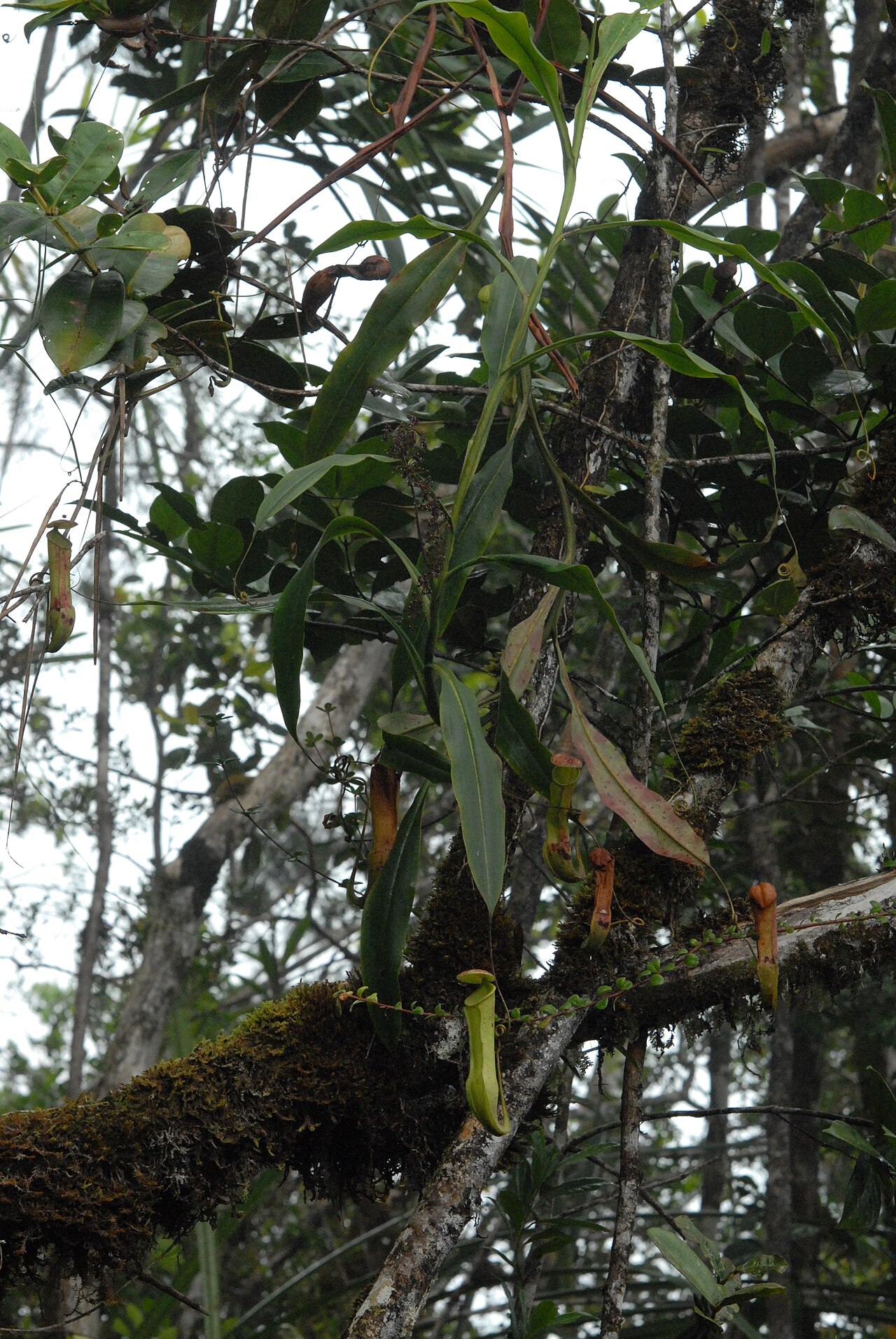

Identification
A climber of several metres, with terete stems half a centimetre thick. The leaves are thinly leathery, sessile or weakly stalked, lanceolate to narrowly elliptic, 15 to 30 cm long and 2.5 to 5 cm wide. The midrib is densely and shortly brown-hairy beneath, and the margin bears a dense fringe of brown velvety hairs; the stem is hairless. Lower pitchers are small, obliquely ovoid and narrowed to the mouth, 3 to 6 cm tall, with two fringed wings and a terete peristome of 1 to 2 mm. Upper pitchers are almost cylindrical, slightly swollen in the lower third and tubular above, 12 to 15 cm tall and 2.5 to 3 cm wide, with a slightly flattened peristome bearing distinct teeth on the inner edge. The lid is nearly round and bears no appendages. Dried plants turn a characteristic reddish brown.
Similar species
The closest relative is Nepenthes neoguineensis, so similar vegetatively that Danser wrote that only full knowledge of the flowering parts led him to name a new species. Nepenthes papuana has a racemose inflorescence with mostly one-flowered pedicels, whereas Nepenthes neoguineensis has a panicle or panicle-like raceme with up to four flowers per pedicel. Nepenthes papuana further has distinct longitudinal and indistinct pinnate veins in the leaf (the reverse in its relative), far more densely hairy leaf margins and less developed wings on the upper pitchers. Flora Malesiana also notes a resemblance to Nepenthes mirabilis, which however has thicker leaves and different pitchers.
The trap and how it works
A modest pitfall trap in two clear forms. The small lower pitchers often lie half sunk in moss at the foot of the plant and catch crawling animals there; the fringed wings serve as a ramp to the mouth. Upper pitchers are narrow and tubular and hang free in the vegetation at the forest edge, where they mainly catch flying insects. The peristome is narrow but bears distinct teeth on the inner edge that hinder escape. Small nectar glands lie under the lid; digestive fluid sits at the bottom. No specific prey study was found in the literature consulted.
Habitat and ecology
Forest edges and forest on white sand, in exposed, light situations, at about 250 to 900 m according to Flora Malesiana; other overviews give a range from sea level to 1300 m (B5, B3). The plant climbs towards the light at the forest edge, while the lower pitchers lie in the moss layer at its foot. White-sand forest in New Guinea, like the kerangas of Borneo, is exceptionally nutrient-poor: the sand holds few nutrients and rainwater washes them away quickly.
Distribution and elevation
Endemic to the Indonesian part of New Guinea (Papua province), on both the northern and southern sides of the central range. Flora Malesiana describes the range as southern Papua, from the Fakfak area to the Baliem Valley; older collections also come from the northern side. Our own species list gives 'New Guinea', which is correct, although no record from the eastern, Papua New Guinean part of the island is reported in the sources consulted. The species grows alongside Nepenthes ampullaria, Nepenthes insignis, Nepenthes maxima and Nepenthes mirabilis.
- Recorded (one-degree cells)
Forms and variation
No varieties or forms have been described. Natural hybrids with Nepenthes paniculata are suspected. Colour differences between the pitcher types are clear: lower pitchers are usually reddish throughout, with red blotches inside, while upper pitchers are usually green with a red-spotted mouth and lid, though they may also be reddish. Plants in full sun at the forest edge usually colour more strongly than plants in shade. In herbarium material the species can often be recognised by the characteristic reddish-brown colour after drying.
Where and when to see it
Search along forest edges and clearings in the hills, preferably where the soil is sandy and white. Upper pitchers are narrow and green and do not stand out among the leaves; watch rather for the red-spotted mouth and lid. Lower pitchers are found by looking in the moss layer at the foot of climbing plants. Because the species grows at several places with other pitcher plants, it is worth checking the hairy leaf margin. The area is remote and the interior of Papua requires permits and local guidance.
Conservation status
Assessed on the Red List as Least Concern. The species is widely distributed in the Indonesian part of New Guinea, on both sides of the central range, and grows on forest edges that form naturally again and again. As a member of Nepenthes it is listed in CITES Appendix II, so international trade in wild plants requires a permit. No specific threats are named in the sources consulted; the general threats to New Guinea's lowland and hill forest, such as logging and clearance, apply here too.
Scientific name
Nepenthes papuana | Danser, 1928
Nepenthes papuana was described in 1928 by Benedictus Hubertus Danser in his monograph "The Nepenthaceae of the Netherlands Indies" (Bulletin du Jardin Botanique de Buitenzorg), based on material (Docters van Leeuwen 10340 and 10341, with male and female floral material respectively) collected by Willem Marius Docters van Leeuwen in September 1926. The border of affluent C of the Rouffaer River, at 250-300 m elevation, in what is now Papua Province, Indonesia. The specific epithet derives from Papua, an alternative name for the island of New Guinea, where the species is endemic.
World Checklist of Vascular Plants (WCVP), via Plants of the World Online (POWO), Royal Botanic Gardens, Kew.