All species › Caryophyllales › Tropical pitcher plant family › Nepenthes kongkandana
Nepenthes kongkandana
One of the youngest members of the Indochinese savanna pitcher plants. Nepenthes kongkandana was described in 2015 by Marcello Catalano and Trongtham Kruetreepradit in the magazine of the Italian carnivorous plant society, from plants from Songkhla and Pattani provinces on the east coast of the southern Thai peninsula. It is a species of sandy coastal flats at sea level, and the eastern counterpart of Nepenthes andamana on the west coast. Within the thorelii group it stands closest to Nepenthes kerrii of Tarutao island.
Identification
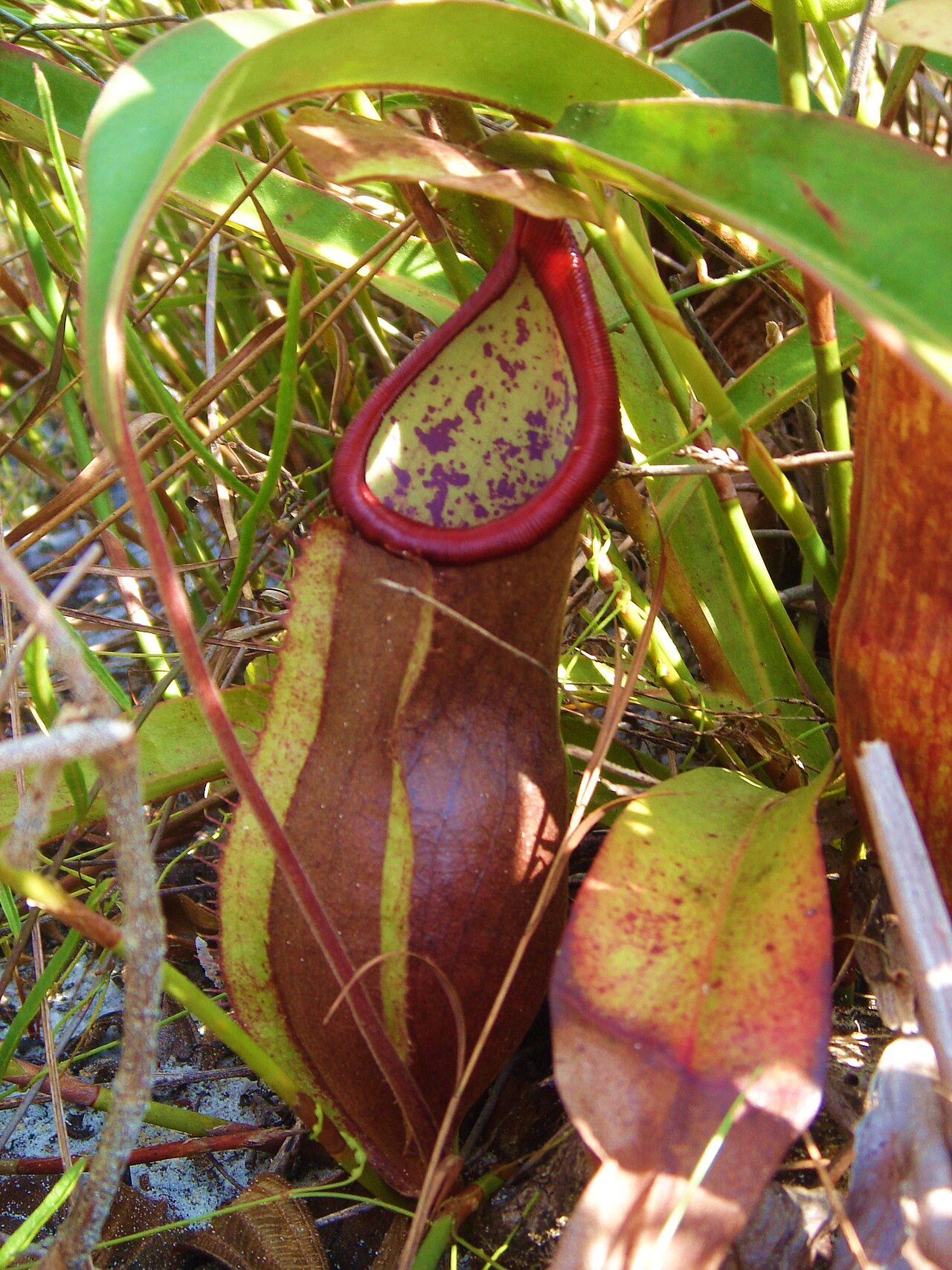
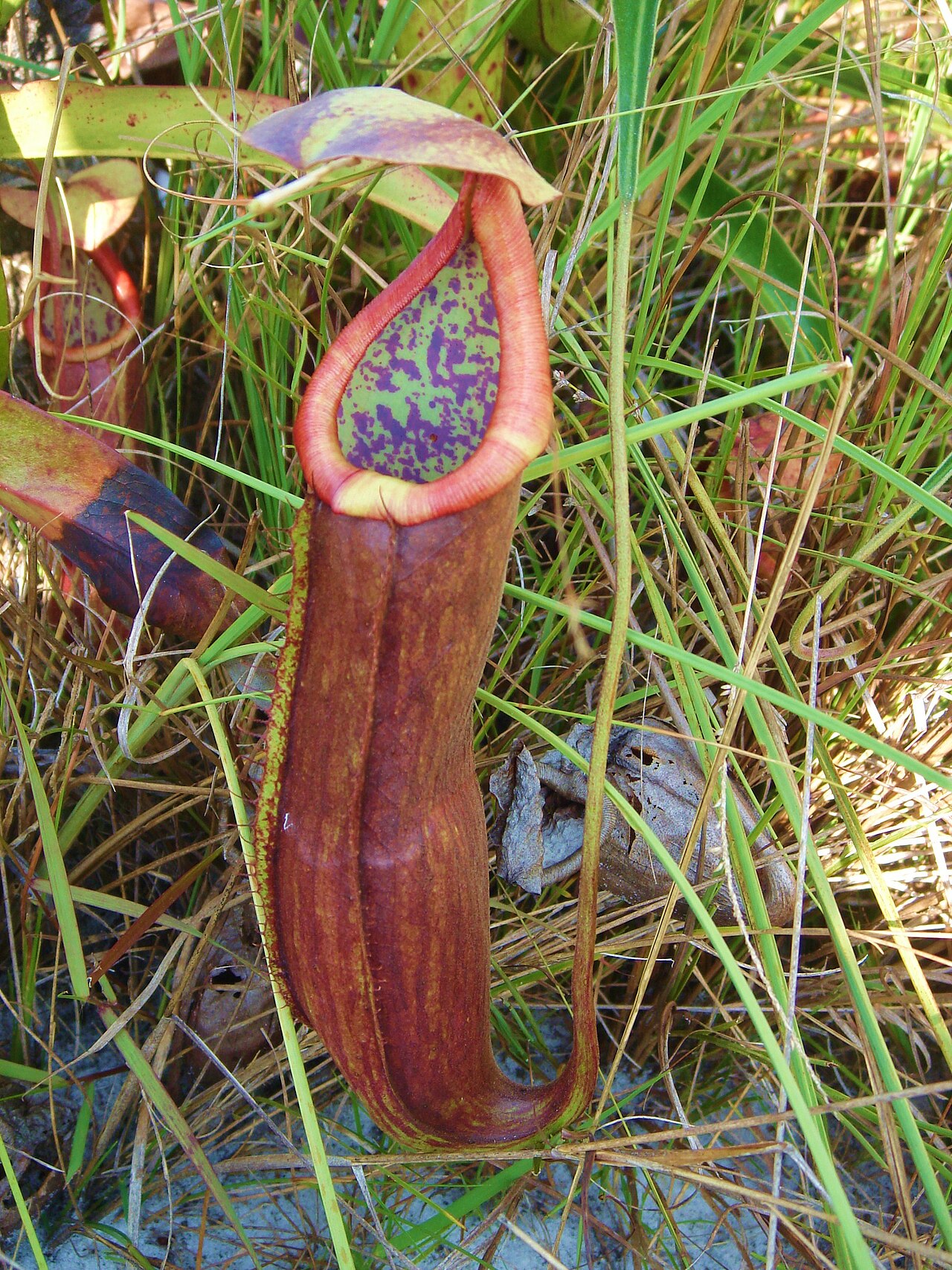
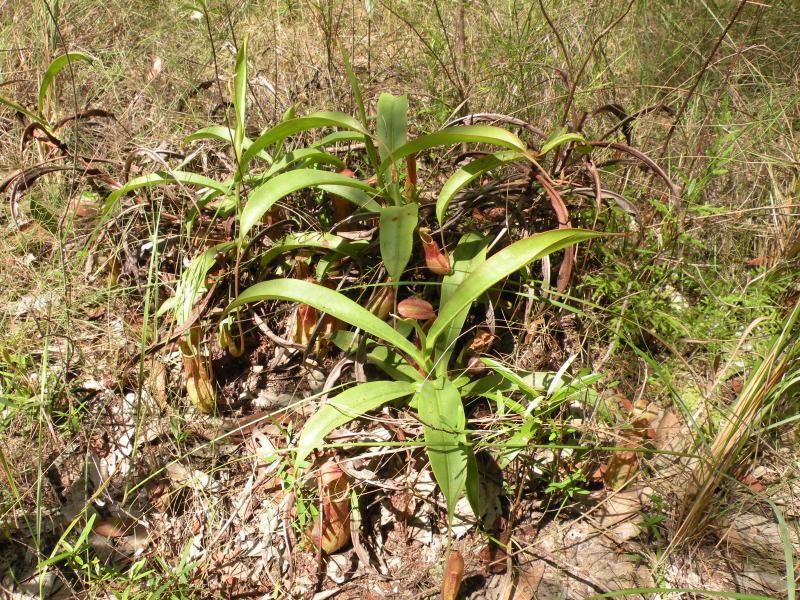
A plant with terete stems three to five millimetres thick and narrowly lanceolate to narrowly obovate leaves, 10 to 30 cm long and one and a half to three centimetres wide, with an acuminate, rarely acute tip. Lower pitchers are 10 to 18 cm tall and two to four centimetres wide, narrowly ovate in the lower third or half and tubular above, with two wings three to seven millimetres wide. The peristome is cylindrical or flattened, two to seven millimetres wide and seldom lobed. Outside, the lower pitchers are green, orange or red with dark red stripes. Upper pitchers are narrow tubes, 10 to 20 cm long but barely two centimetres wide, and light green outside. The male inflorescence reaches 120 cm with 40 to 180 flowers; the female 100 cm with 20 to 40 flowers.
Similar species
The closest relative is Nepenthes kerrii. According to the literature, that species has narrowly ovate rather than elongated, tubular-topped lower pitchers, tendrils two to three times as long as the pitcher (about equal in kongkandana), a lobed and striped peristome on the upper pitchers and more closely spaced wing fringes. From Nepenthes smilesii, kongkandana differs by obovate leaves with an acuminate tip (linear to lanceolate with an acute tip in smilesii), longer tendrils and a broader peristome. Nepenthes andamana, on the west coast, has linear to lanceolate leaves.
The trap and how it works
A pitfall trap with elongated lower pitchers and narrow tubular upper pitchers. The lower pitchers stand in the sand, with wings that guide crawling animals to the mouth; their red stripes on a green or orange ground stand out among the grass. The upper pitchers, light green and barely two centimetres wide, are slender traps for small flying insects. In the dry season the plant forms few pitchers. No specific prey study of this species was found in the sources consulted. As in other members of the thorelii group, the plant survives the dry season with a thickened rootstock, so that energy from one rainy season's prey partly goes into the next season's growth.
Habitat and ecology
Mostly sandy soil in savannas and scrub, at sea level (D1, W5, B6). These are low-lying, nutrient-poor coastal flats, wet in the rainy season and dry and fire-prone in the dry season. Since the source states only 'at sea level' and no altitudinal range, the elevation field is left empty. Such coastal savannas are often overlooked as natural habitat in Southeast Asia: they are flat, grassy and look unremarkable, yet they hold a community of carnivorous plants of their own, with sundews and bladderworts alongside the pitcher plants. Regular fires that are not too fierce keep the vegetation open; without fire, shrubs close in and the light these plants depend on disappears.
Distribution and elevation
Endemic to Thailand, in the south of the peninsula, in Songkhla and Pattani provinces on the Gulf of Thailand coast. Our own list says 'Thailand'; the narrowing to these two provinces comes from the literature.
- Native
Forms and variation
No varieties are recognised. The lower pitchers vary in ground colour from green through orange to red, always with dark red stripes; the upper pitchers are light green. In the wild, hybrids have been reported with Nepenthes mirabilis, which grows on the same low-lying ground. Since the species was described only in 2015, little has yet been published on variation across its range; future fieldwork may reveal more colour forms or local differences.
Where and when to see it
Search the open, sandy coastal flats of Songkhla, in savanna and low scrub, for low plants with narrow leaves and red-striped, elongated pitchers at ground level. The rainy season on the east coast of the southern peninsula comes late in the year, with the heaviest rain around November and December; the weeks after are good for seeing pitchers. Southern Thailand, especially Pattani Province, has had a variable security situation for years; check current travel advice beforehand.
Conservation status
The species has not (yet) been assessed for the Red List. Its range is small and confined to low-lying coastal land, where sand flats and savannas are giving way to rubber and oil-palm plantations, fish ponds and building. As a member of Nepenthes it is listed in CITES Appendix II, so international trade in wild plants requires a permit.
Scientific name
Nepenthes kongkandana | Catalano & Kruetreepradit, 2015
Nepenthes kongkandana was described in 2015 by Marcello Catalano and Trongtham Kruetreepradit, in "Nepenthes kongkandana, da ufficiosa ad ufficiale" (AIPC Magazine 37: 4-11). Songkhla Province, southern Thailand, where the species is endemic; a more precise type locality could not be established with certainty. The form of the name suggests the species honours a person named "Kongkanda", but who exactly could not be established with certainty from the accessible sources.
World Checklist of Vascular Plants (WCVP), via Plants of the World Online (POWO), Royal Botanic Gardens, Kew.