All species › Caryophyllales › Tropical pitcher plant family › Nepenthes suratensis
Nepenthes suratensis
In 1927 the Irish botanist A.F.G. Kerr, who spent decades documenting the flora of Thailand, collected a pitcher plant at sea level near Kanchanadit on the coast of Surat Thani province. The specimen lay in the herbarium for more than eighty years before the Italian researcher Marcello Catalano designated it in 2010 as the type of a new species: Nepenthes suratensis. It is a plant of open sand flats and grasslands in the coastal lowlands, belonging to a group of Indochinese pitcher plants that survive the dry season and fires on a thick rootstock underground.

Identification
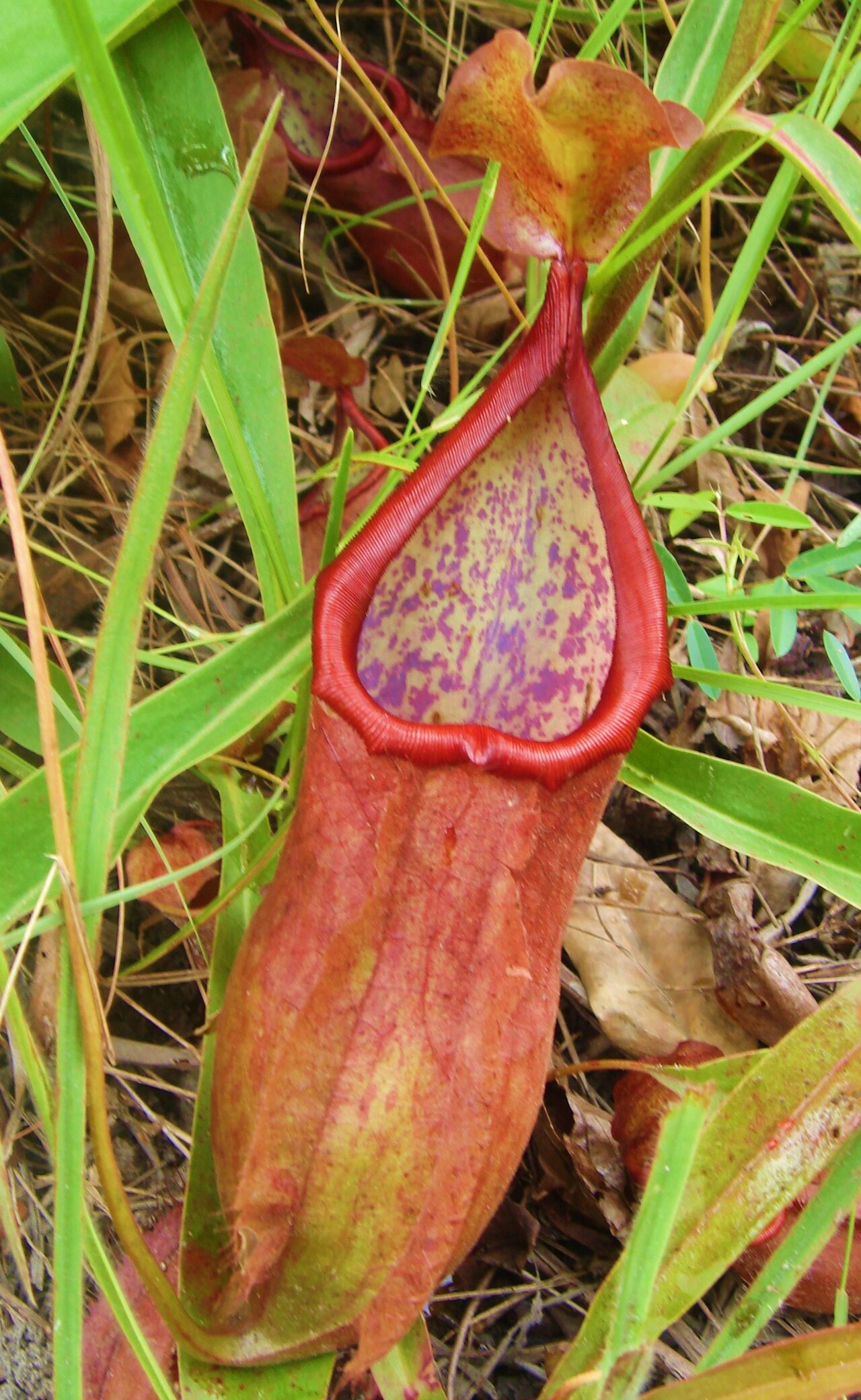
A climber to about 3 m, with stems 3 to 5 mm thick. The leaves are lanceolate, 13 to 35 cm long and 2 to 4 cm wide. A characteristic detail is the indumentum: orange to brown hairs of 0.1 to 0.3 mm, found only on the upper parts of the plant and easily shed. Lower pitchers are ovate, 9 to 15 cm tall and 4 to 5 cm wide; upper pitchers are tubular, 12 to 18 cm tall and 2.5 to 3 cm wide. Pitcher colour ranges from green to red. As in related species the pitcher changes shape between the base and the top of the plant: bulbous and broad below, slender and elongated higher up the climbing stem.
Similar species
The species belongs to the group around Nepenthes thorelii, a set of closely related Indochinese species that are hard to tell apart. It is considered closest to N. andamana, and is also compared with N. kerrii, N. kongkandana and N. bokorensis. The distinguishing character according to the description is the indumentum: short (to 0.3 mm), orange to brown, quickly shed and restricted to the upper parts of the plant, where related species differ in the pattern or density of their hairs. The taxonomist Jan Schlauer regards N. suratensis as a possible synonym of N. thorelii, so its species status is not undisputed.
The trap and how it works
A pitcher trap of the usual kind. The bulbous lower pitchers sit on or just above the ground among the grass and mainly catch walking prey such as ants; the slender upper pitchers hang higher and also catch flying insects. Nectar on the peristome and under the lid attracts the animals, and a wet peristome makes the rim slippery. In the open, sunny grassland where the species grows, the pressure of ants and other ground-dwellers is high, and the lower pitchers matter there. In the dry season pitchers dry out and above-ground parts sometimes die back; the plant then survives on its rootstock.
Habitat and ecology
Sandy soil in open savanna, grassland and open scrub in the lowlands (D1, D4). The species grows from sea level to about 200 m. It is a landscape with a marked dry season in which the grass burns regularly; related species of the N. thorelii group survive this with a thick, branched rootstock from which new stems sprout in the wet season. In the wet season the sandy ground is locally waterlogged. The vegetation is open and nutrient-poor; without regular disturbance it would close over.
Distribution and elevation
Endemic to Thailand, in the coastal lowlands of Surat Thani province on the peninsula, from sea level to about 200 m. The type was collected near Kanchanadit in 1927. It is one of the southernmost species of the N. thorelii group, which otherwise occurs mainly in Cambodia, Vietnam and eastern Thailand. According to the available literature only a few subpopulations are known.
- Recorded (one-degree cells)
Forms and variation
No varieties or forms are distinguished. The species was described relatively recently, from old herbarium material and new field observations, and the boundaries within the N. thorelii group are still shifting: whether N. suratensis remains a species of its own or is merged into N. thorelii depends on future revisions. In the field pitcher colour varies from green to red, depending on the amount of sun. No natural hybrids are mentioned in the sources consulted.
Where and when to see it
Search the coastal lowlands of Surat Thani for open, sandy grasslands and savanna that have not been brought under cultivation. The best time is the end of the wet season, when the plants are full grown and the pitchers full; in the dry season the plant may have largely vanished above ground. Look for small green to red pitchers low in the grass. Much land of this type is privately owned or farmed; ask permission and tread the vegetation carefully.
Conservation status
The species is not evaluated for the Red List (Not Evaluated) in the source this guide uses. What is known is not reassuring: only a few subpopulations are known, none lies in a protected area, and according to published data the largest holds around 250 mature plants. The coastal lowlands of southern Thailand are intensively used for rubber and oil palm, shrimp farming and tourism, and open sandy grasslands are disappearing fast as a result. As a member of the genus it is listed in CITES Appendix II; international trade in wild plants requires a permit.
Scientific name
Nepenthes suratensis | Catalano, 2010
Described by Marcello Catalano in 2010, in his book "Nepenthes della Thailandia: Diario di viaggio" (description reviewed by Alastair Robinson, Latin translation by Andreas Fleischmann) — an unusual form of publication for a botanical name, a book rather than a journal. Holotype Kerr 13136, collected at sea level in Kanchanadit, Surat Thani Province, Thailand, in 1927 by A.F.G. Kerr; deposited at the Bangkok Herbarium (BK). From Surat Thani Province plus the Latin suffix -ensis ("from") — "from Surat [Thani]".
World Checklist of Vascular Plants (WCVP), via Plants of the World Online (POWO), Royal Botanic Gardens, Kew.