All species › Caryophyllales › Tropical pitcher plant family › Nepenthes weda
Nepenthes weda
A pitcher plant that came to light through surveys for a nickel mine. Nepenthes weda was described in 2015 by Martin Cheek of Kew, in a paper on the pitcher plants of Halmahera, the largest island of the North Moluccas. The material had been collected during environmental surveys for a nickel project at Weda Bay, after which the species is named. It is a species of montane forest on ultramafic rock, with three different kinds of pitcher on one plant and an underground network of stems from which new rosettes keep sprouting.
Identification
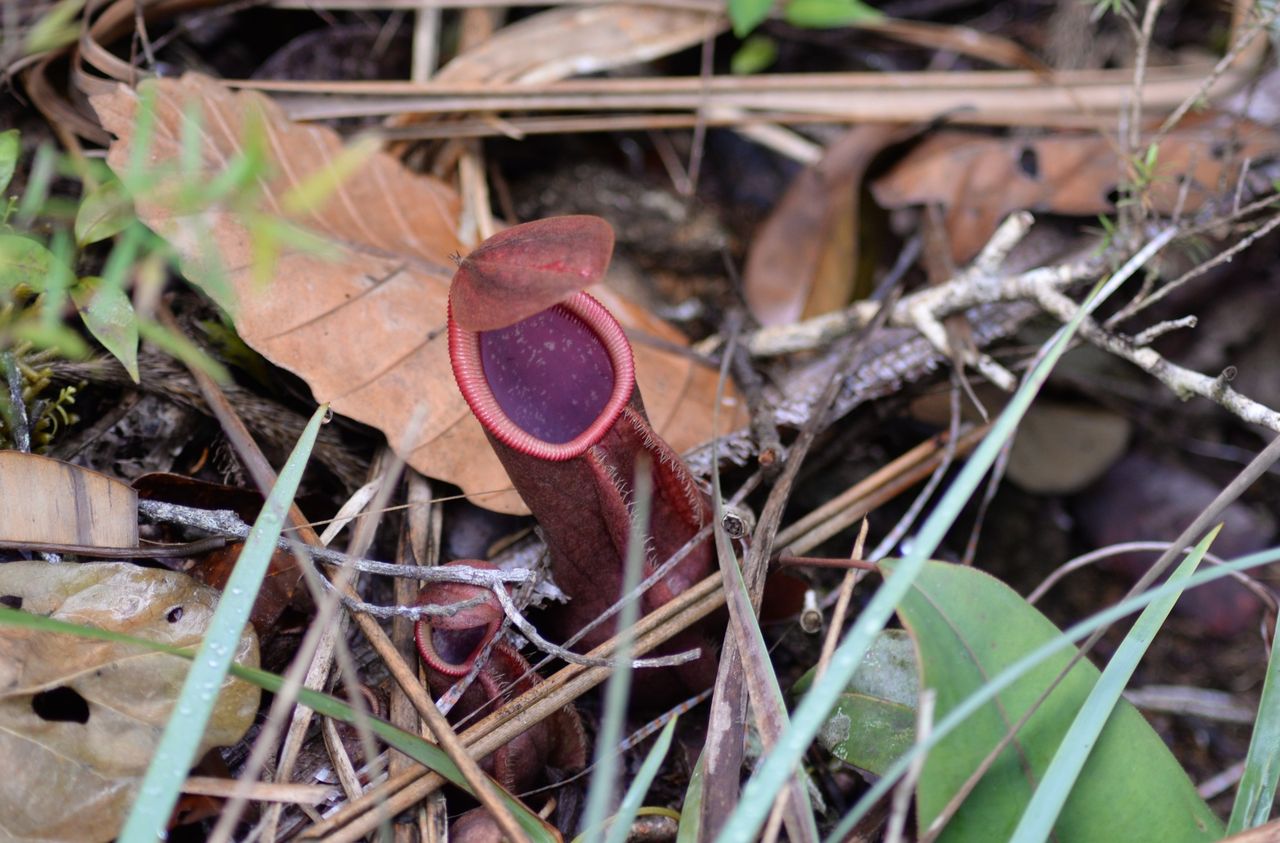
A climber of two to four metres that spreads underground: vertical rosette shoots rise from horizontal stems below the surface. The rosette leaves have a much reduced blade only two centimetres long and a few millimetres wide; leaves of the short shoots are 15 to 25 cm long and 4 to 6 cm wide, those of the climbing stem about 20 to 23 cm. All leaves are leathery. The plant bears three kinds of pitcher. Rosette pitchers are small, 4 to 6.5 cm, broadly cylindrical and matt dark red to red-brown. Lower pitchers on the short shoots are 11 to 20 cm tall, ovoid below, with fringed wings up to nearly three centimetres broad, a peristome of 4 to 7 mm with teeth of 2 to 3 mm, and brownish maroon. Upper pitchers on the climbing stem reach 24 to 25 cm and are dark red or yellow-green, more or less mottled red-brown.
Similar species
Halmahera is also home to Nepenthes halmahera, described at the same time. That species is smaller in every respect: upper pitchers about 8 to 11 cm tall with a peristome of at most 3 mm, against 24 to 25 cm and 3.5 to 5.5 mm in Nepenthes weda; and it grows mainly in open lowland vegetation, whereas Nepenthes weda grows in montane forest. The 2 to 3 mm teeth on the peristome of the lower pitchers and the three clearly different pitcher types are good characters. Nepenthes danseri, in which Halmahera plants were formerly placed, is on current understanding confined to Waigeo and has much smaller, yellowish pitchers.
The trap and how it works
A plant with an unusual division of labour between three pitcher types. The small rosette pitchers sit on shoots with scarcely any leaf blade and appear to serve mainly to catch prey close to the ground. The lower pitchers on the short shoots are large, winged and armed with a toothed peristome: the wings guide walking animals to the mouth, the teeth on the inner edge hinder escape. Upper pitchers hang in the vegetation and catch flying insects. Numerous nectar glands lie under the lid; the interior of the lower pitchers is waxy white with purple blotches, a slippery zone on which insects find no grip. No prey study of this species has yet been published.
Habitat and ecology
Lower montane forest on ultramafic substrate, between about 415 and 1014 m (R3, B1). Ultramafic soils are poor in nitrogen, phosphorus and potassium and rich in nickel, chromium and magnesium; the vegetation on them is often lower and more open than elsewhere and rich in plants found only on such soils. Halmahera has large ultramafic complexes, and it is precisely these that attract nickel mining. The underground stems by which the plant spreads may be an adaptation to disturbance, but this has not been studied.
Distribution and elevation
Endemic to Halmahera in the province of North Maluku, Indonesia, and at the time of description known from a single place: a ridge in the Weda Bay area in the centre of the island. Our own species list gives Halmahera in the Moluccas, which matches the literature. The author estimated the occupied area at about 12 square kilometres. Whether the species occurs on other ultramafic mountains of Halmahera is unknown; the island's interior is poorly explored botanically.
- Recorded (one-degree cells)
Forms and variation
No varieties or forms have been described, and no natural hybrids are known. Variation within a single plant, however, is strikingly large, with three pitcher types differing strongly in size, shape and colour: small, matt dark red rosette pitchers; large, brownish maroon lower pitchers with a waxy white, purple-blotched interior; and tall upper pitchers that may be dark red or yellow-green. Anyone who sees only one type can easily misidentify the species.
Where and when to see it
This species is known only from an area where mining takes place, and access to concession areas is usually restricted and subject to permits. A site tip is therefore not meaningful, and given the small population not desirable either. Anyone visiting montane forest on ultramafic rock on Halmahera can watch for large, dark red, winged lower pitchers with a toothed peristome, and for the small, almost leafless rosettes beside them. Share observations with researchers or a herbarium, but not with an exact location.
Conservation status
The species has not yet been assessed by the IUCN and therefore appears as 'Not Evaluated' (NE) in this guide. In 2015 the author did draw up a provisional assessment: Critically Endangered, because the species is known from one place, with a small occupied area within a region where nickel mining takes place or is planned. As a member of Nepenthes it is listed in CITES Appendix II, so international trade in wild plants requires a permit. Further fieldwork on its true distribution is needed for a formal assessment.
Scientific name
Nepenthes weda | Cheek, 2015
Described by Martin Cheek in 2015, in "Nepenthes (Nepenthaceae) of Halmahera, Indonesia", Blumea, volume 59, p. 215-225. Bukit Limber, in the Weda Bay area, near the centre of Halmahera island, North Maluku, Indonesia. Habitat: lower montane forest on ultramafic (serpentine) substrate, at 415-1014 m elevation. Named after Weda Bay on Halmahera, the region where the species occurs.
World Checklist of Vascular Plants (WCVP), via Plants of the World Online (POWO), Royal Botanic Gardens, Kew.