All species › Caryophyllales › Tropical pitcher plant family › Nepenthes lavicola
Nepenthes lavicola
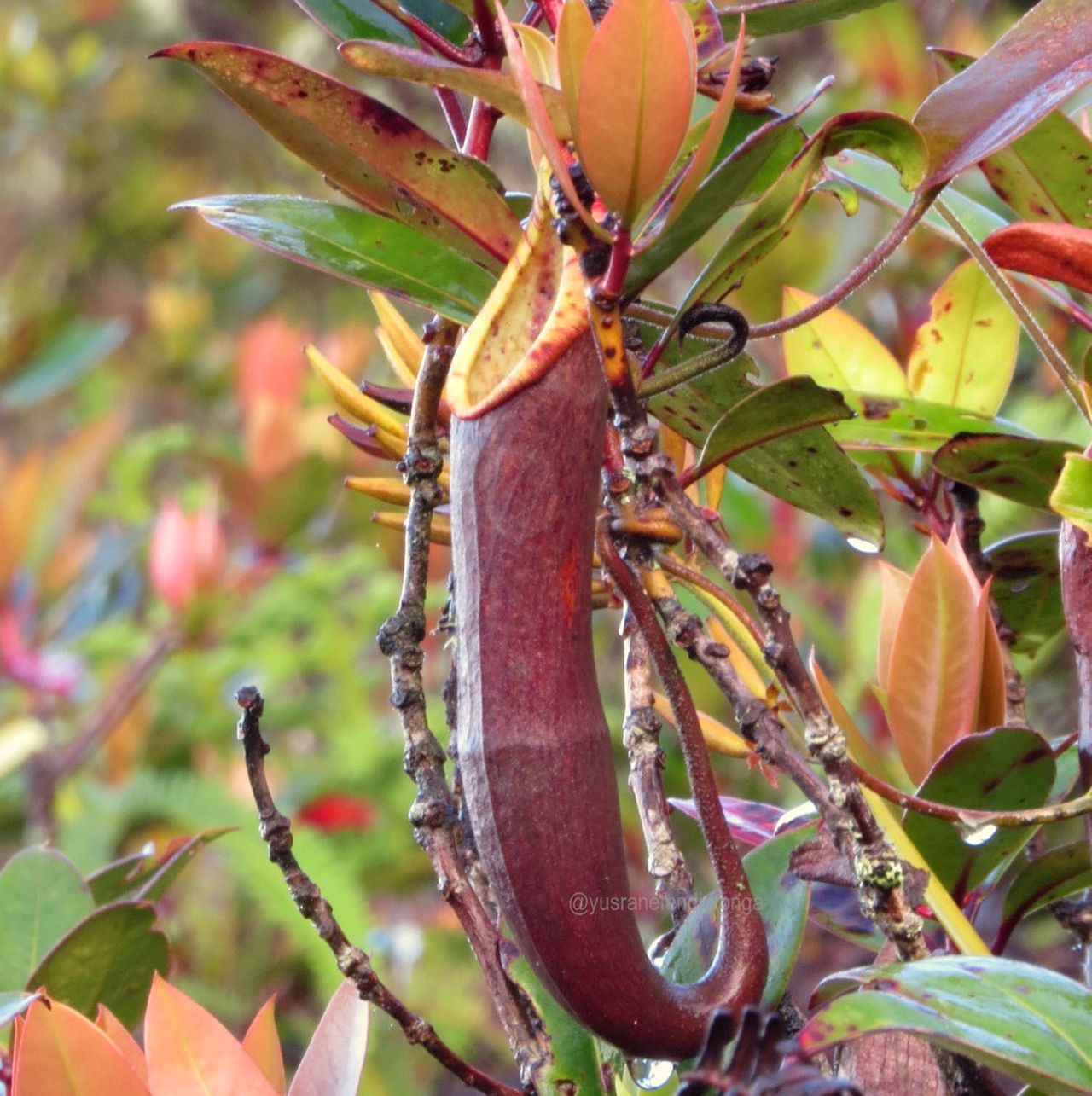
The only pitcher plant that grows on lava. Nepenthes lavicola, 'lava-dweller', is known from open slopes on an old lava flow in the Geureudong massif in Aceh, northern Sumatra. Wistuba and Rischer described the species in 1996 in Carnivorous Plant Newsletter, but it had been noticed much earlier: the Swiss botanist Albert Frey-Wyssling mentioned an unnamed Nepenthes from this area in 1931. With its almost black pitchers on a bare lava field it is one of the most striking species on the island, and one of the rarest.
Identification
A plant with short, erect shoots and climbing stems, round and grooved, 4 to 7 mm thick, with internodes of 4 to 8 cm. Stem and leaf bear small, sessile red glands. Leaves of the short shoots are oblanceolate to spathulate, 6.5 to 11.5 cm long; those of the climbing stem narrowly oblong, 11 to 17 cm long and 2 to 3.2 cm wide, with four or five longitudinal veins on each side. Lower pitchers are short and rounded, 4.5 to 6.5 cm tall and 3.5 to 4.2 cm wide, with two fringed wings of 1.5 to 4 mm, a strongly concave mouth, a peristome of about 3 mm with ribs 0.5 mm apart, a round lid of about 2 cm with 15 to 50 glands along the midline, and a spur of 3 to 5 mm. Upper pitchers are narrowly funnel-shaped or slightly ventricose, 12.5 to 15.5 cm tall (sometimes only 9 cm) and 3 to 3.4 cm wide, with a peristome to 8 mm at the back and an ovate lid of 3.2 to 3.8 cm. Pitchers are dark brownish purple to almost black, rarely yellowish green with black spots; the peristome is often yellowish green, sometimes striped red. The inflorescence is notable for very large bracts, up to 7 cm, that arch over the flowers.
Similar species
The closest relatives are Nepenthes spectabilis and N. singalana. N. spectabilis has a broader peristome, a much longer spur (10 to 22 mm rather than under 6 mm), denser reddish-brown hair, ovoid-cylindrical rather than rounded lower pitchers, and pale green, speckled rather than almost black pitchers. N. singalana grows much further south and has greener pitchers. The most distinctive feature of N. lavicola lies in the inflorescence: up to two bracts per pedicel, so large that they arch over the flowers.
The trap and how it works
On an open lava field, ground-dwelling animals and flying insects are the obvious prey. The small, rounded lower pitchers lie on or among the lava blocks and moss and catch walking animals; the narrower upper pitchers hang in the low vegetation. Nectar glands on the peristome and under the lid lure the prey, and the peristome ribs turn slippery when wet. The dark colour of the pitchers stands out strongly in the open terrain, but what role this plays in attracting prey has not been studied.
Habitat and ecology
Open slopes on an old lava flow (R5), between 2000 and 2600 m. The vegetation on the lava is low and open, with much moss, and the plant stands in full sun and wind. This is an exceptional habitat: no other Nepenthes is known from lava. The young, barely weathered volcanic substrate is extremely poor in available nutrients, which gives a pitcher plant an advantage over other pioneers here.
Distribution and elevation
Endemic to Sumatra, and known only from the Geureudong massif in central Aceh province. Because the species is critically endangered, this guide gives no more precise localities. The world checklist gives Sumatra as its only area.
- Recorded (one-degree cells)
Forms and variation
No varieties or forms have been described, and no natural hybrids are known. The colour is mostly dark brownish purple to almost black; rarely yellowish-green plants with black spots occur. The absence of hybrids fits the isolated site: few other Nepenthes grow on the lava.
Where and when to see it
This species is critically endangered and its only known habitat is small. The Geureudong massif is remote and a visit requires local guides and permits. Anyone who does go keeps to existing trails: vegetation on lava recovers very slowly after trampling. Photograph the pitchers and, if the plant is in flower, the striking bracts, but share no location data and take nothing away.
Conservation status
Assessed on the Red List as Critically Endangered. The species is known from only one massif, and there from a limited area of open lava slopes. Volcanic activity, fire and collecting are the main risks; as a pioneer of open lava it also depends on a landscape that slowly changes as vegetation closes in. As a member of the genus it is listed in CITES Appendix II.
Scientific name
Nepenthes lavicola | Wistuba & Rischer, 1996
Nepenthes lavicola was described in 1996 by Andreas Wistuba and Thomas Rischer, in "Nepenthes lavicola, a new species of Nepenthaceae from the Aceh Province in the North of Sumatra" (Carnivorous Plant Newsletter 25(4): 106-111). The Geureudong Massif, Aceh, northern Sumatra, where the species is endemic at 2,000-2,600 m elevation. The specific epithet is Latin for "growing upon lava", referring to the volcanic terrain on which the species occurs.
World Checklist of Vascular Plants (WCVP), via Plants of the World Online (POWO), Royal Botanic Gardens, Kew.