All species › Caryophyllales › Tropical pitcher plant family › Nepenthes rigidifolia
Nepenthes rigidifolia
One of the most threatened pitcher plants in the world. Nepenthes rigidifolia was discovered before 2001 by the naturalist photographer and researcher Ch'ien C. Lee, and still appeared in Clarke's 2001 monograph as 'Nepenthes species A'. The holotype was collected on 11 December 2003; on 22 November 2004 Pitra Akhriadi, Hernawati and Rusjdi Tamin described the species in Reinwardtia. The name refers to the stiff, thick, leathery leaves. When it was described, the only known population numbered 24 mature plants; a few years later perhaps only two remained.
Identification
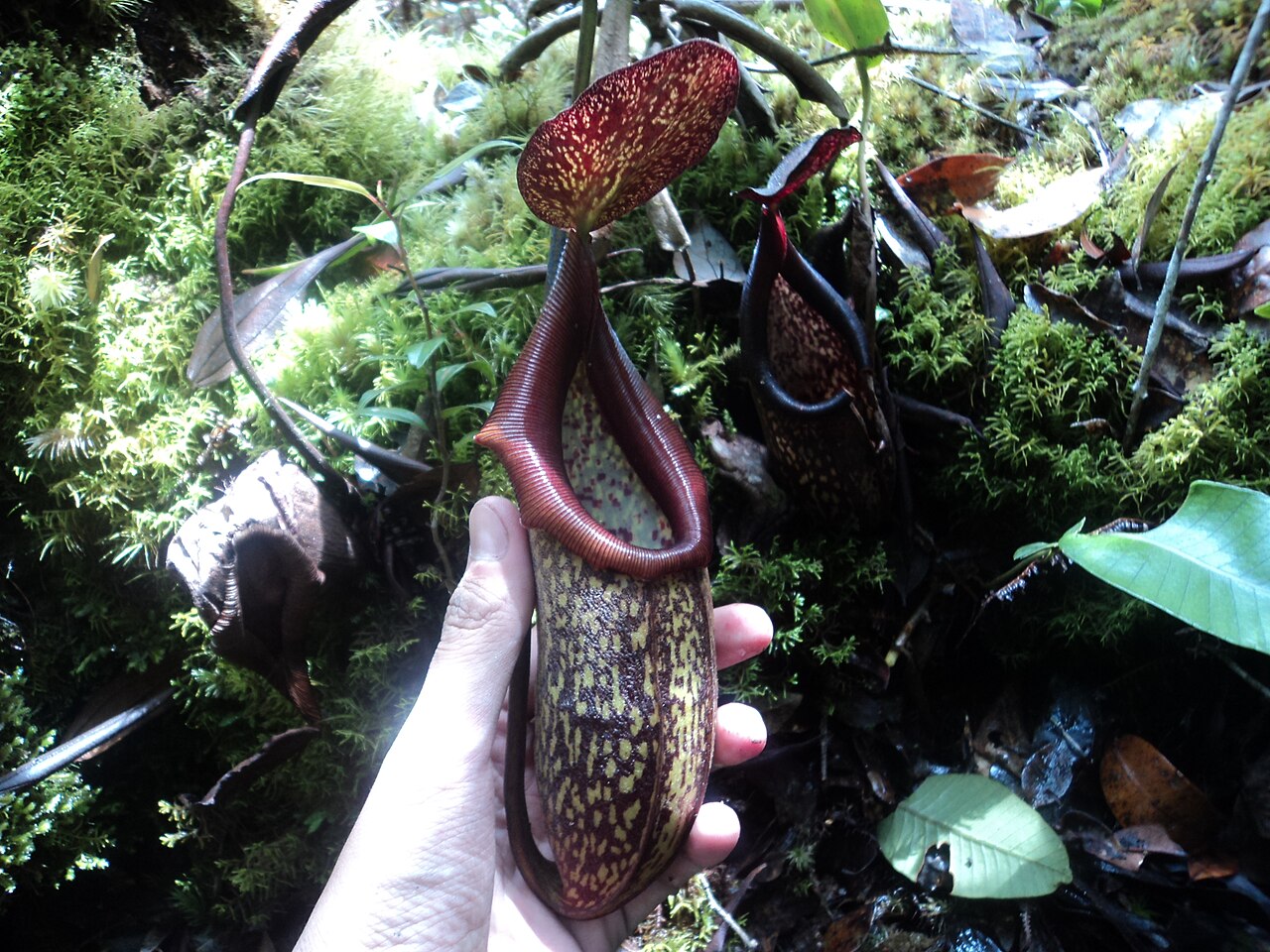
A robust climber whose stem consists of three parts: a rosette and lower section of about 30 cm and up to 8 mm thick with very short internodes, an erect middle section of 1 to 1.5 m and 1 to 1.3 cm thick, and a climbing upper section of 1 to 2 m, sometimes with spine-like nodes. The leaves are thick and stiffly leathery. In the rosette they are ovate to spathulate, 8.5 to 10 cm long; on the middle section spathulate-oblong, 19 to 21 cm long and 7 to 7.6 cm wide, with four longitudinal veins on each side and looped tendrils of 24 to 27 cm; on the climbing section 18 to 20 cm long. Lower pitchers are broadly ovoid, 9.6 to 15 cm tall and 4.4 to 6.4 cm wide, with a peristome of 0.6 to 2.1 cm and a lid of 4 to 5.2 cm. Intermediate pitchers reach 20 cm; upper pitchers are ovoid, 20.7 to 21.1 cm tall and 7.2 to 9.4 cm wide, with a peristome of 2.2 to 4.4 cm, a lid of about 6 to 8 cm and a forked spur of 1 to 1.6 cm. The pitchers are dark with flecks outside, white to pale yellow with red-black blotches inside.
Similar species
Resembles Nepenthes bongso and N. spectabilis, but differs from both in its ovoid upper pitchers, thicker, stiffer blades and forked spur. N. spectabilis has slender, narrowly funnel-shaped upper pitchers and a very long, undivided spur; N. bongso has much more slender upper pitchers. N. ovata has thinner leaves and a tendril arising at the leaf tip, not just below it. The natural hybrid with N. spectabilis is the main identification problem in the field, since it may now outnumber the pure plant.
The trap and how it works
A large pitfall with a broad peristome, especially on the upper pitchers, where it can be up to 4.4 cm wide. Nectar glands on the peristome and under the lid lure prey; the ribbed surface turns slippery when wet. Lower pitchers catch walking animals in the litter, the large ovoid upper pitchers also flying insects. The dark outside and the pale, blotched inner wall create strong contrast around the mouth.
Habitat and ecology
Lower montane forest and scrub (B1, B5), between about 1000 and 1500 m (other records to 1600 m). The plants grow on the ground; young plants have sometimes been found on rocky outcrops. The habitat lies outside protected areas and is heavily degraded.
Distribution and elevation
Endemic to Sumatra, and known only from one small area in the Barisan range of North Sumatra province. Because the species is critically endangered, this guide gives no more precise locality. The world checklist gives Sumatra as its only area.
- Recorded (one-degree cells)
Forms and variation
No varieties or forms have been described. One natural hybrid is known, with N. spectabilis. At the only site that cross has become so numerous that it may outnumber pure N. rigidifolia; with a population of a few plants the species also risks being absorbed genetically into its relative.
Where and when to see it
Do not seek this species out. The population may be down to a few plants, and every visit, every trampling of the site and every shared location increases the risk of the last plants disappearing. Anyone who sees a pitcher plant with stiff, thick leaves and large, ovoid, dark pitchers in the uplands of North Sumatra should report it to researchers at an Indonesian university or herbarium, without making the site public.
Conservation status
Assessed on the Red List as Critically Endangered. The only known population numbered 24 mature plants in 2003 and may since have fallen to two. The site is unprotected and threatened by deforestation, forest fires and poaching; in addition, there is the risk of merging with N. spectabilis. As a member of the genus it is listed in CITES Appendix II. Since 2010 there has been a programme for ex-situ conservation of this and several other threatened species.
Scientific name
Nepenthes rigidifolia | Akhriadi, Hernawati & Tamin, 2004
Nepenthes rigidifolia was described on 22 November 2004 by Pitra Akhriadi, Hernawati and Rusjdi Tamin, in Reinwardtia 12(2): 141-144. The holotype was collected on 11 December 2003 near Sidikalang, Karo Regency, North Sumatra, at 1,000-1,500 m elevation, and is held at the Herbarium Universitas Andalas (ANDA), Padang; an isotype is held at Herbarium Bogoriense (BO), Java. Near Sidikalang, Karo Regency, North Sumatra, Indonesia, at 1,000-1,500 m elevation. The specific epithet is formed from the Latin "rigidus" ("rigid") and "folia" ("leaves"), referring to the plant's stiff, coriaceous leaf blades.
World Checklist of Vascular Plants (WCVP), via Plants of the World Online (POWO), Royal Botanic Gardens, Kew.