All species › Caryophyllales › Tropical pitcher plant family › Nepenthes pectinata
Nepenthes pectinata
The Sumatran counterpart of the Javan Nepenthes gymnamphora, and a name on which opinions are divided. B.H. Danser described N. pectinata in 1928; the name, 'comb-like', refers to the peristome with its tall, thin, closely set ribs. Authors before Danser treated the Sumatran plants as a variety of N. gymnamphora, and Clarke (2001) merged them with that species again. Cheek & Jebb (2001) and the synopsis by Hernawati and colleagues (2022) keep them apart, and the world checklist, which this guide follows, accepts both names.
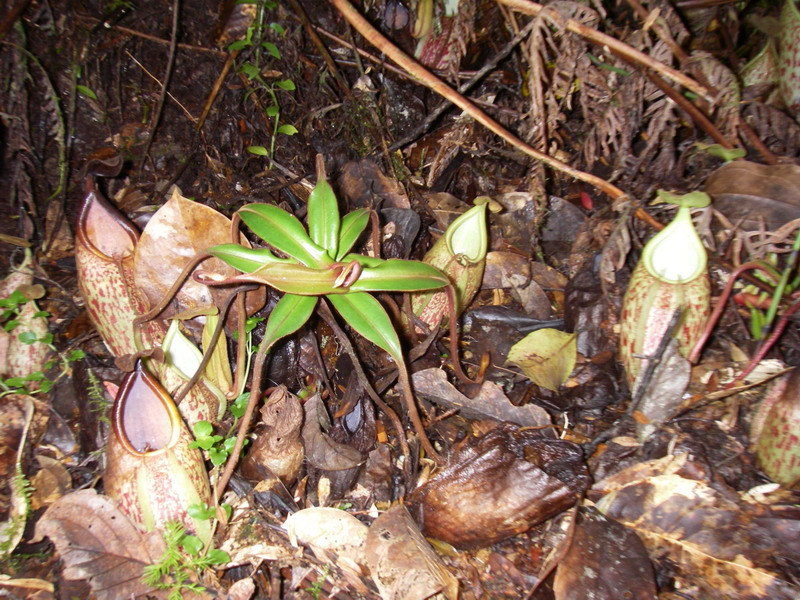
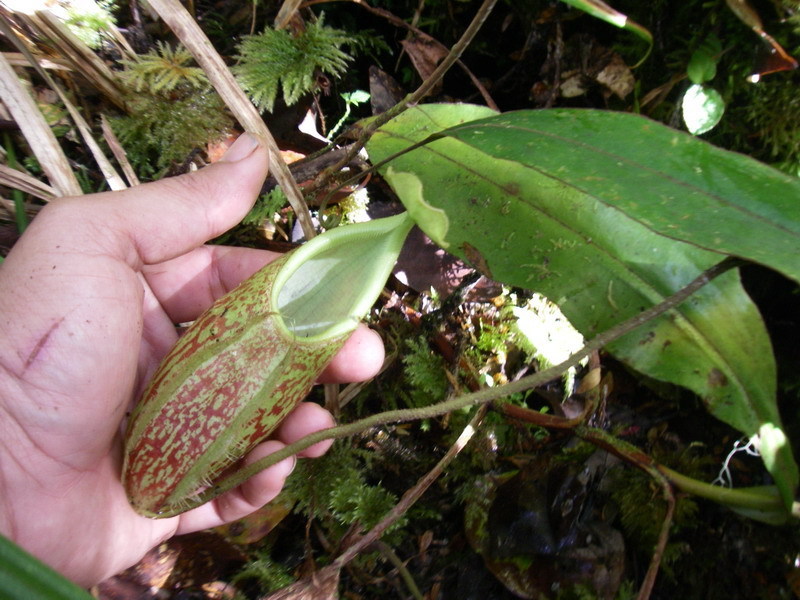
Identification
A climber to about 4 m, with a round stem up to 1 cm thick. Leaves of the climbing stem are thinly leathery, sessile, elliptic-spathulate to oblong, 15 to 27 cm long and 3 to 6 cm wide, with an acute tip and a cuneate or broadly winged base that narrows gradually and runs down the stem; the leaf margin is usually densely hairy beneath. Rosette leaves are much reduced, sometimes only 3 cm long. Lower pitchers are ellipsoid to urn-shaped, narrowing to the mouth, 6 to 16 cm tall and 2 to 6.5 cm wide, with two fringed wings of 2 to 5 mm. The peristome is 2 to 12 mm wide, with prominent, thin, papery ribs 0.8 to 2 mm apart: the 'comb' of the name. The lid measures 2 to 7.3 by 1.5 to 5.3 cm; the spur is thread-like or flattened, 1 to 4 mm. Upper pitchers are rarely formed in most populations; they are 7 to 22 cm tall, with a peristome up to 2.5 cm wide. Young pitchers are densely brown-felted with stellate hairs. Lower pitchers are green, densely blotched maroon.
Similar species
The difference from Nepenthes gymnamphora is subtle: in N. pectinata the leaf narrows more gradually to the base and runs down the stem, the leaf margin is densely hairy beneath, and the whole plant is more felted. N. singalana, on the same mountains, has a narrow, thin peristome without prominent ribs and no broad wings. N. densiflora, once regarded as a cross of N. bongso and N. pectinata, grows in the north of the island. N. bongso has much longer, more slender upper pitchers.
The trap and how it works
The lower pitchers, with their broad fringed wings and strongly ribbed peristome, are typical ground traps for walking animals. The tall, thin ribs of the peristome together form a ridged surface that becomes very slippery when wet: an insect walking from the wing to the rim loses its grip there. Nectar glands on the rim and under the lid lure the prey. Because upper pitchers are rare in many populations, the species catches mainly on and just above the ground.
Habitat and ecology
Hill dipterocarp forest and wet, mossy mountain forest on ridges (B2, B1), over a broad altitudinal zone of about 950 to 2750 m. The species grows mainly on the ground, in the moss layer and along openings on the ridges, and climbs through the scrub.
Distribution and elevation
Endemic to Sumatra, in the central Barisan range. The lectotype, designated in 1994 by Schlauer and Nerz, comes from the Talakmau massif in West Sumatra. The exact limits of the range depend on the species concept: those who place N. pectinata in N. gymnamphora see one species across much of Sumatra and Java. The world checklist gives only Sumatra for N. pectinata.
- Recorded (one-degree cells)
Forms and variation
No varieties have been described. Because Clarke (2001) and much later literature place the species in N. gymnamphora, natural hybrids are usually reported under that name; the hybrids recorded from Sumatra for N. gymnamphora, with N. bongso, N. singalana and N. spathulata among others, thus refer to N. pectinata in the sense of Cheek & Jebb. A cross of N. bongso with N. pectinata reported by Danser in 1928 turns out to be N. densiflora.
Where and when to see it
The volcanoes and ridges of West Sumatra, from the Talakmau massif southwards, are the place. On the ridges look for the spotted lower pitchers in the moss, with their broad fringes and strikingly ribbed, comb-like peristome. Anyone wanting to separate it from N. gymnamphora should feel the leaf margin (densely hairy or not) and see how the leaf base runs down the stem.
Conservation status
Assessed on the Red List as Least Concern: the species has a large range and a wide altitudinal span, and grows on many mountains in hard-to-reach forest. As a member of the genus it is listed in CITES Appendix II. Clearance of the lower slopes, where hill forest is part of its habitat, is the main threat.
Scientific name
Nepenthes pectinata | Danser, 1928
Nepenthes pectinata was described in 1928 by Benedictus Hubertus Danser in his monograph "The Nepenthaceae of the Netherlands Indies"; the original description later proved problematic, as it included material from a different species. In 1994, Jan Schlauer and Joachim Nerz designated a lectotype (Bünnemeijer 700, collected on Mount Talakmau). The taxonomic status remains debated: some authorities treat it as the same as N. gymnamphora (golf 23), while others maintain it as a distinct species based on morphological differences (leaf, pitcher dimensions, reproductive structures). Mount Talakmau, Sumatra, Indonesia — the same mountain as N. dubia (golf 21). The specific epithet derives from the Latin "pectinata", meaning "comb-shaped".
World Checklist of Vascular Plants (WCVP), via Plants of the World Online (POWO), Royal Botanic Gardens, Kew.