All species › Caryophyllales › Tropical pitcher plant family › Nepenthes lingulata
Nepenthes lingulata
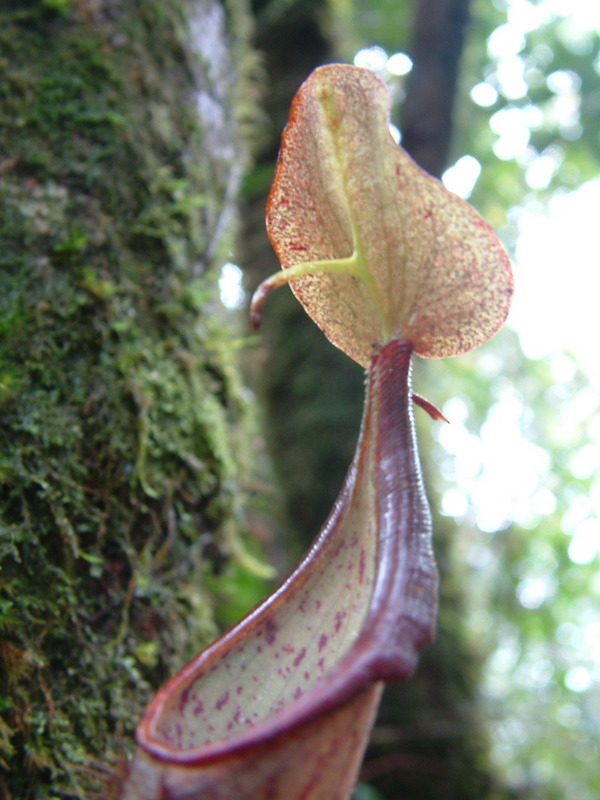
A pitcher plant with a tongue. From the underside of the lid of Nepenthes lingulata hangs a single long, thread-like appendage, up to 4 cm, directly over the pitcher mouth; the epithet means 'with a little tongue'. The species was discovered during fieldwork in Sumatra in 2004 and 2005; the first specimen was collected on 22 April 2005 in the highlands south of Padang Sidempuan in North Sumatra. Ch'ien C. Lee, Hernawati and Pitra Akhriadi described it in 2006 in Blumea. The holotype is kept in the herbarium of Universitas Andalas in Padang.
Identification
A climber with rosette stems to 4 mm thick and climbing stems of the same thickness with internodes of 3.5 to 9 cm. Rosette leaves are leathery, sessile, lanceolate, to 9.6 cm long and 3 cm wide, with an acute tip; leaves of the climbing stem are smaller, elliptic to ovate, 3.7 to 4.8 cm long. Lower pitchers are large: to 28 cm tall and 4.5 cm wide, narrowly funnel-shaped in the lower part and slightly constricted above into a cylinder, with a steeply oblique mouth, a flattened peristome up to 3 cm wide with ribs about 0.5 mm apart, fringed wings to 2.5 mm (fringe to 1 cm) and a flattened, branched spur to 1.5 cm. The lid is broadly triangular, with a cordate base, to 7.5 by 5.5 cm, and carries the thread-like appendage of 2.2 to 4 cm on its underside. Upper pitchers are smaller, to 12.3 cm tall and 2 cm wide, with a distinct hip at the middle and no fringe. Young tendrils and the outside of the pitchers are densely covered in long, woolly, grey-brown hairs. Pitchers are dark purple to black outside, pale bluish green with purple spots inside.
Similar species
The closest relative is Nepenthes izumiae from the highlands of West Sumatra, with similarly long lower pitchers but a round lid without a thread-like appendage, at most with a short crest, and broader pitchers. No other Sumatran species has such a long tongue under the lid. N. bongso and N. gymnamphora, which occur in the same area, have a lid without an appendage and far less hair. N. jamban has small, bulbous funnel pitchers and a quite different look.
The trap and how it works
The lid of N. lingulata differs from that of almost every other Nepenthes: its underside lacks the usual nectar glands except at the tip of the appendage. The nectar is thus found only at the end of the tongue, which hangs over the centre of the pitcher mouth. An insect wanting to reach it must venture onto a precarious perch above the opening, where one false step drops it into the pitcher. The broad, ribbed peristome does the rest: it turns slippery when wet, and the mouth is steeply oblique, so that slips are guided inwards.
Habitat and ecology
Upper montane mossy cloud forest (B1) between 1700 and 2100 m. The species grows both on the ground and epiphytically. It shares its site with other mountain species, including N. bongso, N. gymnamphora and N. jamban. The cloud forest there is cool and very damp, with thick layers of moss on ground and branches.
Distribution and elevation
Endemic to Sumatra, in the Barisan Mountains running along the island's west coast. The species is known only from its type locality in the south of North Sumatra province, in the highlands south of Padang Sidempuan. The world checklist gives Sumatra as its only area.
- Recorded (one-degree cells)
Forms and variation
No varieties or forms have been described from the wild. One natural hybrid is known, with N. jamban, which grows on the same mountain. As the species has only been known since 2005, and from a single site, nothing can be said about variation between populations.
Where and when to see it
The highlands south of Padang Sidempuan are remote and the site lies in steep cloud forest; a visit requires a local guide and preparation. With every large, dark pitcher, look at the underside of the lid: the long, hanging tongue is unmistakable at close range. Because the species is known from only one place, restraint in sharing location data is especially important here.
Conservation status
The species has not been evaluated by the IUCN (NE). What is known: it is recorded only from its type locality, in a small area of upper montane forest, and the number of plants is unknown. That makes it potentially vulnerable to collecting, forest fires and clearance of the lower slopes. As a member of the genus it is listed in CITES Appendix II.
Scientific name
Nepenthes lingulata | Lee, Hernawati & Akhriadi, 2006
Nepenthes lingulata was described in 2006 by Ch'ien C. Lee, Hernawati and Praseno Akhriadi, in Blumea 51(3): 561-568. The holotype (Lee, Hernawati, Akhriadi NP 432) was collected on 22 April 2005 south of Padang Sidempuan, North Sumatra, and is held at the Herbarium of Andalas University (ANDA). South of Padang Sidempuan, North Sumatra, Indonesia — the same region as the concurrently described N. jamban. The specific epithet derives from the Latin "lingula" ("small tongue"), alluding to the distinctive tongue-shaped appendage on the pitcher lid.
World Checklist of Vascular Plants (WCVP), via Plants of the World Online (POWO), Royal Botanic Gardens, Kew.