All species › Caryophyllales › Tropical pitcher plant family › Nepenthes diatas
Nepenthes diatas
A robust pitcher plant of the highest parts of Gunung Bandahara in Aceh, in the far north of the Barisan range. The name is Indonesian: di atas means 'above' or 'up there', a reference to both the northern position and the great altitude of the site. Matthew Jebb and Martin Cheek formally described the species in 1997 in their skeletal revision of the genus in Blumea; the name had been in informal use since 1994. It is seen as a robust northern derivative of Nepenthes singalana.
Identification
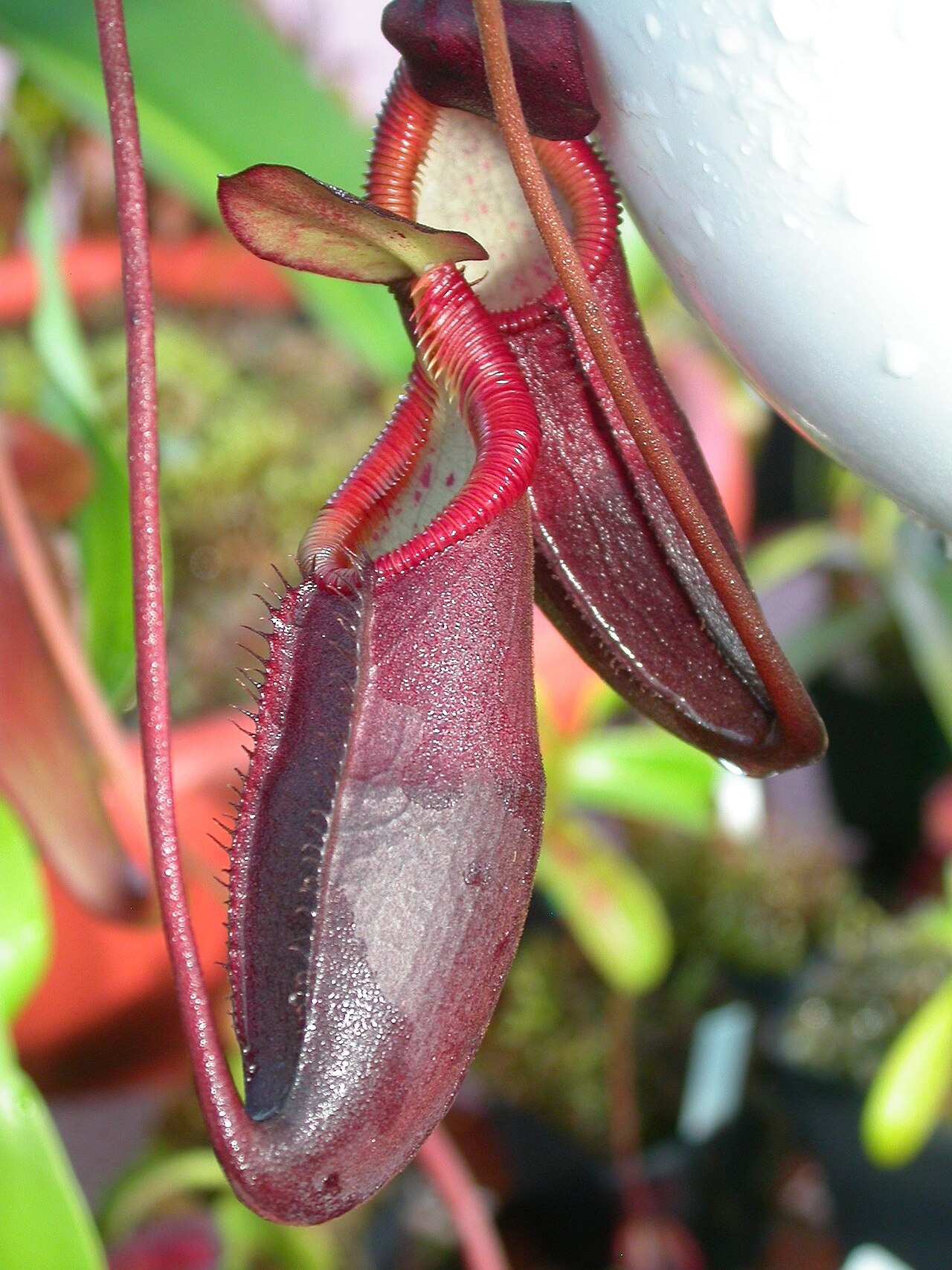
A semi-climbing shrub to 2.5 m, with a woody stem base and a square stem 4 to 8 mm thick whose angles are most marked below the nodes; internodes are short, 1 to 3.5 cm. The leaves are thinly leathery, sessile, oblanceolate, 9.5 to 17 cm long and 2.5 to 3.5 cm wide, with a long, almost parallel-sided base clasping half the stem. Upper pitchers are ventricose in the lower third and cylindrical to slightly funnel-shaped above, 14 to 22 cm tall and 3 to 4.5 cm wide, with prominent ridges. The peristome is the hallmark: woody, 5 to 15 mm wide, rounded at the front and flattened towards the lid, with ribs 1 to 2.5 mm apart and up to 1.5 mm high; the outer edge is entire and projects further than the inner edge, which bears teeth to 2.5 mm. The lid is round, 3.2 to 6.5 cm, with very numerous small nectar glands; the spur is undivided, to 12 mm. Pitchers are reddish brown; the plant carries erect reddish-brown hairs that persist on the tendril and in the leaf axils. Lower pitchers are not described in the flora used.
Similar species
Nepenthes singalana and N. spathulata have the same upper pitchers, ventricose below and tubular above, and a long-attenuate leaf base, but a thin, papery peristome; the woody, broad peristome of N. diatas is the best distinction. N. singalana also grows far to the south. N. densiflora, which occurs in the same northern mountains, has a peristome broadened mainly at the back and pale green pitchers. N. mikei is much smaller and more slender.
The trap and how it works
The upper pitchers hang in the low mountain scrub and mainly catch flying insects. The woody peristome is less slippery than the thin peristome of related species, but the high ribs with their entire outer edge and toothed inner edge form a rim over which an insect can pass inwards but hardly outwards. The numerous nectar glands on the lid lure the prey. A digestive fluid stands in the bottom.
Habitat and ecology
Mountain scrub and mossy cloud forest on the highest parts of the range (R5, B1), between 2400 and 2600 m according to Cheek & Jebb (2001); other sources give a broader zone of 2000 to 2900 m. The vegetation is low, windswept and cold, and the plant grows on the ground, half climbing through the scrub.
Distribution and elevation
Endemic to Sumatra, in the province of Aceh, and known from the summit area of Gunung Bandahara in the northern part of the Barisan range. The world checklist gives Sumatra as its only area. Other mountains in northern Aceh are poorly explored, so the species may occur there too.
- Native
Forms and variation
No varieties or forms have been described. On Gunung Bandahara a natural hybrid with N. mikei is common between 2300 and 2700 m; the hybrid was first reported in 1998. Anyone examining pitcher plants at that altitude must therefore bear in mind that not every robust plant is a pure N. diatas.
Where and when to see it
Gunung Bandahara lies in Gunung Leuser National Park and can only be reached on a multi-day trek with a permit and local guides. Above 2300 m, look for robust, reddish-brown pitchers with a strikingly thick, woody peristome; taking the peristome between your fingers, you feel at once the difference from the thin peristome of its relatives. Bring warm, waterproof clothing.
Conservation status
Assessed on the Red List as Least Concern. The species grows at high altitude in a national park, far from roads and clearings. As a member of the genus it is listed in CITES Appendix II. The small size of its habitat, confined to the summit area of a single massif, does make it sensitive in the long term to fire and to climate warming.
Scientific name
Nepenthes diatas | Jebb & Cheek, 1997
Nepenthes diatas was described in 1997 by Matthew Jebb and Martin Cheek in their revision "A skeletal revision of Nepenthes (Nepenthaceae)" (Blumea), although the name had already been in informal use since at least 1994. The summit region of Mount Bandahara, Aceh, northern Sumatra, in montane scrub and mossy forest at 2,400-2,600 m elevation. The name comes from the Indonesian "di atas" ("above, on top"), referring both to the species' endemic status in northern Sumatra and its high-montane habitat.
World Checklist of Vascular Plants (WCVP), via Plants of the World Online (POWO), Royal Botanic Gardens, Kew.