All species › Caryophyllales › Tropical pitcher plant family › Nepenthes masoalensis
Nepenthes masoalensis
Madagascar has two pitcher plants. One, Nepenthes madagascariensis, has been known since the seventeenth century and grows along the whole east coast. The other was described only in 1977, by the Swiss botanist R. Schmid-Hollinger, and is confined to the rugged north-east of the island: Nepenthes masoalensis, named after the Masoala peninsula. It is one of the westernmost species of the whole genus and one of the least known: the area is remote, rugged and largely covered in rainforest.
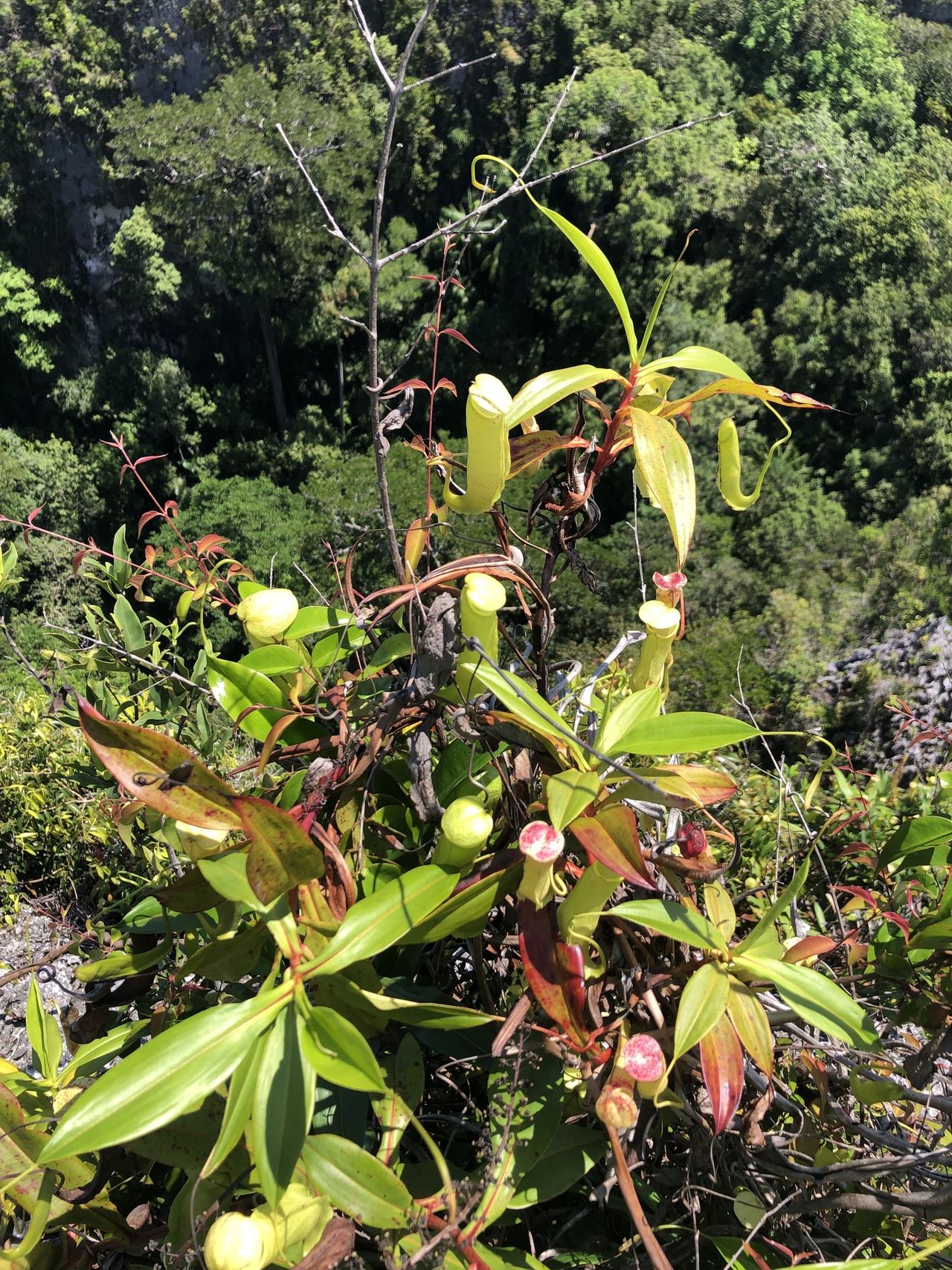
Identification
A scrambling or climbing plant with stems up to five metres long. The lamina is linear, slightly lanceolate or elliptic, to 30 cm long and 6 cm wide. Lower pitchers reach 12 cm tall and 4.5 cm wide, are swollen below and carry two wings on the front; they are often reddish orange or reddish purple. The peristome of the lower pitchers is up to 5 mm wide, the lid up to 4.5 cm long and 4 cm wide. Upper pitchers are larger, to 19 cm tall and 5 cm wide, with a broader peristome up to 8 mm, and usually entirely bright yellow. The inflorescence is an elongated panicle of 20 to 50 cm, with four (in female plants) to twelve (in male plants) flowers per branch.
Similar species
The only species it can be confused with is Nepenthes madagascariensis, which occurs along the east coast as far as Masoala. Both have red lower pitchers and yellow upper ones. N. masoalensis is distinguished by broader, more clearly stalked leaves and pitchers with a wider, more flaring peristome; its upper pitchers are also more robust. The habitats overlap only in part: N. madagascariensis is a plant of swamps and sand flats in the coastal lowlands, whereas N. masoalensis also grows on ridges and in drier, shrubby vegetation. Where the two meet, crossing cannot be ruled out; no hybrids are described in the sources consulted.
The trap and how it works
A pitcher trap rich in nectar. The lid of the lower pitchers carries eighty to a hundred, sometimes up to a hundred and fifty, large round nectar glands, and the peristome secretes nectar too. As in related species, the lower pitchers mainly catch walking prey and the yellow upper pitchers also catch flying insects; the bright colour stands out well against the green. The broad peristome of the upper pitchers — up to 8 mm — turns slippery when a film of water lies on it. In the lower half of the upper pitchers there are 120 to 400 digestive glands per square centimetre.
Habitat and ecology
A varied set of wet and dry sites in the lowlands: Pandanus and Sphagnum swamps, mountain ridge-tops and xerophytic, shrubby vegetation (W1, B5). The species grows from about 30 to 400 m. What the sites have in common is open vegetation and poor soil: in the swamp because of the water and the peat, on the ridges because of the thin, leached ground. It does not grow in closed rainforest, only along its edges and in natural openings.
Distribution and elevation
Endemic to Madagascar, and known there from the Masoala peninsula in the north-east and from a second area in the north-east, around the Ambato massif. It grows between about 30 and 400 m. Precise sites are not given here, because of the species' status. Masoala is largely a national park and forms part of the Rainforests of the Atsinanana World Heritage Site.
- Recorded (one-degree cells)
Forms and variation
No wild varieties or forms are distinguished. The most striking variation lies within the plant: lower pitchers are reddish orange to reddish purple, upper ones usually plain yellow. Plants in full sun are redder and stockier than those in shelter. The species is closely related to N. madagascariensis; together the two form the western outpost of the genus, and their shared origin from Asia is attributed to long-distance dispersal of the light seed.
Where and when to see it
Masoala can be reached only by sea or on long treks, usually from Maroantsetra on the Bay of Antongil. A permit and a guide are compulsory for the national park. Search along swamp margins and on open ridges, not in closed forest. Flowering falls in September and October, which is also the drier period on this coast, when travel is easiest. Take no plants or seed: the species is threatened and its populations are small.
Conservation status
The Red List assesses the species as Endangered. Its range is small and fragmented, and north-eastern Madagascar is under pressure from shifting cultivation, logging and fire. Much of Masoala is, however, protected as a national park, which gives the populations there a degree of protection. As a member of the genus it is listed in CITES Appendix II, so international trade in wild plants requires a permit.
Scientific name
Nepenthes masoalensis | Schmid, 1977
Nepenthes masoalensis was described in 1977 by Rita Schmid-Hollinger, in "Nepenthes-Studien IV. Eine neue Nepenthes-Art aus Madagascar, Nepenthes masoalensis sp. nov." (Botanische Jahrbücher für Systematik, Pflanzengeschichte und Pflanzengeographie 97(4): 575-585). The Masoala Peninsula, eastern Madagascar, where the species occurs together with the Mount Ambato region; the precise type locality could not be established more precisely. The specific epithet derives from the Masoala Peninsula in eastern Madagascar, where this pitcher plant occurs.
World Checklist of Vascular Plants (WCVP), via Plants of the World Online (POWO), Royal Botanic Gardens, Kew.