All species › Caryophyllales › Tropical pitcher plant family › Nepenthes merrilliana
Nepenthes merrilliana
One of the largest pitcher plants of the Philippines, with pitchers rivalling in size those of Nepenthes rajah from Borneo. Nepenthes merrilliana was described in 1911 by John Muirhead Macfarlane and named after the American botanist Elmer Drew Merrill, who spent decades documenting the flora of the Philippines. The species is a climber of the lowlands and lower mountain slopes of north-eastern Mindanao and the surrounding islands, and is closely related to Nepenthes surigaoensis, long regarded as a synonym.
Identification
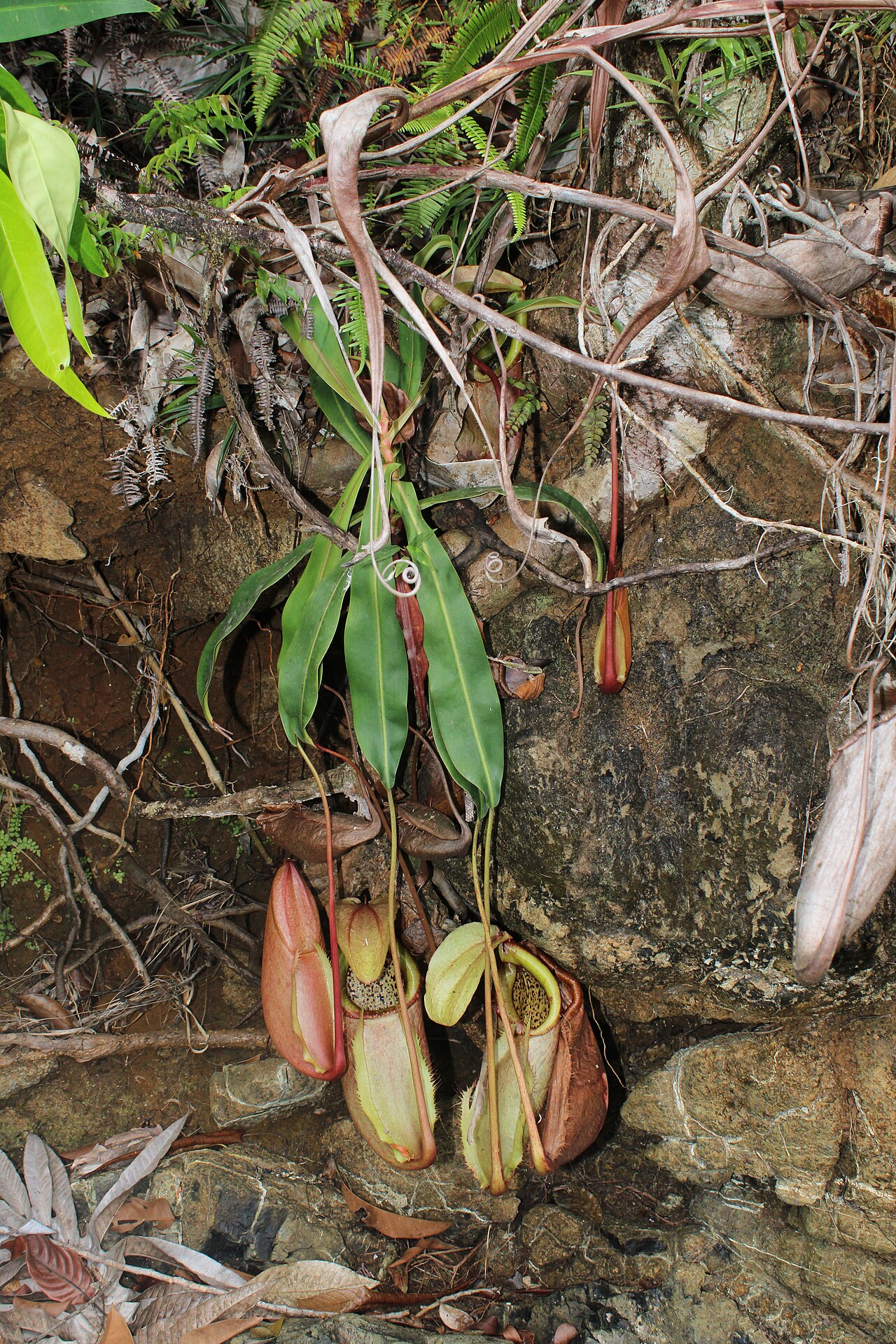
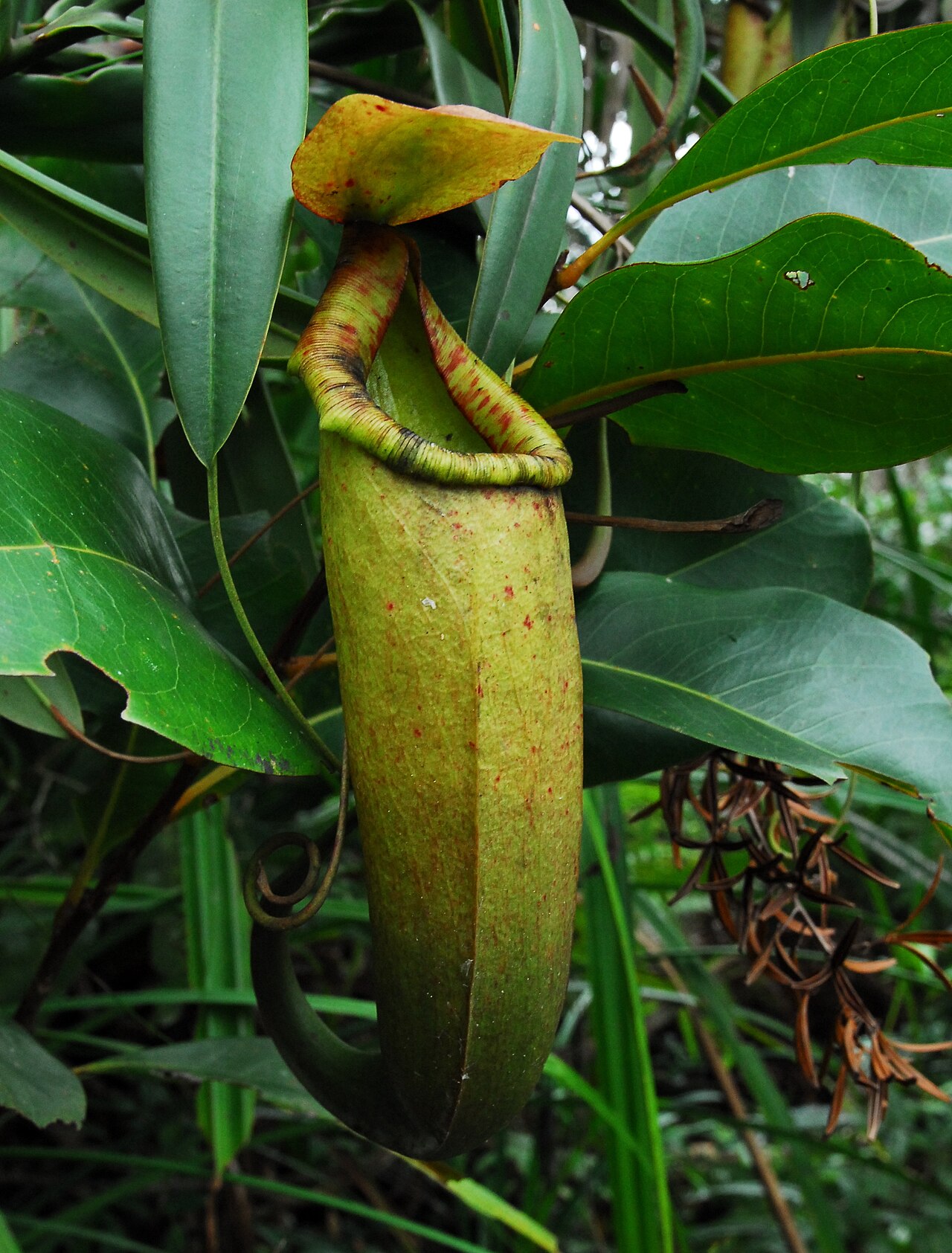
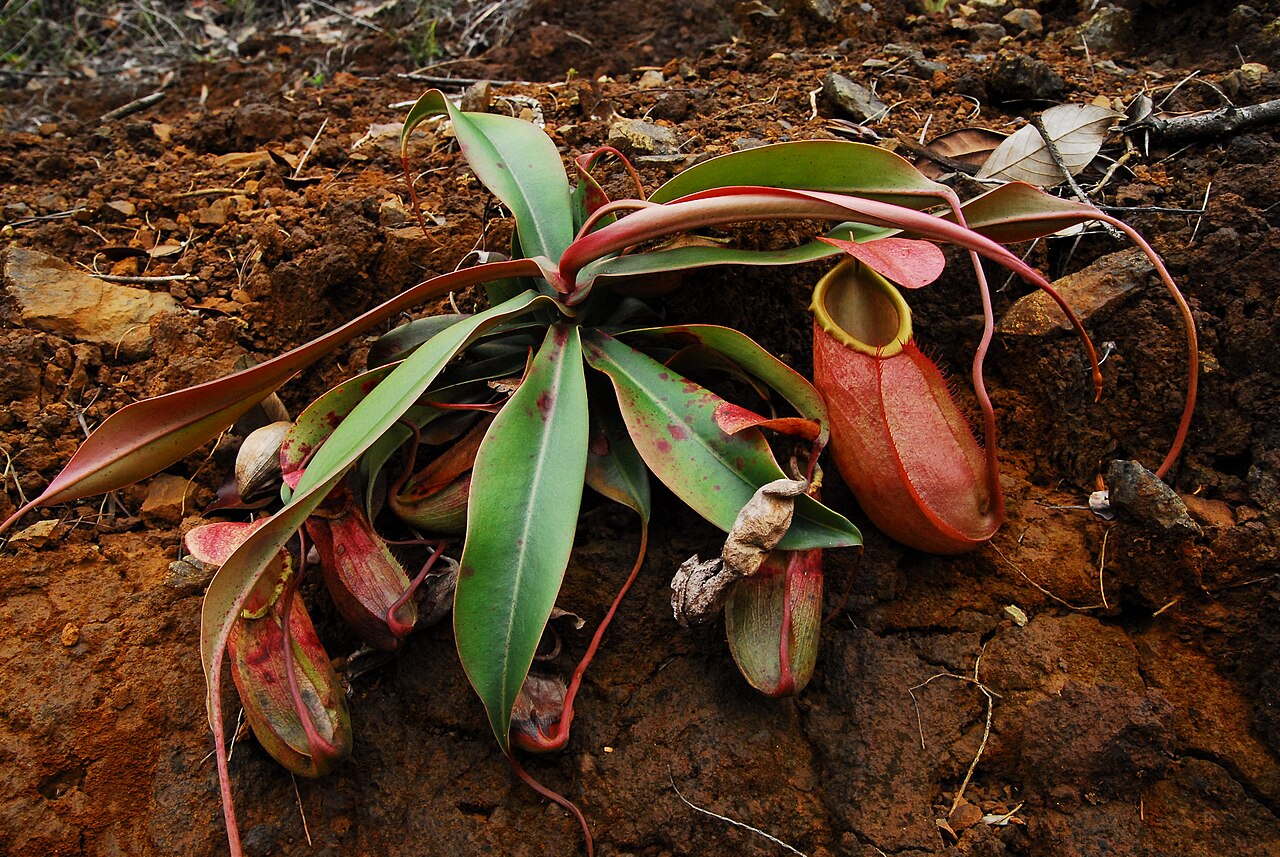
A robust plant with scrambling or climbing, branched stems up to ten metres long. The leaves are linear to slightly lanceolate and large, up to 40 cm long and 7 cm wide. Young, unfolding leaves are bright orange-red or purple and gradually turn green, so that a plant usually carries two or three red leaves among the green; in some populations the underside of the leaf is red too. The lower pitchers are among the largest in the genus: broadly cylindrical or ellipsoidal, typically up to 35 cm tall and 14 cm wide, with a peristome up to three centimetres wide. Upper pitchers are wholly funnel-shaped, often broadly so, and likewise up to 35 cm tall, with wings reduced to ridges. The inflorescence is a raceme up to 50 cm long with two-flowered pedicels.
Similar species
Its closest relative is Nepenthes surigaoensis, long included in this species. There is also affinity with Nepenthes samar from Samar and with Nepenthes bellii, which shares its leaf shape and reddish young leaves but is far smaller in every part. Danser placed the species with Nepenthes insignis from New Guinea in the Insignes group. In the field Nepenthes truncata is the other giant of north-eastern Mindanao; it has much broader, long-stalked leaves with a truncate or notched tip. Nepenthes mindanaoensis, which often grows in the same area, has much smaller, slimmer pitchers and distinct petioles.
The trap and how it works
A giant trap. The broad peristome, up to three centimetres, with ribs up to two millimetres high, forms a large slippery platform on which insects lose their footing. The largest pitcher measured was 42 cm long and 16 cm wide and held 2.3 litres of fluid; there are reports of pitchers up to 45 cm and three litres. Pitchers of this size catch not only insects and may also contain larger animals, although this is not specifically described for this species in the sources consulted. Lower pitchers stand on the ground or hang in low vegetation; the funnel-shaped upper pitchers hang higher on the climbing stems and mainly catch flying insects.
Habitat and ecology
Lowland heath forest, degraded or recovering secondary vegetation, logged dipterocarp forest, exposed inland cliffs and landslides, and stunted lower montane forest, from sea level to about 1100 m (B3, R3, B2). The species also grows on steep slopes in coastal forest. Many of its sites lie on ultramafic rock, with open, nutrient-poor vegetation. It is a light-loving species that can benefit from open ground and disturbance, as long as the vegetation does not disappear altogether.
Distribution and elevation
Endemic to the Philippines: northern and central Mindanao, the island of Dinagat and, according to later overviews, Samar as well. Whether the species occurs in southern Mindanao is uncertain. Our own species list gives 'Philippines', which is correct, but the range is limited to the east of the southern islands. Because Nepenthes surigaoensis and Nepenthes samar were long not distinguished from this species, older distribution records may include plants of those species.
- Recorded (one-degree cells)
Forms and variation
No varieties or forms have been described, but colour is highly variable. The outside of the pitchers ranges from yellowish green to orange, sometimes flushed red, pink or brown; the inside is usually yellow or orange with dark purple to black flecks. Natural hybrids are known with Nepenthes bellii, Nepenthes mindanaoensis, Nepenthes mirabilis and with plants that fell under the old, broad name Nepenthes alata. Hybrids with Nepenthes bellii appear rare, possibly because the species flower at different times.
Where and when to see it
North-eastern Mindanao and Dinagat are the best areas, and the species can be seen well there locally along roads, on open slopes and in coastal forest. Watch for the large red young leaves, which stand out from afar, and look beneath them for the enormous lower pitchers on the ground. On Dinagat the species often grows with Nepenthes bellii, giving a fine contrast in pitcher size. Check the security situation in parts of Mindanao beforehand and travel with local guidance.
Conservation status
Listed on the Red List as Vulnerable, based on an older assessment (version 2.3 of the criteria). The main threat is habitat loss: deforestation and mining on ultramafic rock in north-eastern Mindanao and on Dinagat have affected large parts of the lowlands. The species is also popular with collectors because of its large pitchers. As a member of Nepenthes it is listed in CITES Appendix II, so international trade in wild plants requires a permit.
Scientific name
Nepenthes merrilliana | Macfarlane, 1911
Nepenthes merrilliana was described in 1911 by John Muirhead Macfarlane, in "New species of Nepenthes" (Contributions from the Botanical Laboratory of the University of Pennsylvania 3(3): 207-210), with accompanying plates. The species is endemic to the Philippines, native to northern and central Mindanao and the neighbouring islands of Dinagat and Samar; the precise type locality could not be established with certainty. The species is named after the botanist Elmer Drew Merrill.
World Checklist of Vascular Plants (WCVP), via Plants of the World Online (POWO), Royal Botanic Gardens, Kew.