All species › Caryophyllales › Tropical pitcher plant family › Nepenthes bellii
Nepenthes bellii
A small pitcher plant of the lowlands of north-eastern Mindanao and the island of Dinagat, with round, densely fringed lower pitchers on exceptionally long tendrils. Nepenthes bellii was described in 1969 by the Japanese botanist Katsuhiko Kondo in the Bulletin of the Torrey Botanical Club, from a plant he had collected with J. V. Pancho in Surigao province in April 1968. The species is named after the American botanist Clyde Ritchie Bell. A few years later Kurata and Toyoshima described the same plant again as Nepenthes globamphora, after the globular pitchers; that name is now a synonym.
Identification
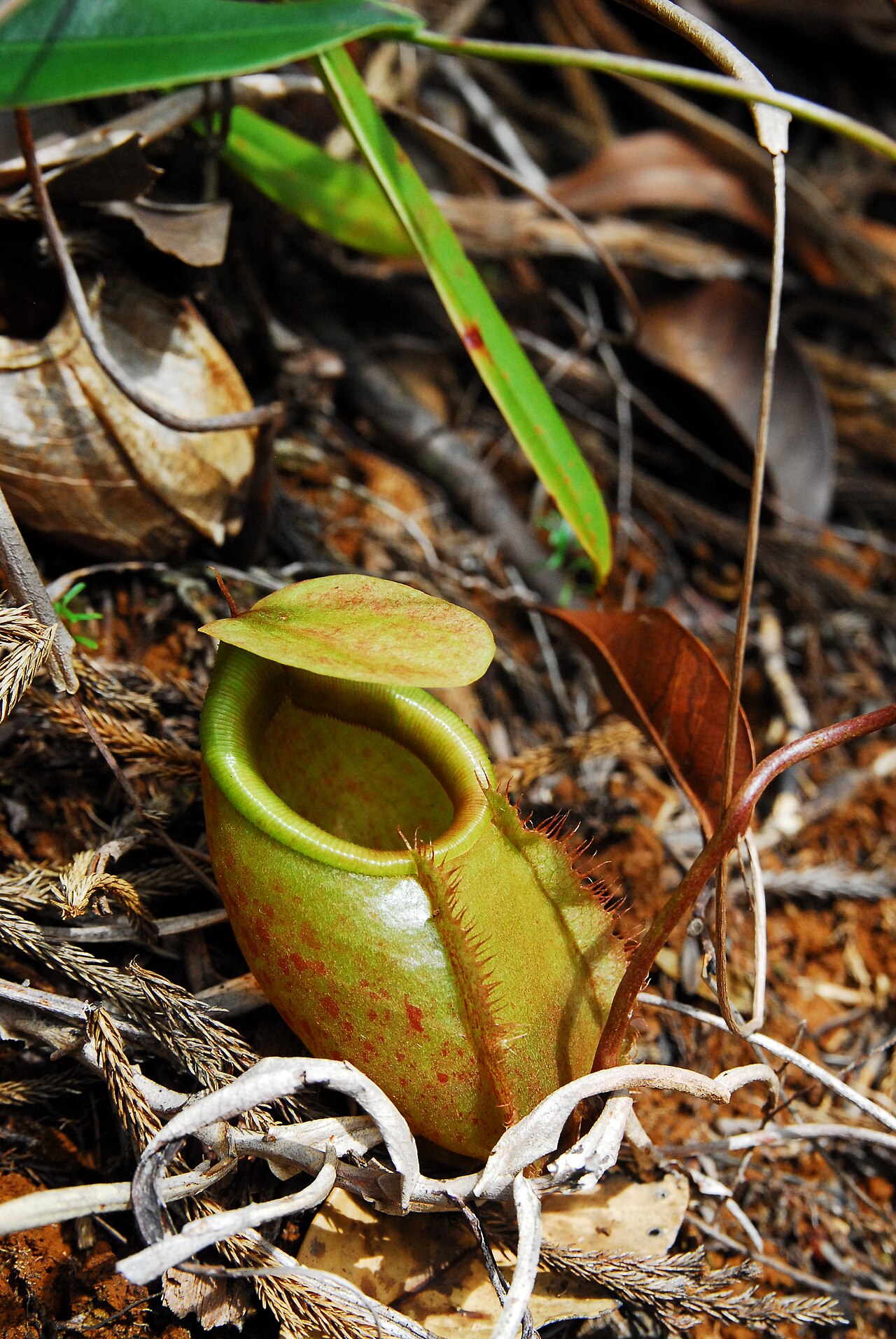
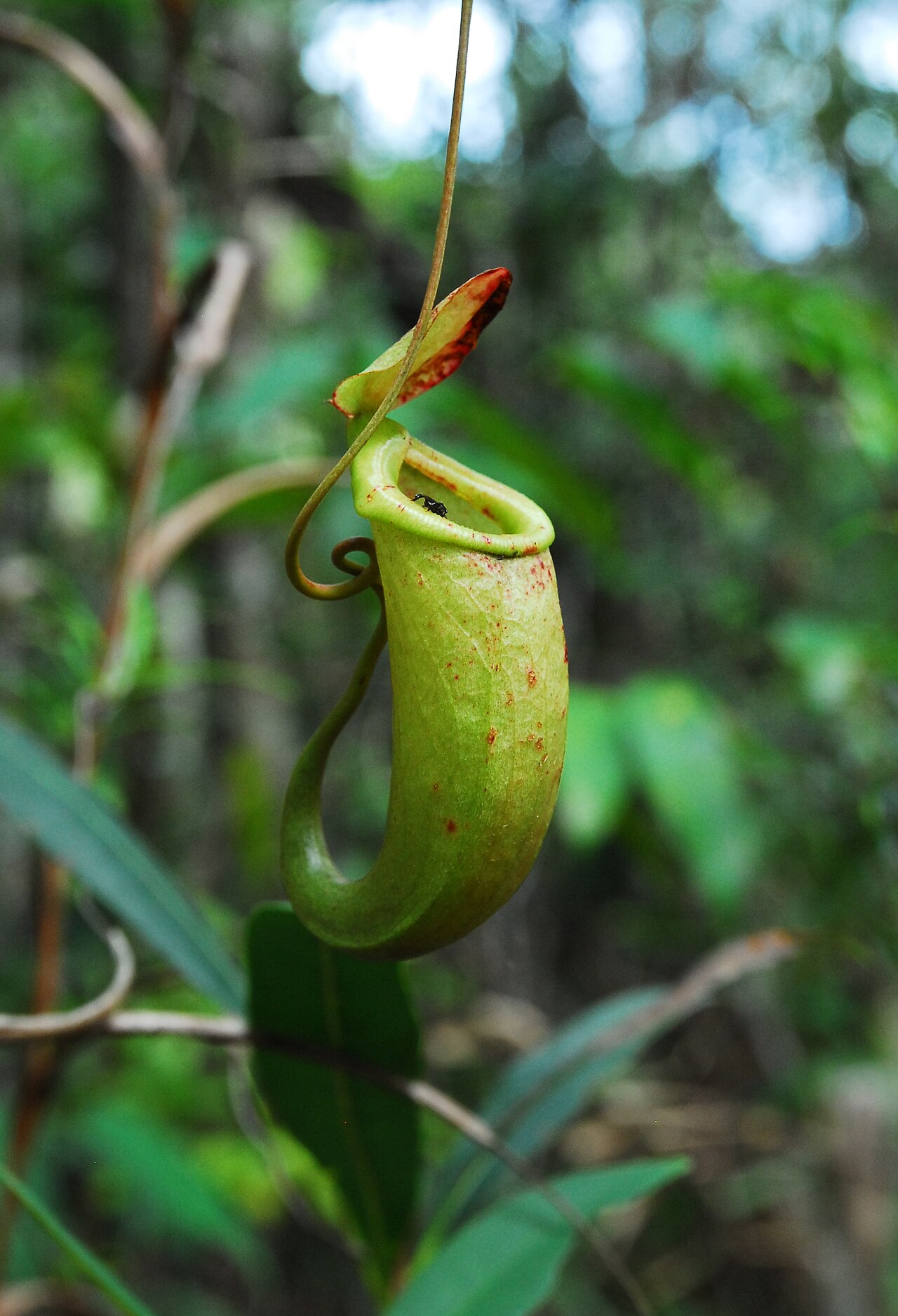
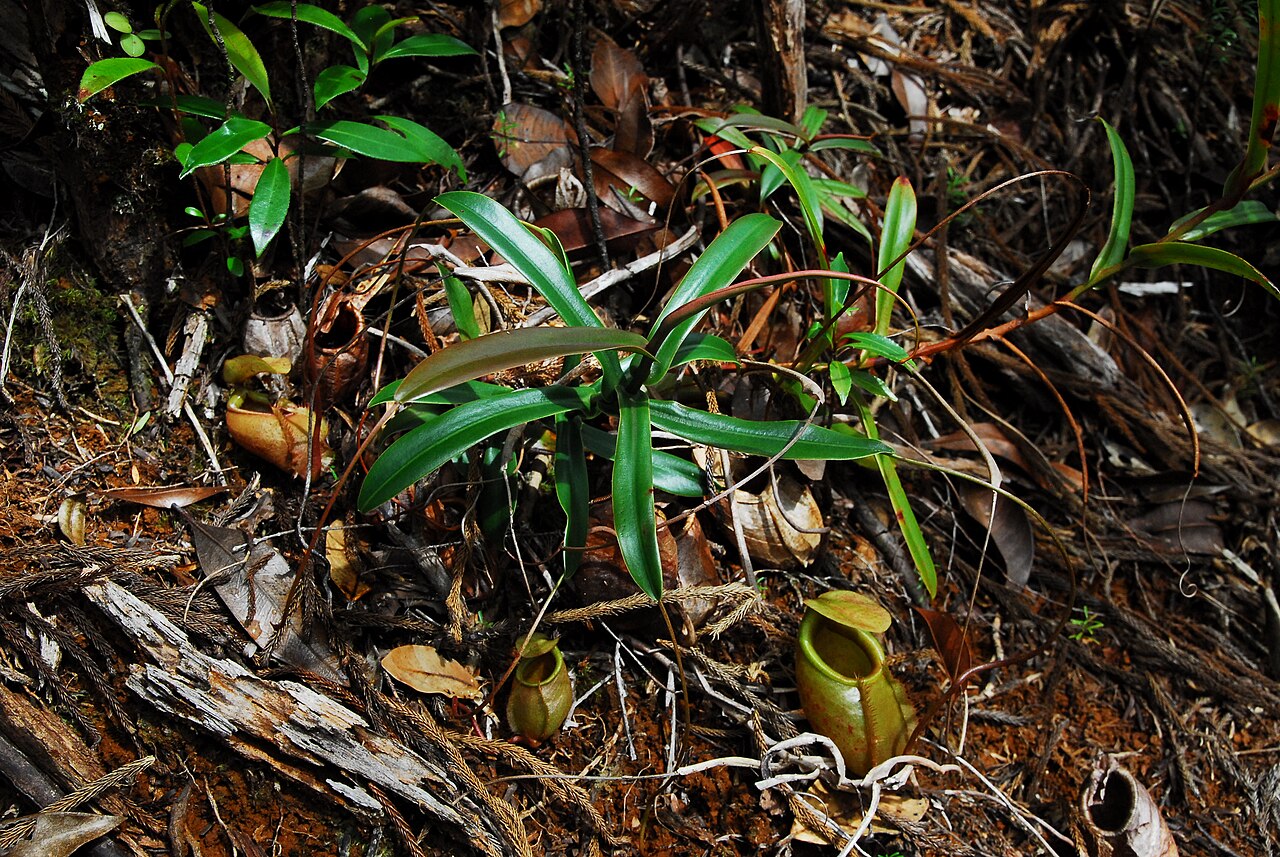
A slender climber from thirty centimetres to two and a half metres, sometimes longer, with stems 3 to 5 mm thick. The leaves are leathery, sessile and narrowly elliptic, 8 to 15 cm long and only 1 to 1.8 cm wide, with an acute tip; the uppermost leaves are often reddish. The lower pitchers are the most striking: ovoid to almost globose, 4 to 9 cm tall and 3 to 5 cm wide, with two very densely fringed wings whose fringe elements reach nearly a centimetre and often stand in clusters. They hang from tendrils that can exceed 30 cm. The peristome is subcylindrical to flattened, 5 to 8 mm wide, with a finely toothed inner edge. Upper pitchers are smaller and funnel-shaped, about 7.5 cm tall, with reduced or absent wings. The colour is yellowish or reddish with diffuse purple spots and a yellow peristome.
Similar species
Its closest relatives are Nepenthes merrilliana and Nepenthes surigaoensis, which share its leaf shape and reddish upper leaves but are far larger in every part, especially pitchers and inflorescences. With its round, fringe-winged lower pitchers it also resembles Nepenthes argentii from Sibuyan, but that species does not climb and has a different peristome. On Mount Hamiguitan in south-eastern Mindanao a related plant was long identified as Nepenthes bellii; it was described in 2009 as Nepenthes micramphora and is smaller in every respect. Flora Malesiana points to a possible affinity with the Insignes group.
The trap and how it works
A small trap whose lower pitchers are notably equipped for walking prey. The very densely fringed wings act as ladders that guide crawling animals to the mouth; the peristome with its toothed inner edge makes climbing back difficult. Because the lower pitchers hang from very long tendrils, they can lie far from the plant on the ground or among litter. Upper pitchers are funnel-shaped with few or no wings; as throughout the genus they catch mainly flying insects. Scattered nectar glands lie under the lid. No targeted prey study was found in the literature consulted.
Habitat and ecology
Lowland heath forest, exposed cliffs and landslides, stunted lower montane forest and disturbed secondary vegetation, including logged dipterocarp forest; the species also often colonises forest edges along roads (R3, B3, H1). Flora Malesiana gives an altitude of 250 to 800 m; other sources give sea level to 800 m. The known sites roughly coincide with ultramafic areas, with their open, nutrient-poor vegetation. The species is clearly a pioneer of open places that can benefit from disturbance.
Distribution and elevation
Endemic to the Philippines: northern Mindanao, notably the provinces of Surigao del Norte and Surigao del Sur, and the island of Dinagat, where it is common. It is poorly documented from southern Mindanao, partly because of the long-running unrest in that region. Our own species list gives 'Mindanao, Philippines'; that is correct, but Dinagat emphatically belongs to the range. Older records from Mount Hamiguitan concern Nepenthes micramphora.
- Recorded (one-degree cells)
Forms and variation
No varieties or forms have been described. The species often grows with Nepenthes merrilliana and Nepenthes mindanaoensis and forms natural hybrids with both, but these appear rare; field observations suggest the three species flower in different seasons. Colour varies: lower pitchers are usually green, yellow, orange or sometimes red with darker orange to purple blotches; upper pitchers are more often plain green, yellow, orange or red, sometimes with a contrasting peristome.
Where and when to see it
On Dinagat and in the Surigao provinces the species is locally common and sometimes easy to see along roads, at forest edges on ultramafic ground. Do not look only at the plant itself: follow the long tendrils, as the round lower pitchers often lie some distance from the stem on the ground, among grass and litter. The densely fringed wings are the best recognition point at close range. Where the species grows with Nepenthes merrilliana, the great difference in pitcher size is immediately apparent.
Conservation status
Assessed on the Red List as Least Concern. The species is widespread on Dinagat and in northern Mindanao, with extensive stands, and tolerates disturbed vegetation. Lowland habitat is nonetheless being lost, especially on Dinagat, where mining on ultramafic rock and deforestation affect large areas. As a member of Nepenthes it is listed in CITES Appendix II, so international trade in wild plants requires a permit.
Scientific name
Nepenthes bellii | Kondo, 1969
Nepenthes bellii was described in 1969 by Katsuhiko Kondo, in the Bulletin of the Torrey Botanical Club 96(6): 653-655. The holotype (Kondo 11514) was collected on 14 April 1968 from a "swimming pool between Hayangobon and Carrascar" in Surigao Province, Mindanao, Philippines, at 800 m elevation. A natural swimming pool between Hayangobon and Carrascar, Surigao Province, Mindanao, at 800 m elevation. The specific epithet honours the American botanist Clyde Ritchie Bell.
World Checklist of Vascular Plants (WCVP), via Plants of the World Online (POWO), Royal Botanic Gardens, Kew.