All species › Caryophyllales › Tropical pitcher plant family › Nepenthes faizaliana
Nepenthes faizaliana
A pitcher plant of the limestone mountains of Gunung Mulu in Sarawak that mainly shows its upper pitchers: long, narrow funnels over thirty centimetres tall, hanging from limestone walls and from the trees on the ridges. Nepenthes faizaliana was described by Adam and Wilcock in 1991 and named after Muhammad Khairul Faizal. Jebb and Cheek placed it under N. stenophylla in 1997, but Clarke kept it separate, and that view has been generally followed since.

Identification
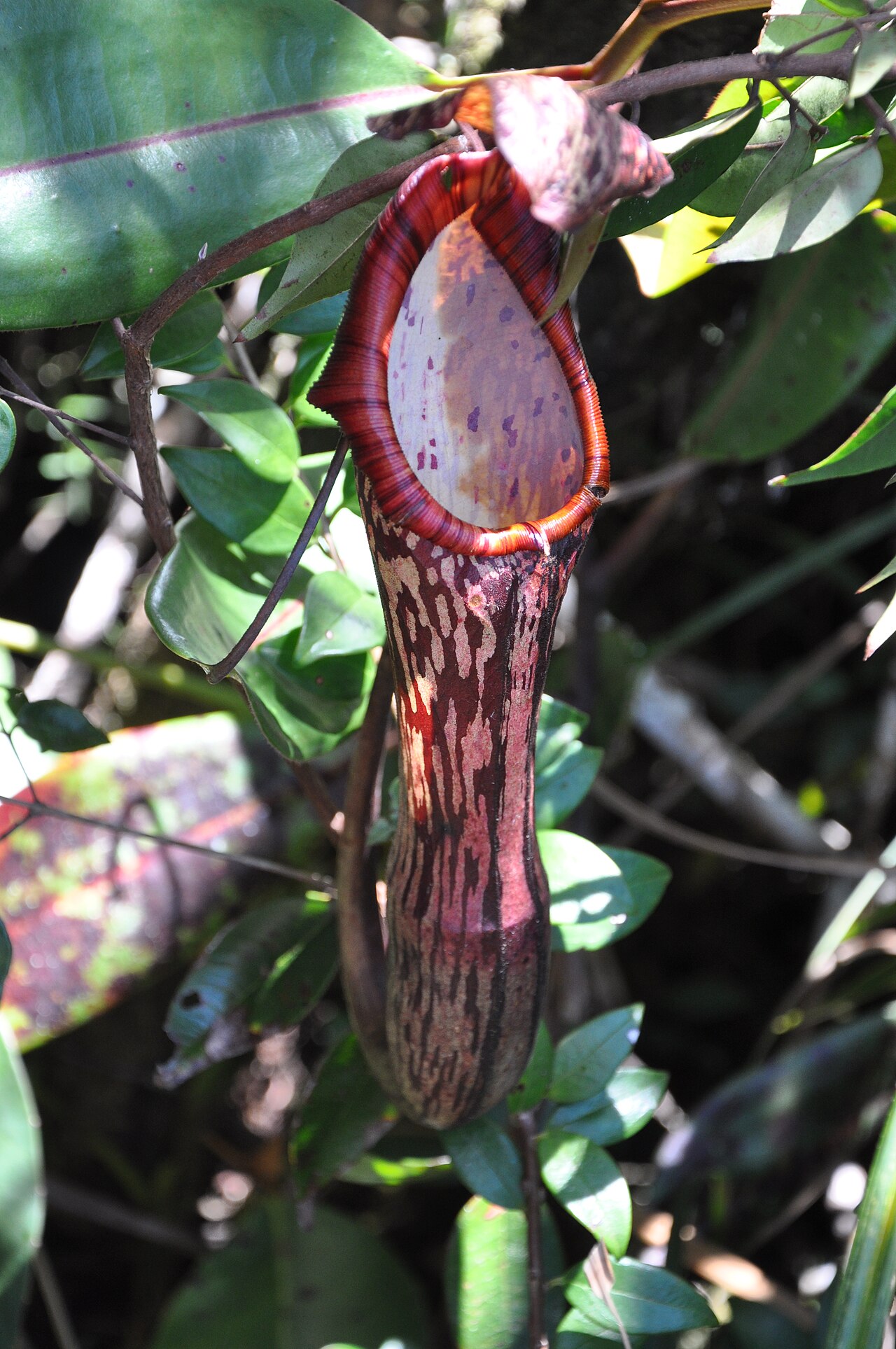
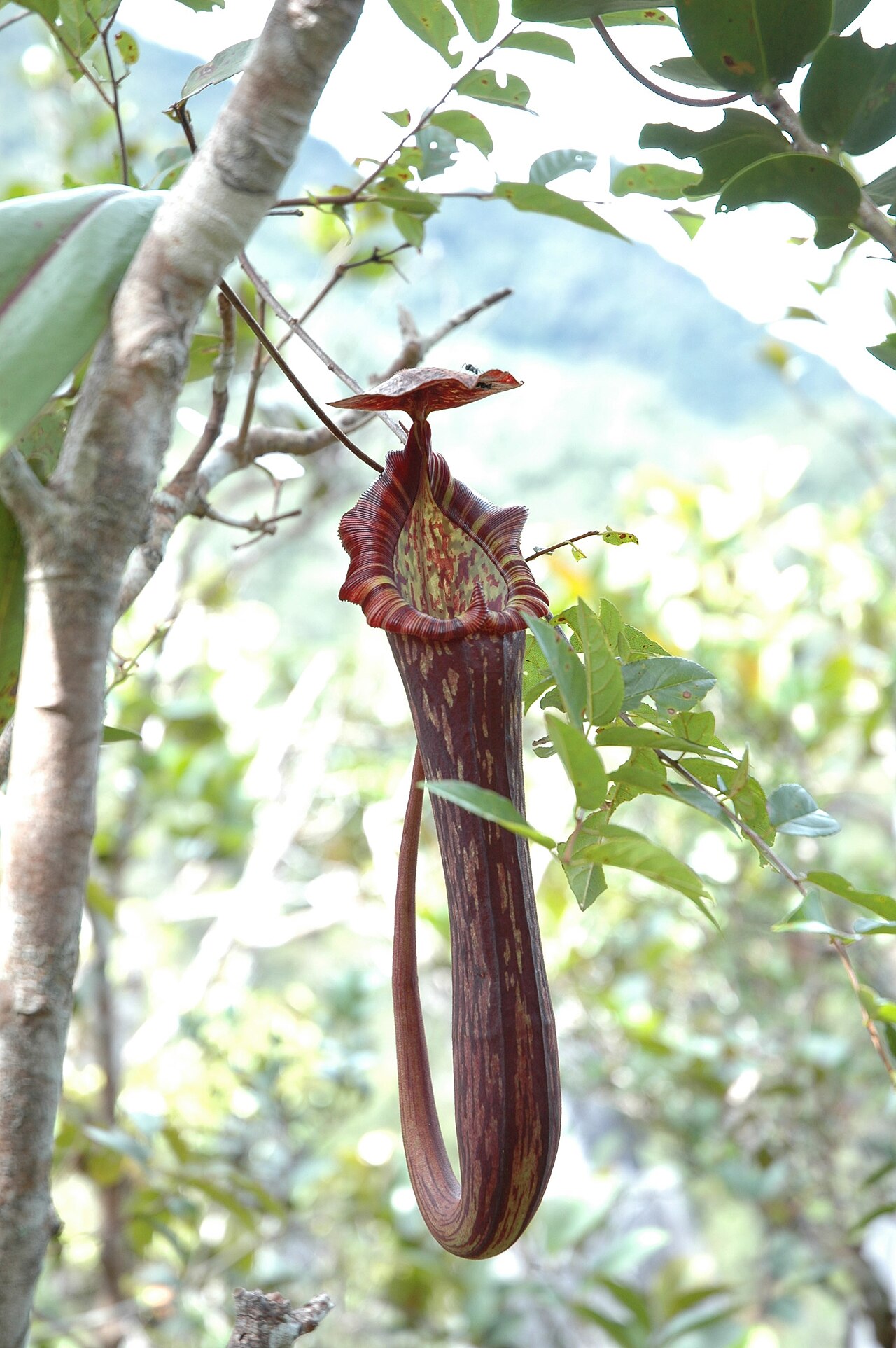
A climber with a stem to 8 mm thick and short, cylindrical internodes to 3 cm. The leaves are leathery and stalked, lanceolate to elliptic, to 14 cm long and 4 cm wide, with an acute tip; the channelled, wingless petiole reaches 5 cm and half-clasps the stem. The tendrils reach 20 cm. Stem and petioles bear white stellate hairs, and long white hairs stand at the base of the midrib. Upper pitchers are narrowly funnel-shaped and slightly widening above, over 30 cm tall, with ribs instead of wings, a well-developed waxy zone, an obliquely set mouth and a flattened peristome of a few millimetres. The lid is round and carries a characteristic glandular crest on its underside. Lower pitchers are smaller, produced less often and have never been formally described; they are bulbous at the base.
Similar species
Its closest relative is Nepenthes boschiana, which is hairless where N. faizaliana is distinctly hairy, and differs in the bulbousness of the lower-pitcher base, peristome width and the mouth width of the upper pitchers. From N. stenophylla, with which it grows at Mulu, it differs in more lanceolate leaves, larger inflorescences, a broader, more colourful and less recurved peristome, one-flowered bracteate pedicels, a differently shaped glandular crest and bulbous lower-pitcher bases. N. fusca has a very narrow rather than round lid.
The trap and how it works
A trap that in practice consists mainly of upper pitchers. The long, narrow funnels have a well-developed waxy zone on the inner wall, a layer of loose wax flakes on which insects find no grip, so that after slipping on the peristome they cannot climb back up. The round lid stands over the mouth and bears a glandular crest beneath, supplying nectar right above the opening. Lower pitchers are rare and small. Nothing has been published on the prey.
Habitat and ecology
Limestone (R2): limestone walls, crags and the vegetated ridges of the limestone mountains, mostly between 1000 and 1600 m, locally from 400 m. The plant grows both on the ground and as an epiphyte, on rock outcrops and in the trees of the low, mossy ridge forest (B1). It shares its habitat with N. stenophylla, N. tentaculata and N. vogelii. The sharp limestone spires of Mulu, the famous Pinnacles, lie within its area.
Distribution and elevation
Endemic to Borneo, and as far as known confined to the limestone mountains of Gunung Mulu National Park in Sarawak, Malaysia. The type was collected in 1981. Altitude: mostly 1000 to 1600 m, locally from 400 m. The area in our species list (Gunung Mulu) is correct; strictly speaking it concerns the park's limestone mountains, such as Gunung Api, rather than the sandstone summit of Mulu itself.
- Recorded (one-degree cells)
Forms and variation
No varieties or forms have been described. The species was long confused with N. stenophylla, so pre-1997 literature records should be read with care. One putative natural hybrid has been reported, with N. veitchii. Because the lower pitchers have never been formally described, the description of the species remains incomplete; the female flowers have not been formally described either.
Where and when to see it
The best-known place to see the species is the Pinnacles trail on Gunung Api in Gunung Mulu National Park: a steep, strenuous day climb permitted only with a park guide and after booking. The long, narrow upper pitchers hang on the limestone crags and in the trees along the upper part of the trail. The route crosses sharp limestone with ladders and ropes; good footwear and gloves are needed. Do not touch the plants and stay on the trail.
Conservation status
The Red List assesses the species as Least Concern. Its entire known range lies within Gunung Mulu National Park, also a World Heritage Site, and the limestone walls are largely inaccessible. Being confined to one area does make it sensitive to changes there, such as drought or fire. Like the whole genus, it is listed in CITES Appendix II.
Scientific name
Nepenthes faizaliana | Adam & Wilcock, 1991
Nepenthes faizaliana was described in 1991 by J.H. Adam and C.C. Wilcock, in Blumea. The type specimen was collected on 10 November 1981 at Batu Panjang in Gunung Mulu National Park, Sarawak, Borneo, and is held at the Sarawak Forest Department Herbarium in Kuching; isotypes are held at Kew and Leiden. Batu Panjang in Gunung Mulu National Park, Sarawak, Borneo. The species is named after Muhammad Khairul Faizal, son of describing author J.H. Adam.
World Checklist of Vascular Plants (WCVP), via Plants of the World Online (POWO), Royal Botanic Gardens, Kew.