All species › Caryophyllales › Tropical pitcher plant family › Nepenthes mapuluensis
Nepenthes mapuluensis
A limestone species of eastern Kalimantan, and one that was once thought extinct. Nepenthes mapuluensis was collected by Kostermans in 1957 and described by Adam and Wilcock in 1990; the original population then turned out to have vanished, until the species was found again by Davis, Nerz and Wistuba. It is closely related to N. northiana of Sarawak, and whether it stands as a separate species is uncertain. It grows on low, often extremely inaccessible limestone ridges.
Identification
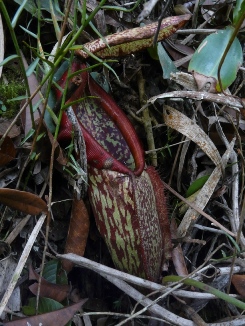
A climber with a stem to 6 mm thick and cylindrical internodes to 4 cm; its maximum length is unknown. The leaves are leathery, oblanceolate to linear, to 26 cm long and 5 cm wide, with an acute tip and a narrowed, almost stalked, half-clasping base; the tendrils reach 50 cm. Lower pitchers are ellipsoid, to 21 cm tall and 8.5 cm across, with two fringed wings to 10 mm and a moderately developed, folded to wavy peristome to 12 mm wide with distinct but not prominent teeth. Upper pitchers are often cylindrical and relatively small, sometimes wholly funnel-shaped, with reduced fringed wings or ribs. The plant is mostly hairless, with scattered short hairs, especially on the pitchers.
Similar species
The only species likely to cause confusion is Nepenthes northiana, also a limestone plant, but found only around Bau in western Sarawak, hundreds of kilometres away. N. mapuluensis has more linear leaves, darker pitchers and narrower upper pitchers. Because the two are so alike, the validity of N. mapuluensis as a separate species has been questioned; the geographical separation and the differences listed are regarded as sufficient in the standard literature.
The trap and how it works
A pitfall of the N. northiana type, but less pronounced. Lower pitchers are ellipsoid and winged, with a wavy, folded peristome forming a slippery platform around the mouth; the teeth on the inner edge are distinct but small. Upper pitchers are narrower, cylindrical to funnel-shaped, and hang free in the low vegetation on tendrils up to half a metre long. No prey data have been published; the habitat on bare limestone ridges suggests that ants and other crawling animals make up an important part of the catch.
Habitat and ecology
Exclusively limestone (R2): low, stunted vegetation on limestone ridges, from 50 to 850 m. The ridges are narrow, sharp and often extremely hard to reach, and the plant grows among the low shrubs in full light. As with other Bornean limestone plants, the soil is shallow and dries out quickly, which makes the habitat sensitive to drought and fire.
Distribution and elevation
Endemic to Borneo, and known there from a limestone range in the province of East Kalimantan, Indonesia. Altitude: 50 to 850 m. Because the species is listed as endangered, this guide gives no further localities. The area in our species list (Borneo, Kalimantan) agrees with the literature.
- Recorded (one-degree cells)
Forms and variation
No varieties or forms have been described and no natural hybrids are known. The main open question is taxonomic: whether N. mapuluensis is a species of its own or an eastern form of N. northiana. Genetic study of wild material could settle this but, as far as known, has not been published. Artificial crosses in cultivation have no bearing on the species in the wild and are not covered here.
Where and when to see it
Do not seek out this species. The sites are small, inaccessible and threatened, and any disturbance of the limestone ridges has lasting consequences. Anyone visiting limestone areas in East Kalimantan, for example for research or conservation, does so with permission from the Indonesian authorities and with local guidance. Photographs with date and altitude, without publishing coordinates, are valuable to specialists.
Conservation status
The Red List assesses the species as Endangered. The original population has disappeared, and the species is known from only a few places. The limestone areas of East Kalimantan are under general pressure from logging, land clearing and quarrying, and from fire in dry El Niño years. As a rare species little grown in cultivation, it is also attractive to collectors. It is listed in CITES Appendix II.
Scientific name
Nepenthes mapuluensis | Adam & Wilcock, 1990
Nepenthes mapuluensis was described in 1990 by J.H. Adam and C.C. Wilcock, in Blumea 35: 265-267, based on a single duplicate specimen (Kostermans 14017) in the Leiden and Bogor herbaria, collected in 1957. The limestone Mount Ilas Mapulu, East Kalimantan, Borneo, at 800 m elevation; the original population was later destroyed and the species feared extinct, until rediscoveries expanded the known range to the Sambaliung mountain range. The specific epithet derives from Mount Ilas Mapulu, where the plant was first discovered.
World Checklist of Vascular Plants (WCVP), via Plants of the World Online (POWO), Royal Botanic Gardens, Kew.