All species › Caryophyllales › Tropical pitcher plant family › Nepenthes rhombicaulis
Nepenthes rhombicaulis
A pitcher plant of the shady understorey of mountain forest, with a stem that is rhomboid in cross-section: hence rhombicaulis. The Japanese botanist Shigeo Kurata collected it on 29 March 1972 on Gunung Pangulubao near Lake Toba, between 1700 and 1900 m, and described the species in 1973 in The Gardens' Bulletin Singapore. The holotype is kept in the herbarium of the Nippon Dental College. For a long time that single specimen was almost all that herbaria held of the species.
Identification
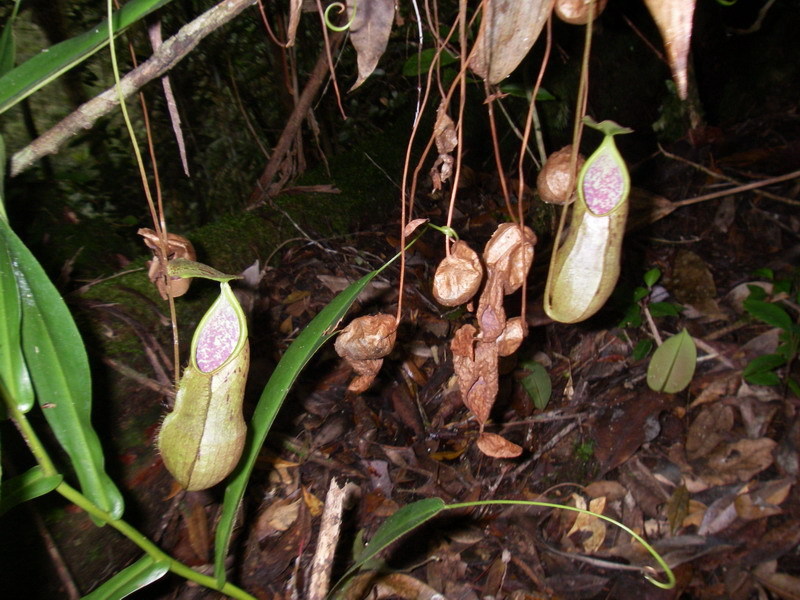
A robust climber, according to Cheek & Jebb (2001) up to 20 m long, with a four-angled to rhomboid climbing stem 5 to 10 mm thick; short shoots and rosettes also occur. The stem is glabrous with prominent glands; the leaf margins carry reddish-brown hairs. Leaves of the climbing shoot are lanceolate, 12 to 22 cm long and 3 to 4 cm wide, with a nearly peltate to emarginate tip and a clasping base, and two or three longitudinal veins on each side. Lower pitchers are ventricose below and cylindrical above, 6 to 12 cm tall and 2.5 to 3.5 cm wide, with two fringed wings, a peristome of 3 to 5 mm with ribs about 0.5 mm apart, a lid of 2.5 by 1.7 to 2.5 cm and a spur split to the base into two threads, about 5 mm long. They are dull green to light red with purple blotches, with a peristome from light green to dark purple. Upper pitchers have rarely been seen in the field: ventricose below, tubular to slightly funnel-shaped towards the mouth, with a much reduced peristome; they are yellowish green with pale red spots.
Similar species
Nepenthes gymnamphora, which grows with this species on Pangulubao, has round stems, broader wings on the lower pitchers and a broader, toothed peristome. N. hirsuta from Borneo superficially resembles N. rhombicaulis but does not occur on Sumatra. N. spectabilis and N. ovata, on the same mountain, have respectively much longer, speckled upper pitchers and rounded lower pitchers with a hooked appendage under the lid. The rhomboid stem and the spur split into two threads are the handiest features.
The trap and how it works
The lower pitchers often lie half sunk in leaf litter and humus on the forest floor, and so catch almost only what walks over the ground: ants, beetles, springtails and other litter dwellers. The fringed wings guide these to the mouth, where the ribbed peristome turns slippery when wet. In the shade of the forest, where flying insects are scarcer than on open ridges, this ground-level strategy makes sense. The rarely formed upper pitchers catch flying insects.
Habitat and ecology
Dense, shady mountain forest (B1), especially lower montane forest on steep slopes, between about 1600 and 2000 m. The species grows on the ground and is one of the few Nepenthes that is common in the understorey of closed forest, rather than being tied to openings and forest edges. The lower pitchers often sit in the litter layer.
Distribution and elevation
Endemic to Sumatra, in North Sumatra province around Lake Toba: known from the Pangulubao complex and Gunung Lubukraya, with possible sightings on Gunung Bandahara in Aceh. The world checklist gives Sumatra as its only area.
- Recorded (one-degree cells)
Forms and variation
No varieties have been described; lower pitcher colour ranges from dull green to light red, peristome colour from light green to dark purple. Natural hybrids are known with N. flava, N. gymnamphora, N. ovata, N. spectabilis and N. tobaica. On Pangulubao, where many species meet, such hybrids are readily found in the field.
Where and when to see it
Gunung Pangulubao near Lake Toba is the type locality and the best place. Look not only along the open ridge, where the other species grow, but also in the dense forest on the slopes below: that is where N. rhombicaulis stands, with its lower pitchers in the litter. Feel the stem: the four sharp angles are easy to recognise with the fingers. Anyone who finds upper pitchers has seen something rare; note and photograph them carefully.
Conservation status
Assessed on the Red List as Vulnerable, because of its small range around Lake Toba. The mountain forest in this area is under pressure from clearance on the lower slopes and from fire. As a member of the genus it is listed in CITES Appendix II. Because the species grows in closed forest, it is more sensitive to logging than ridge-top species, which may benefit from disturbance.
Scientific name
Nepenthes rhombicaulis | Kurata, 1973
Nepenthes rhombicaulis was described in 1973 by Shigeo Kurata, in The Gardens' Bulletin Singapore 26(2): 227-232. The holotype (Kurata 4300) was collected on 29 March 1972 on Mount Pangulubao, Sumatra — the same mountain as N. mikei and N. ovata (golf 27/28) — at 1,700-1,900 m elevation, and is held at the Nippon Dental College herbarium; an isotype is held at the National Herbarium of Singapore. Mount Pangulubao, Sumatra, Indonesia, at 1,700-1,900 m elevation. The specific epithet is formed from the Latin "rhombicus" ("rhomboid") and "caulis" ("stem"), referencing the characteristic cross-sectional shape of the stem internodes.
World Checklist of Vascular Plants (WCVP), via Plants of the World Online (POWO), Royal Botanic Gardens, Kew.