All species › Caryophyllales › Tropical pitcher plant family › Nepenthes ovata
Nepenthes ovata
A pitcher plant with a long history of confusion. Franz Wilhelm Junghuhn collected it around 1840 on Gunung Lubukraya near Lake Toba, at nearly 2000 m. B.H. Danser took that material for Nepenthes bongso in 1928, and later botanists confused the plant with N. densiflora and N. pectinata. Only in 1994 did Joachim Nerz and Andreas Wistuba describe it as a separate species, N. ovata, after its egg-shaped lower pitchers. Nerz collected the holotype on 16 March 1989 on the west ridge of Gunung Pangulubao.

Identification
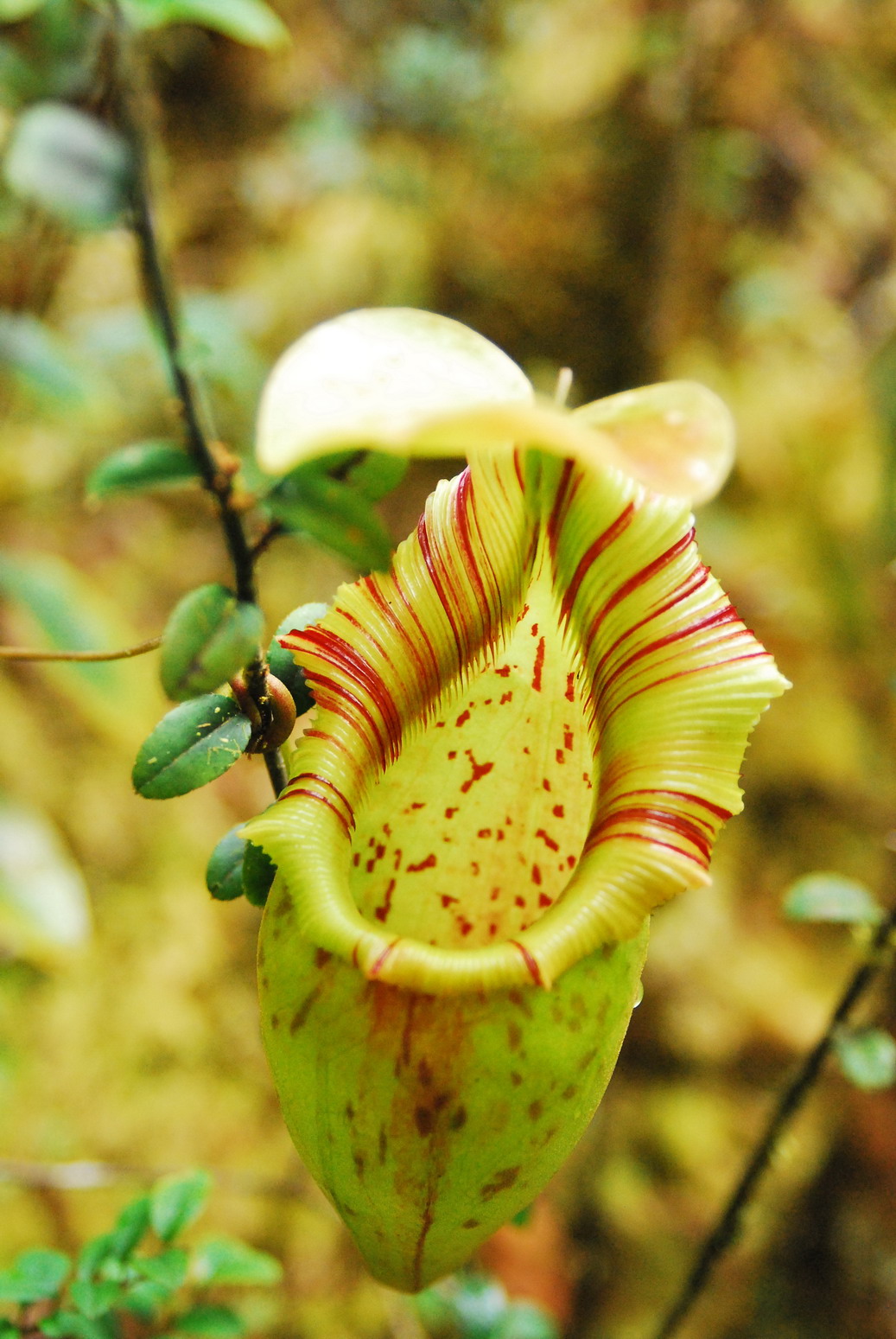
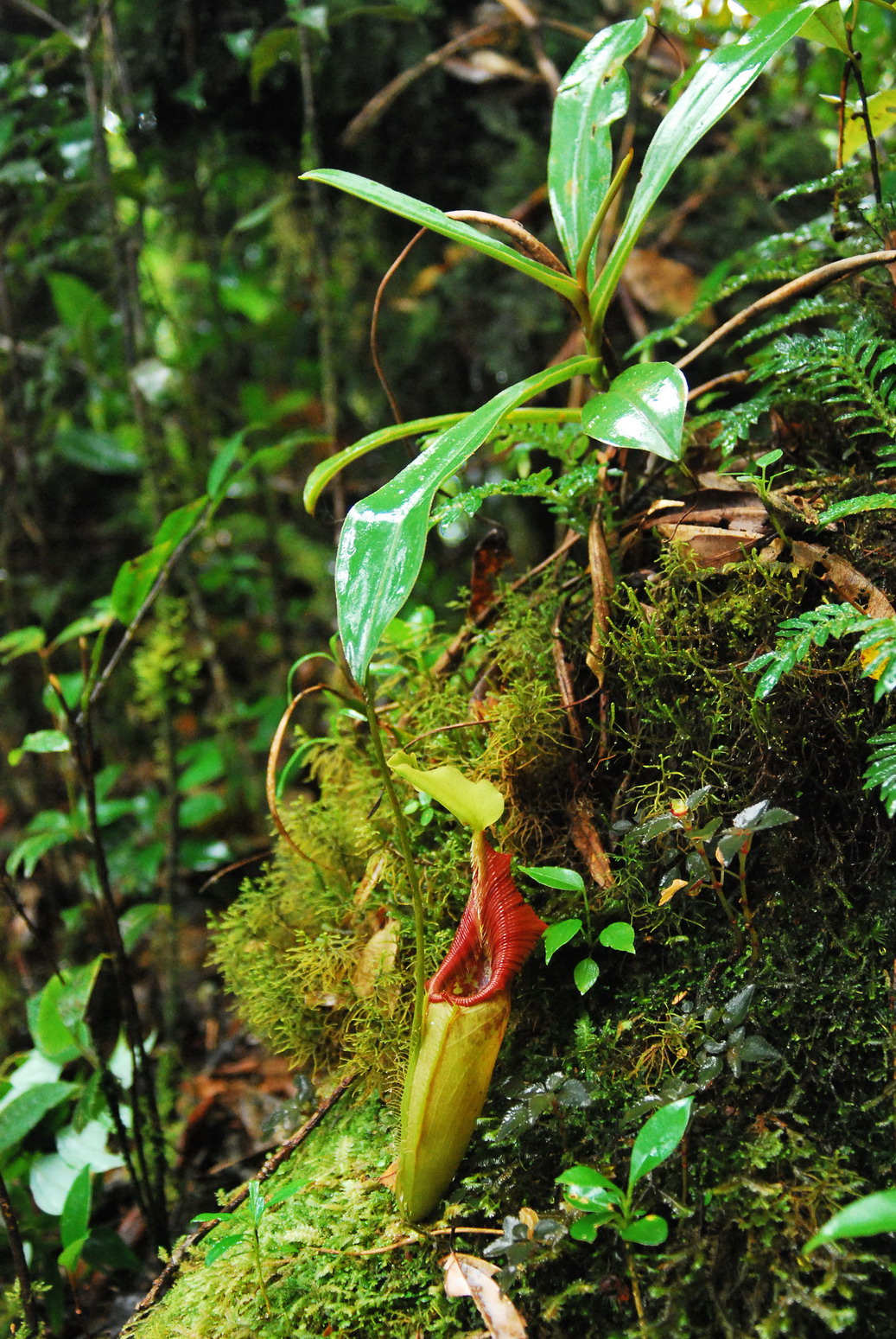
An epiphytic, rarely terrestrial shrub or climber with a round stem of 4 to 6 mm and internodes of 4 to 15 cm. Rosette leaves are 10 to 15 cm long and 2 to 3 cm wide; leaves of the climbing stem 5 to 16.5 cm long and 2.5 to 3.5 cm (to 5.7 cm) wide, with three longitudinal veins on each side and a base running 3 to 7 mm down the stem. Lower pitchers are broadly ellipsoid to ovoid, 10 to 15 cm tall (to 25 cm) and 5 to 8 cm wide, with two fringed wings of 2 to 5 mm and a peristome widening from 3 to 8 mm at the front to 15 to 25 mm (rarely 40 mm) at the back. The lid measures 5.5 to 7 by 4.5 to 6 cm and carries the species' hallmark on its underside near the base: a laterally flattened, symmetrical or recurved appendage of 2 to 5 mm, sometimes hooked. Upper pitchers are funnel-shaped, 12 to 18 cm tall and 4.8 to 6 cm wide, with a narrower peristome. Lower pitchers are green to red with a dark red peristome; upper pitchers yellow to yellowish green, often striped, with a red peristome striped yellow.
Similar species
Nepenthes bongso sometimes has a comparable crest under the lid, but less often and less pronounced, and much more slender pitchers. N. densiflora lacks the hooked appendage and has lower pitchers with a longer neck. N. singalana has a rounded rather than acuminate leaf tip and a different distribution of glands. N. rigidifolia has thicker, stiffer leaves and a tendril arising just below the leaf tip. N. spectabilis, which grows on the same mountains, has much more slender, speckled upper pitchers.
The trap and how it works
The rounded lower pitchers, in Sphagnum or on mossy branches, are large pitfalls with a broad peristome widening strongly towards the back. Nectar glands lie under the lid, and the hooked appendage itself bears glands; in this way insects are drawn to a point above the mouth. When wet the peristome is glassy. The funnel-shaped yellow upper pitchers catch flying insects; the yellow colour with its red rim stands out strongly against the green canopy.
Habitat and ecology
Stunted mossy cloud forest and ridge-top vegetation (B1), often among Sphagnum, between about 1700 and 2100 m. On Gunung Pangulubao the species grows on the ground on the ridge; on Gunung Lubukraya mainly epiphytically in the open, wet moss forest. It is a cool, almost permanently wet environment with a thick moss layer.
Distribution and elevation
Endemic to Sumatra, and confined to a few mountains in the area around Lake Toba in North Sumatra province: Gunung Pangulubao, Gunung Lubukraya and Gunung Simanukmanuk. The world checklist gives Sumatra as its only area.
- Recorded (one-degree cells)
Forms and variation
No varieties have been described; the colour of the lower pitchers ranges from green to red. Four natural hybrids are known from Gunung Pangulubao, with N. gymnamphora (or N. xiphioides), N. mikei, N. rhombicaulis and N. spectabilis; a cross with N. flava has also been reported. The hybrid with N. spectabilis has pitchers roughly intermediate between the parents.
Where and when to see it
Gunung Pangulubao near Lake Toba is the classic place, and one of the richest pitcher-plant mountains of Sumatra, with N. mikei, N. spectabilis, N. rhombicaulis and N. gymnamphora as well. Look for N. ovata on the ridge among the Sphagnum. Check under the lid for the hooked appendage: it is the surest feature and helps to separate the species from the many hybrids on the mountain.
Conservation status
Assessed on the Red List as Least Concern. Despite its small range the species is no longer considered threatened. As a member of the genus it is listed in CITES Appendix II. The mountains around Lake Toba are, however, under pressure from clearance and fire on the lower slopes, and collectors have been visiting Pangulubao for decades.
Scientific name
Nepenthes ovata | Nerz & Wistuba, 1994
Nepenthes ovata was described in 1994 by Joachim Nerz and Andreas Wistuba, in "Five new taxa of Nepenthes (Nepenthaceae) from North and West Sumatra" (Carnivorous Plant Newsletter 23(4): 101-114). The holotype (Nerz 1601) was collected on 16 March 1989 on the west ridge of Mount Pangulubao, at 1,800 m elevation, North Sumatra — the same mountain as N. mikei (golf 27) — and is held at the National Herbarium of the Netherlands (Leiden). The west ridge of Mount Pangulubao, North Sumatra, Indonesia, at 1,800 m elevation. The specific epithet is Latin for "ovate", referring to the shape of the lower pitchers, which are characteristically egg-shaped or oval.
World Checklist of Vascular Plants (WCVP), via Plants of the World Online (POWO), Royal Botanic Gardens, Kew.