All species › Caryophyllales › Tropical pitcher plant family › Nepenthes densiflora
Nepenthes densiflora
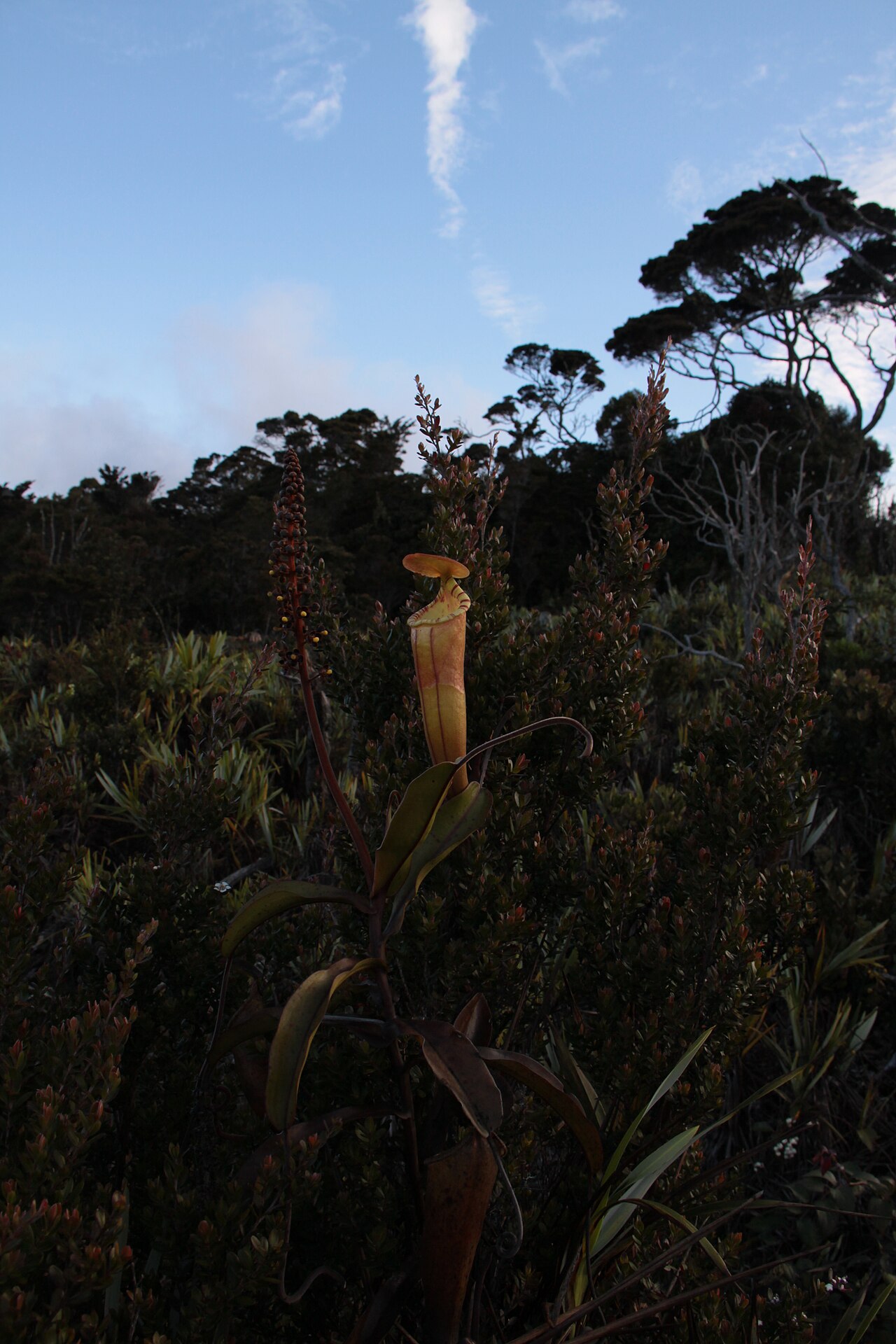
A species of the highest summits of northern Sumatra that was long taken for a hybrid. B.H. Danser reported plants in 1928 that he regarded as a hybrid of Nepenthes bongso and N. pectinata; in 1940 he described these plants as the independent species N. densiflora, named after its dense, compact inflorescence. It is a plant of the open mountain scrub above the tree line, up to more than 3000 m, where few other pitcher plants still grow.

Identification
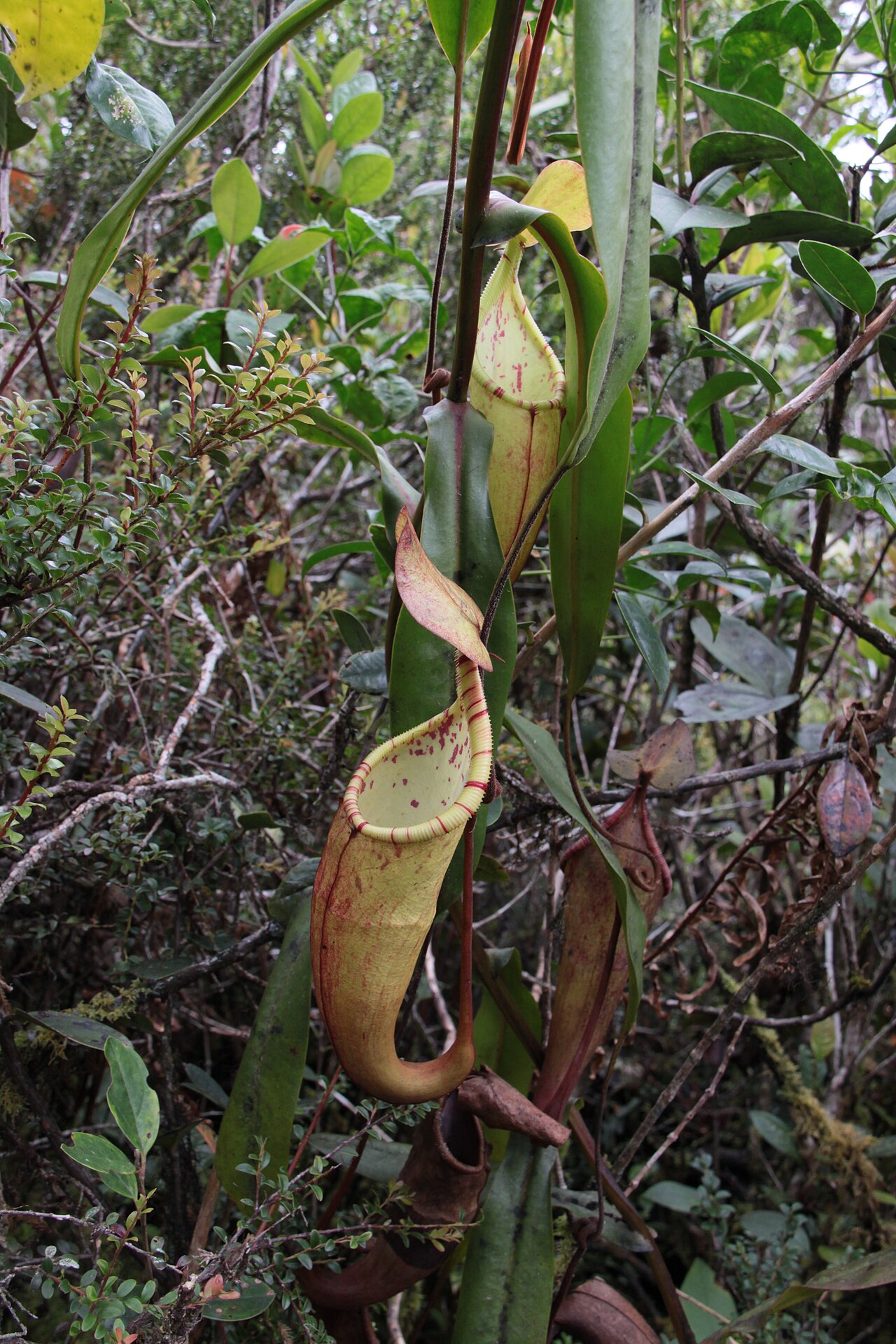
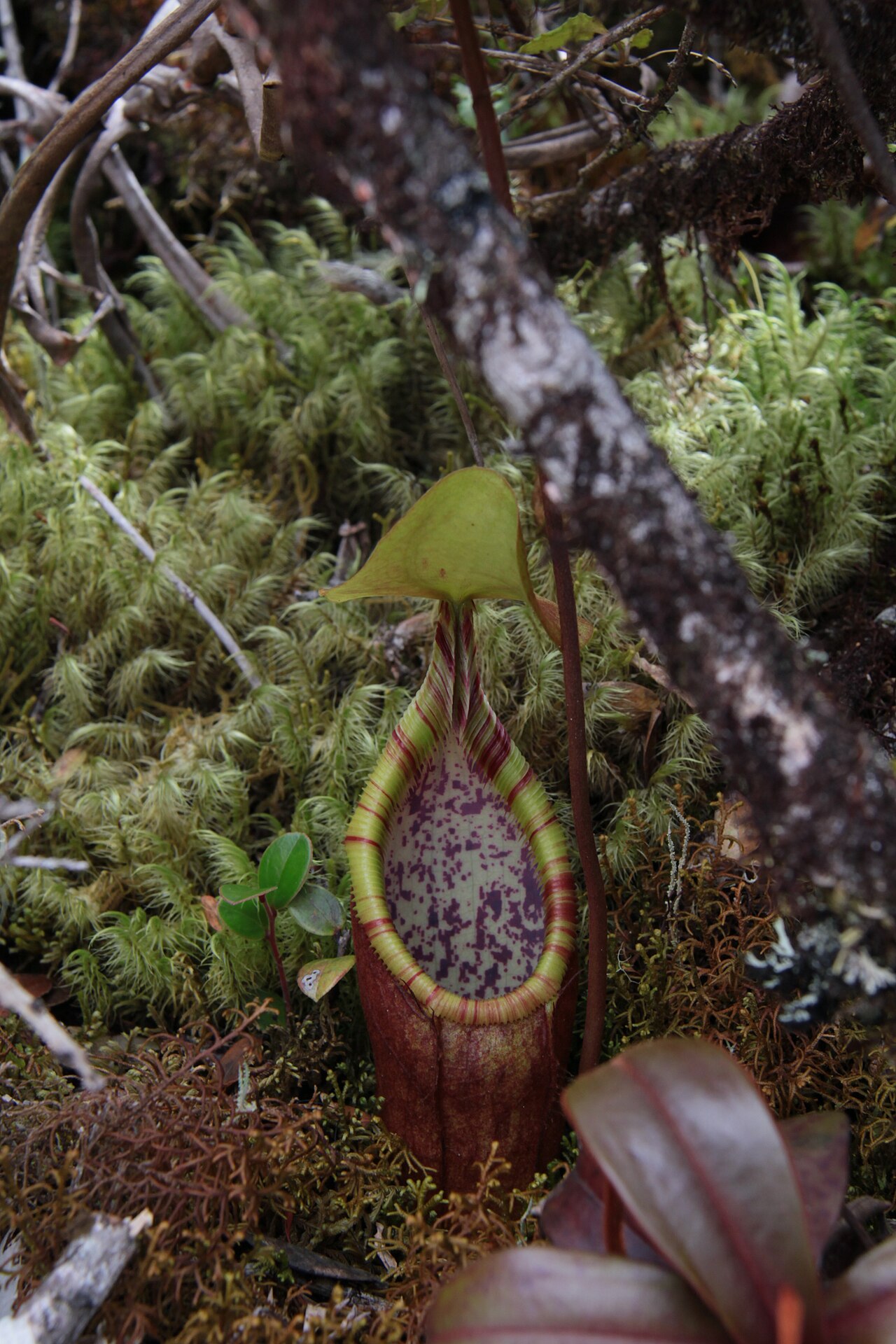
A climber with a bluntly triangular to square stem 2 to 8 mm thick and internodes of 1 to 9 cm. The leaves are thinly leathery, sessile, obovate to obovate-lanceolate or slightly spathulate, 3 to 15 cm long and 1 to 3.2 cm wide, with a red midrib. Lower pitchers are ovoid, about 10 cm tall and 3 cm wide, with fringed wings of 3 mm (fringe about 5 mm). The peristome is rounded and 3 to 5 mm wide at the front, broadening towards the lid into a flattened rim of 18 mm, with ribs 0.5 to 1 mm apart. The lid is round, 3 to 3.5 cm across, with a dense covering of pit-like nectar glands beneath; the spur is undivided, to 7 mm. Upper pitchers are broadly to narrowly funnel-shaped, slightly constricted at the mouth, 9 to 23 cm tall and 3 to 4.5 cm wide, with a peristome of 2 to 4 mm at the front to 11 mm near the lid and a round lid to 5.5 cm. The pitchers are pale green, the peristome streaked red. New growth, tendrils and inflorescence carry dense reddish-brown hair.
Similar species
Nepenthes bongso has more slender, much longer upper pitchers and a laxer inflorescence. N. ovata from the Lake Toba area has a conspicuous, laterally flattened, often hooked appendage under the lid, which N. densiflora lacks; the lower pitchers of N. densiflora also have a longer neck. N. diatas from the same summits has a woody peristome with a clearly projecting outer edge. N. angasanensis is much smaller and has narrow tubular pitchers.
The trap and how it works
The peristome is asymmetric: narrow at the front, broad and flattened under the lid. It is just there, under the densely gland-studded underside of the lid, that insects seek nectar, and there that the surface is widest and most slippery when wet. Whatever slips falls into the pitcher, where a digestive fluid breaks down the prey. Upper pitchers hang in the low scrub and catch mainly flying insects; lower pitchers stand in the moss and catch walking animals.
Habitat and ecology
Open mountain scrub and the transition to cloud forest on the highest parts of the range (R5, B1), from about 1700 to above 3000 m. Cheek & Jebb (2001) give the habitat as 'montane scrub' between 1700 and 3000 m; Clarke (2001) gives 1700 to 3200 m. The vegetation is low, windswept and cold, with a thin humus layer over volcanic or other rock.
Distribution and elevation
Endemic to Sumatra, in the province of Aceh in the north of the island, with sites in and around Gunung Leuser National Park. The world checklist gives Sumatra as its only area.
- Recorded (one-degree cells)
Forms and variation
No varieties or forms have been described. A natural hybrid with N. angasanensis is known. The species itself, as noted, was first understood as a cross of N. bongso and N. pectinata; that interpretation has been abandoned. In Clarke's (2001) cladistic analysis N. densiflora falls in a group with other Sumatran highland species.
Where and when to see it
The highest summits of Aceh lie in remote, protected territory and can only be reached on multi-day treks with permits and local guides. Once there, search above the tree line in the low, windswept scrub: pale green pitchers with a red-streaked peristome that widens strongly towards the back, and a round lid. Bring warm clothing; at this altitude night temperatures can approach freezing.
Conservation status
Assessed on the Red List as Least Concern (Clarke's 2018 assessment): the species grows at high altitude in remote mountain country, largely within a national park, where there are few direct threats. As a member of the genus it is listed in CITES Appendix II. Fire in the mountain scrub and climate change, which pushes the habitat of high-mountain species upwards, are the main long-term risks.
Scientific name
Nepenthes densiflora | Danser, 1940
Nepenthes densiflora was described in 1940 by Benedictus Hubertus Danser, in "A new Nepenthes from Sumatra" (Bulletin du Jardin Botanique de Buitenzorg, series III, 16: 268-271). The precise type locality could not be established with certainty; the species is endemic to Sumatra, at 1,700-3,200 m elevation. The name is Latin for "densely flowered" ("densus", dense, + "flos", flower), referring to this species' tightly packed inflorescence.
World Checklist of Vascular Plants (WCVP), via Plants of the World Online (POWO), Royal Botanic Gardens, Kew.