All species › Caryophyllales › Tropical pitcher plant family › Nepenthes orbiculata
Nepenthes orbiculata
Round pitchers, red as tomatoes, low in the grass of a coastal savanna: that is Nepenthes orbiculata at its best. The name comes from the Latin orbiculatus, round. Plants from these populations in Phang Nga province, on the Andaman coast of southern Thailand, were long known as a globular form of Nepenthes mirabilis, ‘var. globosa’. In 2018 Marcello Catalano and Trongtham Kruetreepradit described them as a separate species. The species sits between two relatives, quite literally: in the savanna it grows on the wet spots, between the places of N. mirabilis and those of N. andamana.
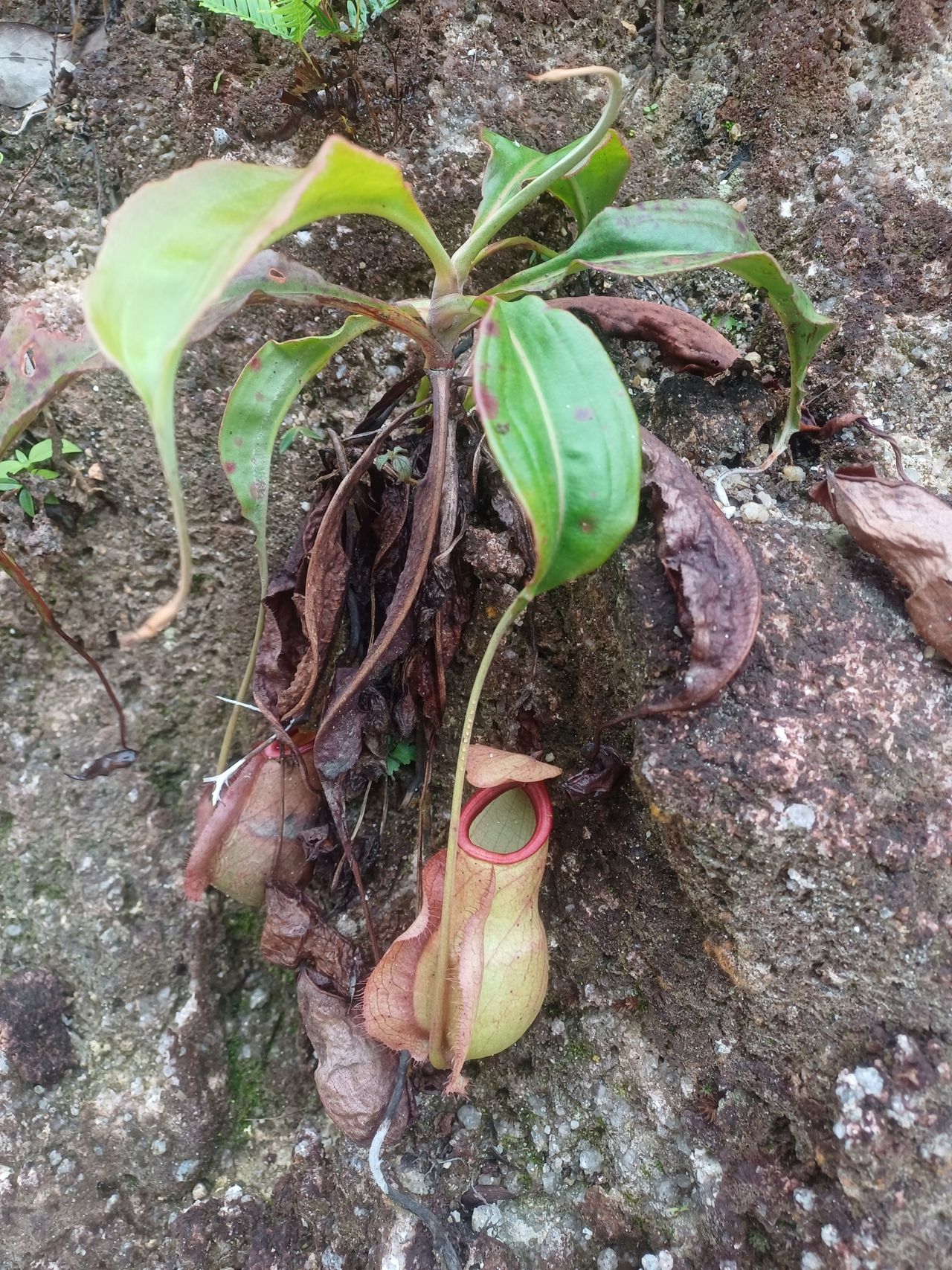
Identification
A low shrub of about 50 to 150 cm, with sturdy stems 5 to 10 mm thick. The leaves are up to 25 cm long and 3 to 8 cm wide. The distinctive part is the pitchers: globular, with the ‘hip’ — where the shape changes — just below the lid, so almost the whole pitcher is swollen. Lower pitchers are 8 to 12 cm tall and 5 to 7 cm wide, bright to dark red outside, often with light green to white tints. Upper pitchers are 10 to 15 cm tall and 4 to 7 cm wide, and light green inside and out. The lid is 3 to 5 cm long and 2.5 to 5 cm wide, and bears on its underside a glandular boss about 2 mm long and 1 mm wide.
Similar species
Nepenthes mirabilis, which grows in the same savannas, is the species it was confused with. The difference: N. mirabilis has elongated pitchers with the hip halfway or lower, and is a climber; N. orbiculata has globular pitchers with the hip just below the lid and is a low shrub of at most one and a half metres. N. andamana, also in this area, grows on drier spots in the savanna and belongs to the group around N. thorelii. According to the description, the glandular boss on the lid underside is a character separating N. orbiculata from related species.
The trap and how it works
A pitcher trap with an almost spherical chamber. Thanks to the round shape and high hip the volume is large relative to the mouth, and much of the pitcher is filled with fluid. The lower pitchers sit low in the grass and mainly catch walking prey such as ants; the light green upper pitchers hang higher and also catch flying insects. The glandular boss under the lid may be an extra nectar source, like the appendages under the lid in other species, but its function has not been studied. The peristome works as in related species: when wet it is slippery.
Habitat and ecology
Sandy soil in savannas and grasslands in the coastal lowlands, at sea level (W6, D1). Within the savanna the species grows on the wet spots: places that stay wet or flood, some two to three metres from open water. That puts it, according to the describers, between two relatives: N. mirabilis grows closer to the water, N. andamana on drier ground. Such a division of the wet and dry parts of a single landscape has rarely been described so clearly for pitcher plants.
Distribution and elevation
Endemic to Thailand, in Phang Nga province on the Andaman coast of the peninsula, at sea level. The species is known from two populations. Trang province, named in our list as a second area, is not mentioned in the sources consulted for this guide, so more work is needed there. The Andaman coast has a marked monsoon climate with a wet season from about May to October.
- Recorded (one-degree cells)
Forms and variation
No varieties or forms are distinguished. The name ‘N. mirabilis var. globosa’, under which plants from this area circulated among growers, is not a recognised taxon of this species; N. orbiculata is the name for the Phang Nga populations. Since N. mirabilis and N. andamana grow in the same savannas, natural hybrids are plausible, but they are not described in the sources consulted. Colour varies from bright red to dark red, with more or less green.
Where and when to see it
Search the open coastal savannas of Phang Nga, at sea level, and focus on the wet spots not far from open water. The red, globular lower pitchers lie low in the grass and are the first thing to catch the eye. The best time is the end of the wet season, around October–November, when the pitchers are full grown and the ground still wet. Much of this savanna lies on land used for farming or building; ask permission and walk carefully, as the sites are small.
Conservation status
The species is not evaluated for the Red List (Not Evaluated) in the source this guide uses. What is known is worrying enough: only two populations, both in the coastal lowlands of a single province, an area with much tourism, rubber and oil-palm cultivation and building. Open coastal savanna is a shrinking landscape type in southern Thailand. As a member of the genus it is listed in CITES Appendix II; international trade in wild plants requires a permit.
Scientific name
Nepenthes orbiculata | Catalano & Kruetreepradit, 2018
Nepenthes orbiculata was described in 2018 by Marcello Catalano and Trongtham Kruetreepradit. Phang Nga Province, Peninsular Thailand, where the species is known only from two populations, in sandy soils in savannahs and grasslands at sea level. The specific epithet derives from the Latin "orbiculatus" ("round"), referring to the plant's characteristic globose (spherical) pitcher shape.
World Checklist of Vascular Plants (WCVP), via Plants of the World Online (POWO), Royal Botanic Gardens, Kew.