All species › Caryophyllales › Tropical pitcher plant family › Nepenthes nigra
Nepenthes nigra
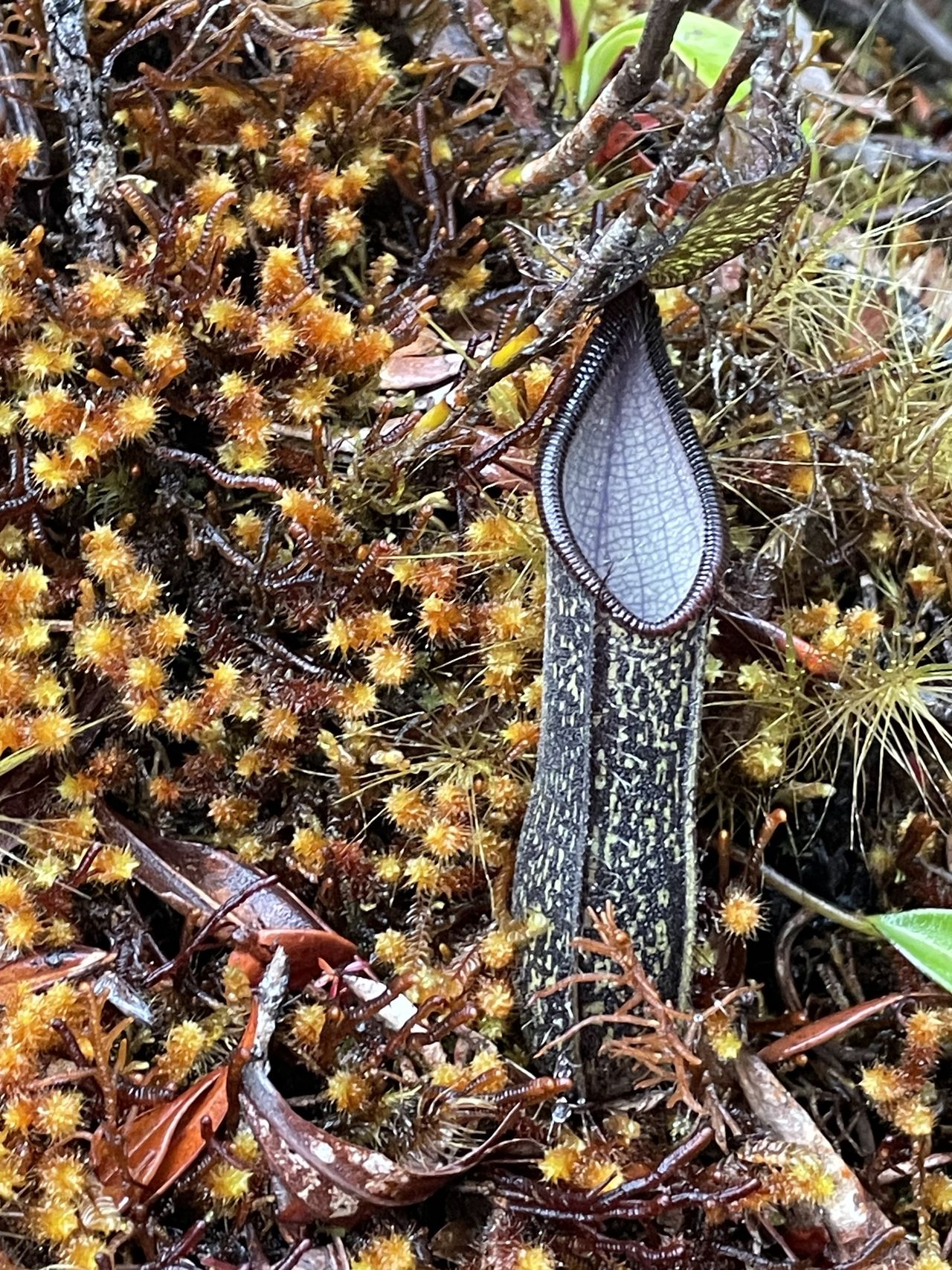
A pitcher plant named for its colour: the lower pitchers of Nepenthes nigra are black or very dark brown outside, while the inside is white or pale purple. The species was described in 2011 by Joachim Nerz, Andreas Wistuba, Ch'ien Lee, Greg Bourke, U. Zimmermann and Stewart McPherson, in the first volume of New Nepenthes, a book series in which a whole run of new species from South-East Asia was published. It belongs to the group around Nepenthes tentaculata and N. hamata, which is represented on Sulawesi by a remarkable number of species.
Identification
A climber with stems to five metres and up to 12 mm thick, and glabrous, sessile, lanceolate leaves to 22 cm long. The lower pitchers are ovate and inflated, to 23 cm tall, with fringed wings almost 2 cm wide down the front. The outside is black or very dark brown, the inside white or pale purple, a contrast that makes the species instantly recognisable. The peristome is up to 4 mm wide, with blade-like ribs ending in fine, needle-like teeth. The lid is cordate to ovate and has no appendage. The upper pitchers are smaller, to 14 cm tall, ovate below, with a flat, broad front without wings. The pitchers are covered outside in soft, orange-brown hairs.
Similar species
Its closest relatives are Nepenthes hamata and Nepenthes tentaculata, and it forms natural hybrids with both. N. hamata has a peristome with long, curved hooks and a lid with filiform processes; N. tentaculata is smaller and also has such processes on the lid. N. nigra lacks those processes and stands out by the black exterior of its lower pitchers. Nepenthes glabrata, which grows in the same mountains, is much smaller and has a very narrow, toothless peristome.
The trap and how it works
A pitfall with a peristome of blade-like ribs ending in needle-like teeth. Nectar on the peristome and under the lid lures insects; on the wet ribs they lose their footing. The lower pitchers, with their broad, fringed wings, stand in moss and take mainly walking animals; the upper pitchers, with their flat front, hang in the vegetation. Why the lower pitchers are so dark outside has not been studied; a contrast between a dark exterior and a pale interior may be a visual signal to some insects, but that is a hypothesis. No prey study has been published. Work on other species of the genus has shown that the peristome works by 'aquaplaning': a thin film of water on the finely ribbed surface makes it so slippery that the adhesive pads of insect feet can no longer grip. The trap therefore works best when it is damp, which in cloud forest is almost always the case.
Habitat and ecology
Mossy mountain forest, montane scrub, small clearings and cliff sides between about 1500 and 2700 m (B1, R5). On the ground the plant grows in the moss of the mountain forest and in openings; as an epiphyte it sits in thick moss cushions on smaller cloud-forest trees. It is a cold, permanently damp habitat in the highest parts of the mountains of Central Sulawesi.
Distribution and elevation
Endemic to Sulawesi and known from several mountains in the province of Central Sulawesi. This agrees with 'Sulawesi' in the guide's own species list. The species has one of the largest altitudinal ranges of the island's pitcher plants, up to 2700 m. Sulawesi lies east of Wallace's Line, in the transition zone between the Asian and Australian floras and faunas, and holds far fewer pitcher plants than Borneo; all the more striking, then, that a large share of the island's species is endemic.
- Recorded (one-degree cells)
Forms and variation
No varieties or wild forms have been described. The degree of black colouring varies, from very dark brown to jet black. Natural hybrids have been reported with N. glabrata and N. tentaculata; crossing with N. hamata is also expected, as the species grow in the same area. Like all pitcher plants the species is dioecious: there are male and female plants, and both must be in flower for seed to set. The small, inconspicuous flowers are borne in racemes or panicles and are pollinated by insects; the seeds are light and dispersed by wind.
Where and when to see it
The species grows in the highest parts of the mountains of Central Sulawesi, reachable only on treks of several days. Above about 1500 m, in the moss of the cloud forest and in clearings along the ridges, the black lower pitchers stand out well against the green moss. Look also at epiphytic moss cushions on the trunks of low trees.
Conservation status
The IUCN Red List assesses the species as Least Concern. It occurs on several mountains, in high areas that see little disturbance, and also grows in open places. As a member of Nepenthes it is listed in CITES Appendix II, so international trade in wild plants requires a permit. For enthusiasts it is worth knowing that almost all species of the genus are now available through tissue culture; anyone wishing to grow a plant has no need of wild ones.
Scientific name
Nepenthes nigra | Nerz, Wistuba, Lee, Bourke, Zimmermann & McPherson, 2011
Nepenthes nigra was described in 2011 by Joachim Nerz, Andreas Wistuba, Ch'ien C. Lee, Greg Bourke, Urs Zimmermann and Stewart McPherson, in the book New Nepenthes: Volume One. Several mountains across Central Sulawesi, Indonesia, at 1,500-2,700 m elevation; no single, specific type locality could be established. The specific epithet refers to the dark colouration of the pitchers and stem.
World Checklist of Vascular Plants (WCVP), via Plants of the World Online (POWO), Royal Botanic Gardens, Kew.