All species › Caryophyllales › Tropical pitcher plant family › Nepenthes rafflesiana
Nepenthes rafflesiana
The big, everyday pitcher plant of the Sundaland lowlands, and at the same time the most variable of them: from nearly white with red flecks to almost wholly dark purple, sometimes within a single population. And anyone who meets it in the field sees two plants in one — the pitchers at the bottom and those at the top hardly resemble each other.

Natural hybrids
Identification
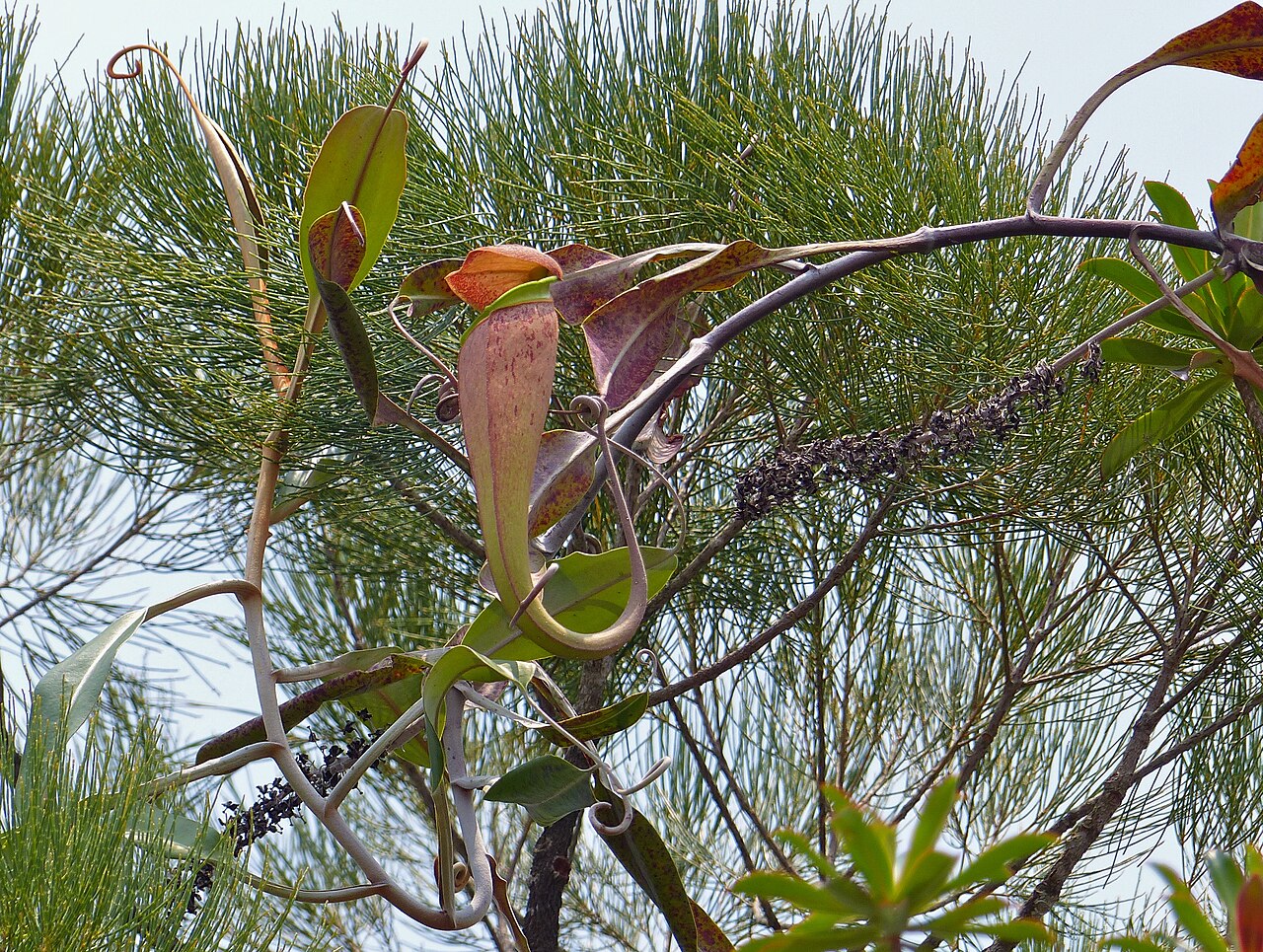
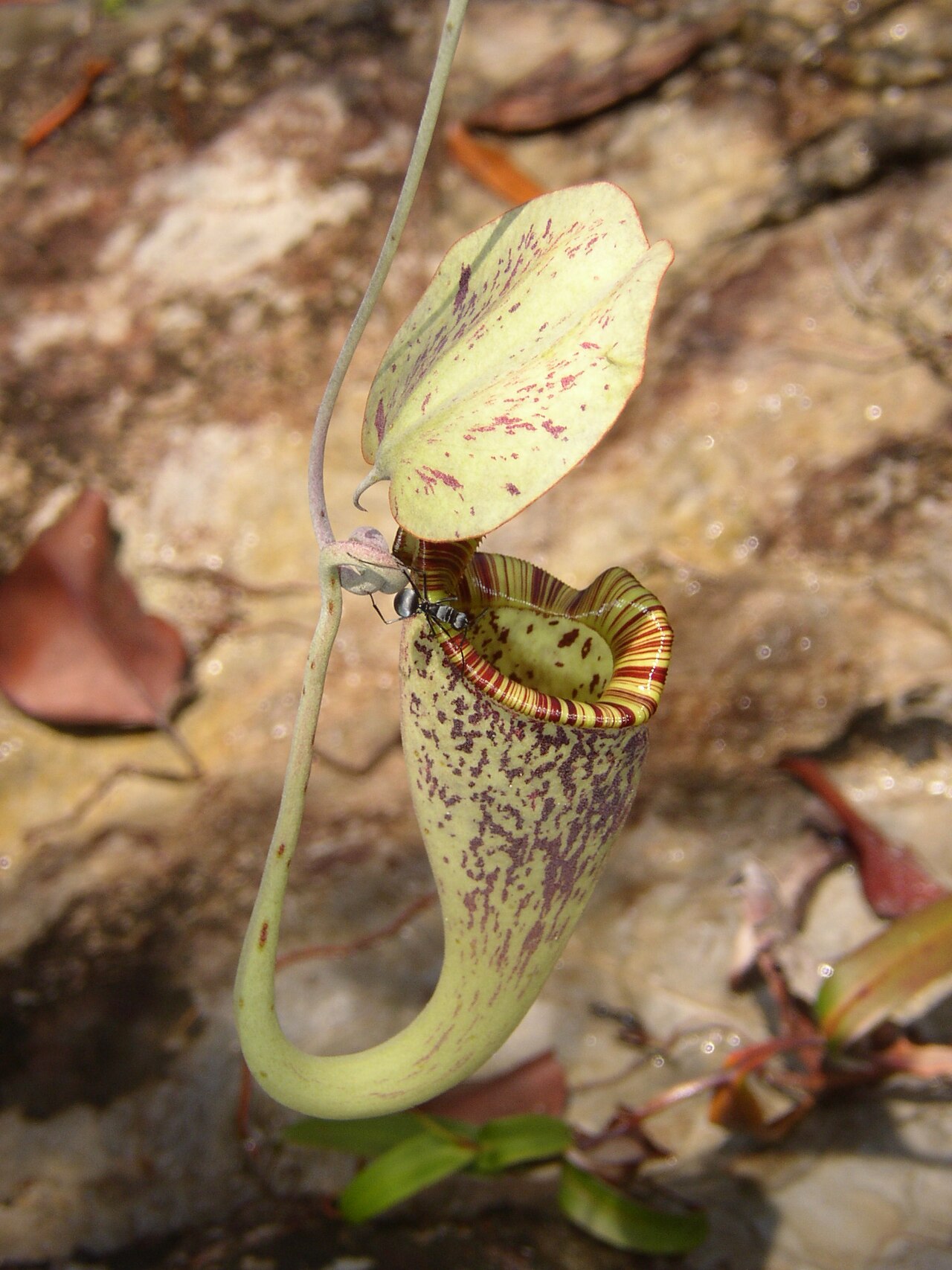
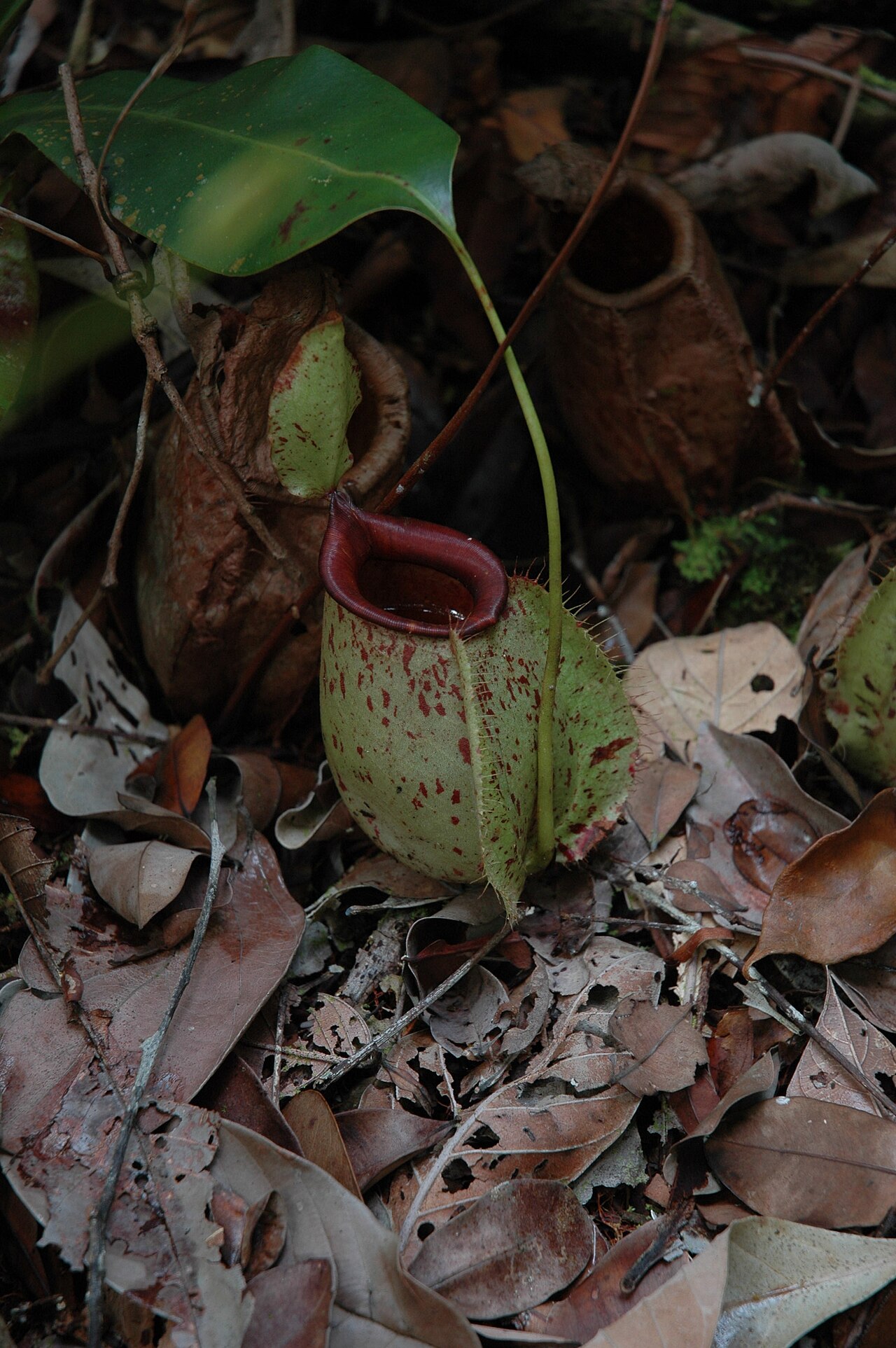
A climber that can reach fifteen metres up into the vegetation, with a stem up to 10 mm thick, internodes to 20 cm and tendrils exceeding 110 cm. Young plants are hung with long brown and white hairs, most of which are later shed. The lower pitchers sit squat on the ground, bulbous, usually up to 20 cm high, with two broad fringed wings down the front; typically light green with purple blotches. The upper pitchers hang free from the climbing stem, are funnel-shaped with a narrow base, have the wings reduced to ribs and are usually cream to pale yellow with little marking. What both types share, and what gives the species away, is the back of the peristome: it is drawn out into a neck three centimetres or more long that runs up behind the lid and ends there in a raised column. The inflorescence is a raceme 16 to 70 cm long with red to purple flowers.
Similar species
The peristome neck is the best character; no other common lowland species has it. N. hemsleyana of Brunei, until recently treated as a variety of this species, has longer and narrower upper pitchers in which bats roost. N. ampullaria is told at once by its lidless little pitchers on the forest floor, but the hybrid between the two, N. × hookeriana, is often commoner in such places than either parent and stands exactly between them. N. bicalcarata carries two fangs beneath the lid. N. mirabilis has fringed margins to its rosette leaves and lacks the peristome neck; N. northiana, of the limestone near Bau, has a much broader, striped peristome.
The trap and how it works
Two pitcher types with two menus. The lower pitchers stand in the litter and take mainly ants and other crawling prey; the upper ones hang free in the air and take more flying insects. The rim is threaded with channels that fill with water and nectar: wet, it is glass-slippery, while in dry weather it gives grip, so the trap works with the weather. Nectar glands under the lid draw prey to the rim, and the pitchers of the giant form give off a strong scent besides. Inside, below the rim, lies a waxy zone of loose flakes that offers nothing to hold on to, and below that the digestive fluid, which in this species is notably viscous and wraps itself in threads around a struggling insect. Like all Nepenthes the plant is dioecious.
Habitat and ecology
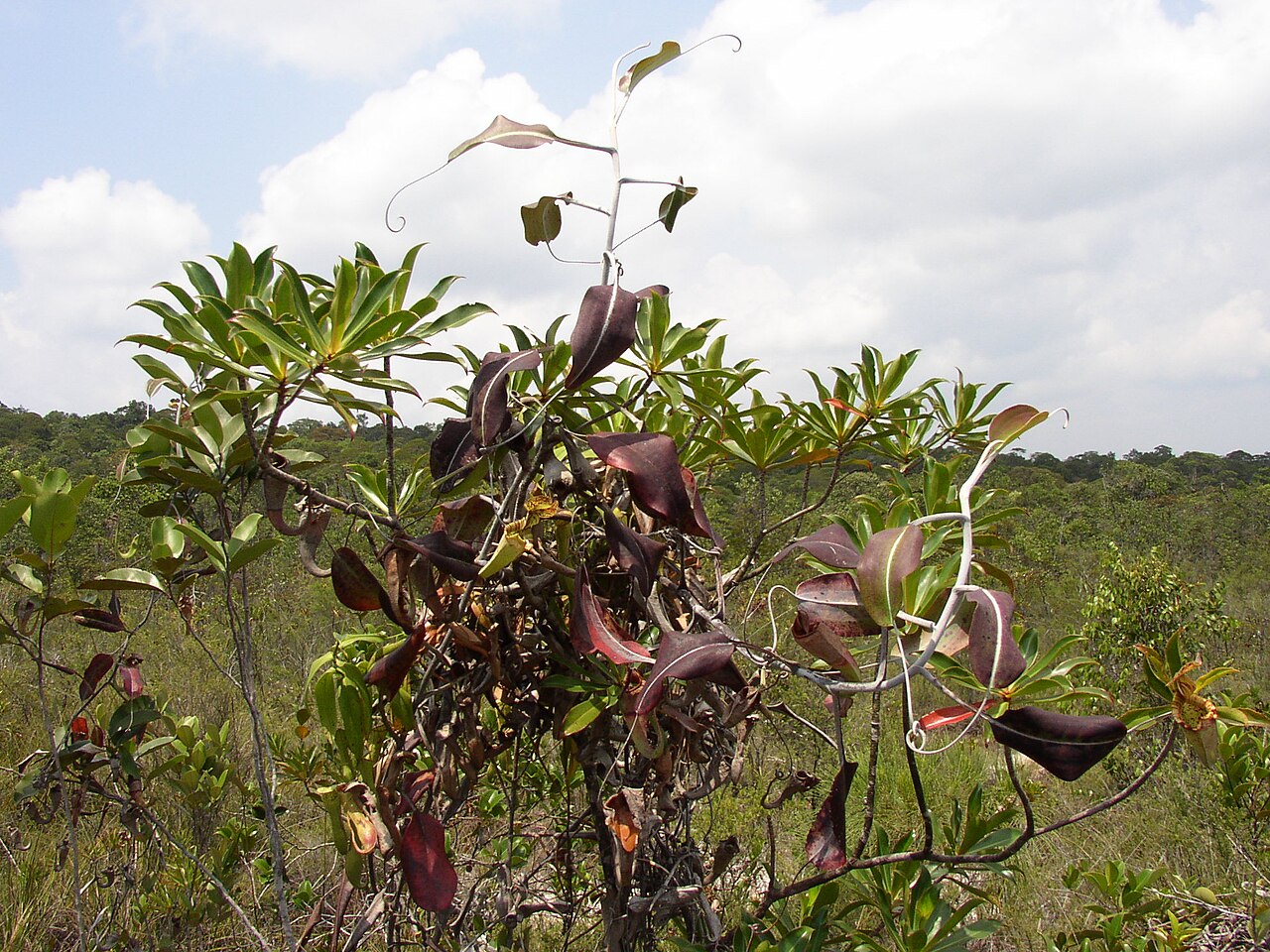
Open, wet, sandy ground in the lowlands: kerangas — heath forest on white quartz sand — the margins of peat swamp forest, sandy coastal flats and sea cliffs, and the clearings and scrub edges that follow logging. The soil is acid, poor and usually permanently wet. The species takes full sun and comes up readily in secondary growth along tracks and ditches, but the large populations stand in true heath forest. It grows from sea level to about 1,500 metres, with its centre of gravity far below two hundred.
Distribution and elevation
Borneo, Sumatra and the Malay Peninsula, and within those areas also Singapore, Bangka, Labuan, the Natuna Islands and the Lingga Archipelago. On Sumatra it is confined to the west coast, roughly between Indrapura and Barus; along the north-west coast of Borneo it is locally the commonest pitcher plant of all. It is thus a species of Sundaland rather than of a single island — one of the few Nepenthes to be met with in three of the standard distribution regions.
- Recorded (quarter-degree cells)
Forms and variation
This is the species in which variation is the subject. In the wild the colour runs from nearly white with red flecks through light green with purple blotches to almost wholly dark purple, and that already differs within one site. Alongside this, two forms grow side by side in north-western Borneo that differ in everything: the ordinary form, and a giant form near Sematan whose stem reaches fifteen metres, whose leaf blades are more than twice as long and whose lower pitchers grow to 35 by 15 cm and hold over a litre of fluid. The developing leaves of that giant form carry a bronze sheen. Clarke established that both forms keep their characters when grown side by side, so the difference is inherited and does not come from the site. Of the old names — var. nivea, var. insignis, var. glaberrima, var. minor, var. nigropurpurea — most describe no more than such a colour form; var. elongata and var. subglandulosa now belong to N. hemsleyana. Natural hybrids abound, with N. ampullaria, N. bicalcarata, N. gracilis, N. mirabilis, N. albomarginata, N. clipeata and N. hemsleyana.
Where and when to see it
One of the easiest species to find: heath forest and open sandy ground in Sarawak, Brunei, Johor and Singapore, often right beside the road. Look at both ends of the same plant — the rosette with its squat, blotched lower pitchers in the litter, and ten metres higher the pale funnels on the climbing stem. Seen separately they pass for two species. Early in the morning, with the pitchers wet, the scent is strongest and the rim at its most slippery.
Conservation status
Least Concern on the Red List and, like all Nepenthes, listed in CITES Appendix II. It is widespread, tolerates disturbance and colonises verges and clearings, and that keeps the category low. But its core habitats — lowland heath forest on white sand, and peat swamp forest — are precisely the vegetation being drained, burnt and turned into plantations across Borneo and Sumatra, and those do not come back. Populations have already gone locally as a result. Collecting from the wild matters less here than with the montane species: what is in trade now comes largely from tissue culture.
Scientific name
Nepenthes rafflesiana | Jack, 1823
William Jack described the species in 1823, having discovered it near Singapore in 1819; his description first appeared as a letter in a journal before being formally published. The type locality lies near Singapore, at the southern tip of the Malay Peninsula. The genus name Nepenthes comes from the Greek nepenthes pharmakon, the 'grief-dispelling drug' from Homer's Odyssey — Linnaeus's allusion to the plant's wondrous pitchers. The species epithet rafflesiana honours Sir Thomas Stamford Raffles, the British administrator and naturalist to whom the genus Rafflesia is also dedicated.
World Checklist of Vascular Plants (WCVP), via Plants of the World Online (POWO), Royal Botanic Gardens, Kew.