All species › Caryophyllales › Tropical pitcher plant family › Nepenthes lowii
Nepenthes lowii
Of all the pitcher plants this is the one that has half given up hunting. Its upper pitchers barely catch insects any more: they stand mouth-up beneath a lid folded right back, and serve a tree shrew as both perch and latrine. The plant grows on a handful of isolated mountain tops in Borneo, between roughly 1,650 and 2,600 metres.

Identification
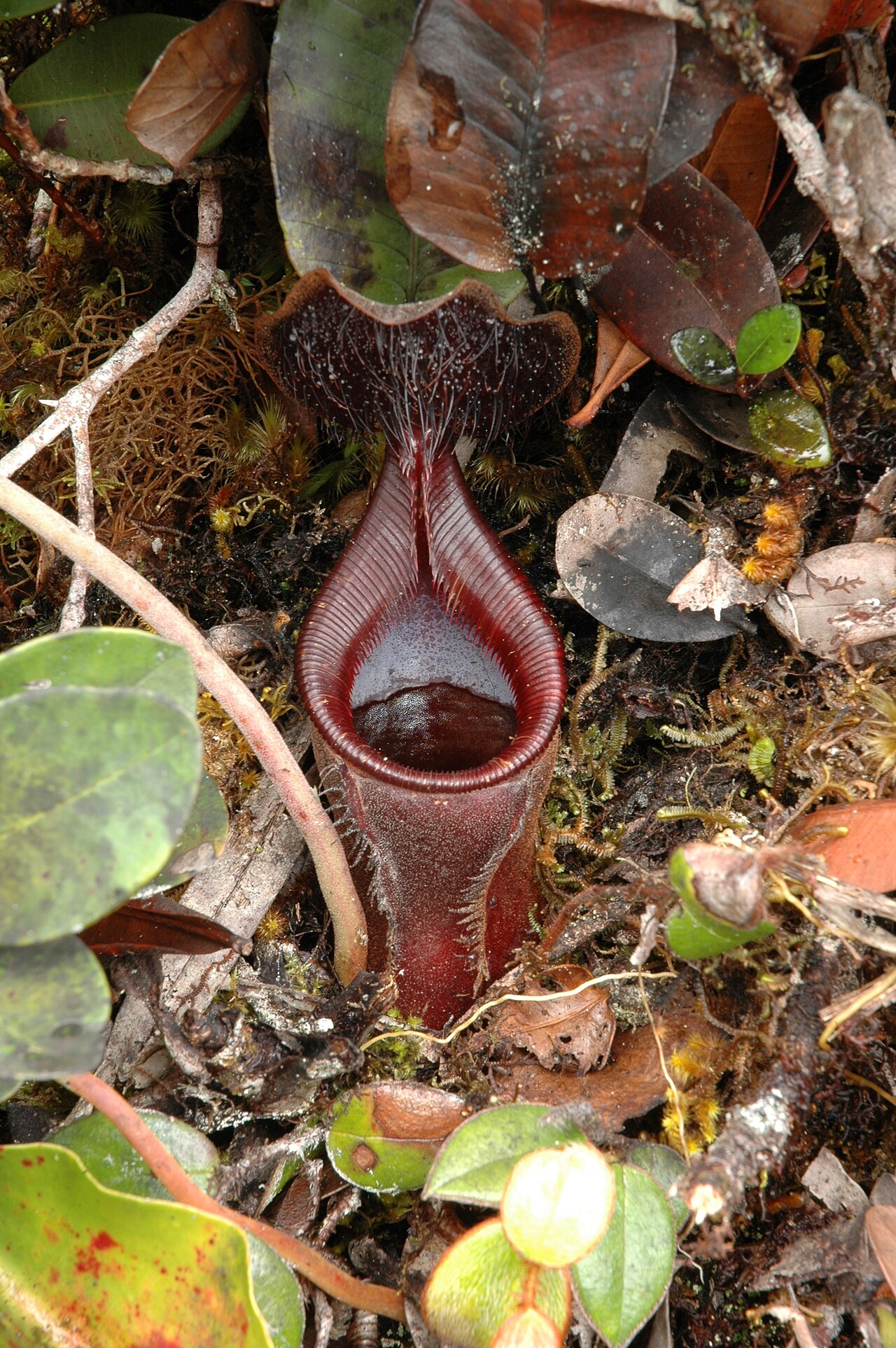
A climber with an almost hairless stem over ten metres long and up to 20 mm thick. The leaf is oblong-lanceolate, up to 30 by 9 cm, on a petiole clasping the stem for two-thirds to four-fifths of its circumference. The two pitcher types look nothing alike. The lower pitchers are small, up to 10 by 4 cm, bulbous at the base and swollen in the middle, with a cylindrical peristome up to 12 mm wide carrying distinct teeth and ribs. The upper pitchers reach 28 by 10 cm, globose at the base, sharply constricted at the waist and funnel-shaped above; the wings are reduced to ribs and little is left of the peristome but a rim around the mouth. The vaulted lid, up to 15 by 9 cm, is held well back from the mouth and bears on its underside a dense brush of stiff bristles up to 2 cm. The pitchers are rigid, almost woody, and keep their shape even when dry. The inflorescence is a raceme with a peduncle to 20 cm and a rachis to 25 cm, the flowers set in pairs.
Similar species
The lid settles it: no other Nepenthes carries such a brush of stiff bristles beneath the lid. The nearest thing to it is N. macrophylla of Mount Trus Madi, which also holds its lid away from the mouth but has a heavily toothed peristome and a broader pitcher; on that same mountain grows the natural hybrid between the two, N. × trusmadiensis, exactly intermediate. On Kinabalu the neighbours are N. rajah, with far larger pitchers and the lid held over the mouth, and N. villosa and N. edwardsiana with their heavy toothed peristomes. Crosses with N. fusca and N. stenophylla do carry lid bristles, but fewer, and add a hairy stem that this species lacks.
The trap and how it works
The lower pitchers still do what a pitfall trap does: they sit in the litter and take ants and other crawling prey. The upper pitchers have become something else. Inside they lack the waxy zone on which prey normally slips, and almost nothing is left of the peristome; the lid stands wide open and secretes, between its bristles, a white glandular exudate. The mountain tree shrew Tupaia montana climbs onto the pitcher, straddles the mouth to lick that exudate, and defecates into the pitcher while it does so. Clarke and co-workers found droppings in the pitchers at five of seven populations in 2009, and inferred from nitrogen ratios that mature plants take 57 to 100 per cent of their foliar nitrogen from that source. Chin, Moran and Clarke showed in 2010 that the distance from mouth to exudate matches the body length of the animal: it cannot reach from any closer than astride the opening. At night the summit rat Rattus baluensis has been filmed on the pitchers too. The evidence goes no further than that: how many pitchers are actually visited varies greatly from mountain to mountain.
Habitat and ecology
Upper montane forest: mossy forest and the low, contorted growth of ridge crests, where the trees rise no more than a few metres and everything lies under a thick blanket of moss. The plant grows there both on the ground and epiphytically in that moss, which serves at once as sponge and as rooting medium. The rock beneath matters little — ultramafic, sandstone, granite and limestone have all been recorded — as long as it is poor and the peat layer over it is deep. Cloud passes through daily: high humidity, little sun and cold nights.
Distribution and elevation
Endemic to Borneo, and there confined to separate summits standing island-like above the lowlands. In Sabah on Mount Kinabalu, Mount Tambuyukon, Mount Trus Madi, Mount Alab, Mount Mentapok and Mount Monkobo; in Sarawak on Mount Mulu, Mount Murud, Mount Api, Bukit Batu Lawi and in the Hose Mountains, among others; in Brunei on Bukit Pagon. The altitudinal range runs from about 1,650 to 2,600 metres, everywhere above the cloud base. The distribution data give no more than 'Borneo' as a region; within that island the species is restricted to these summits, each carrying its own small population.
- Recorded (one-degree cells)
Forms and variation
No varieties are recognised. What varies is pitcher colour — from green with red-brown markings to almost wholly dark red — and the length and density of the lid bristles, and that differs mainly from mountain to mountain: each summit holds a population that has long had no exchange with the others. The real variation lies in the natural hybrids, and they are numerous: N. × trusmadiensis with N. macrophylla, further crosses with N. fusca, N. stenophylla, N. veitchii, N. hurrelliana and N. muluensis, and a single find with N. rajah along the Mesilau trail.
Where and when to see it
Kinabalu Park is the only place where the species can be seen without an expedition: along the Mesilau trail and higher up the summit path. Do not count on it standing where it once stood — the drought of the 1997–1998 El Niño and the traffic of climbers have thinned the plants along the summit trail badly. Look up: the upper pitchers hang from climbing stems in the crowns of the low mossy forest, while the rosette with its small lower pitchers disappears down in the moss. Stay on the path; collecting is forbidden in the park.
Conservation status
Vulnerable on the Red List and, like all Nepenthes, listed in CITES Appendix II. The range is small and fragmented: some fifteen summits, each with a population that will not be replenished if it is lost. The largest stand in Kinabalu Park, where collecting is an offence; Clarke for that reason called the species conservation dependent in 1997. The threats are digging for the trade, drought years such as 1997–1998 that emptied whole slopes, and on the visited trails the trampling itself. Most of the other summits have simply not been counted often enough to know how it stands.
Scientific name
Nepenthes lowii | J.D. Hooker, 1859
Nepenthes lowii was described in 1859 by Joseph Dalton Hooker, in The Transactions of the Linnean Society of London; the original description and illustration were later reproduced in Spenser St. John's book Life in the Forests of the Far East (1862). The type material was collected by Hugh Low and is held at the herbarium of the Royal Botanic Gardens, Kew. Mount Kinabalu, Borneo, at 1,800-2,400 m elevation ("6,000-8,000 feet" in the original publication). The species is named after Hugh Low, who discovered it in March 1851 during his first ascent of Mount Kinabalu.
World Checklist of Vascular Plants (WCVP), via Plants of the World Online (POWO), Royal Botanic Gardens, Kew.