All species › Caryophyllales › Tropical pitcher plant family › Nepenthes bicalcarata
Nepenthes bicalcarata
The heaviest plant of the genus, with the thickest stem and the largest leaves — but not the largest pitchers. What makes it unique hangs beneath the lid: two sharp thorns, found on no other pitcher plant. And in its hollow tendrils lives an ant that occurs nowhere on earth without this plant.
Identification
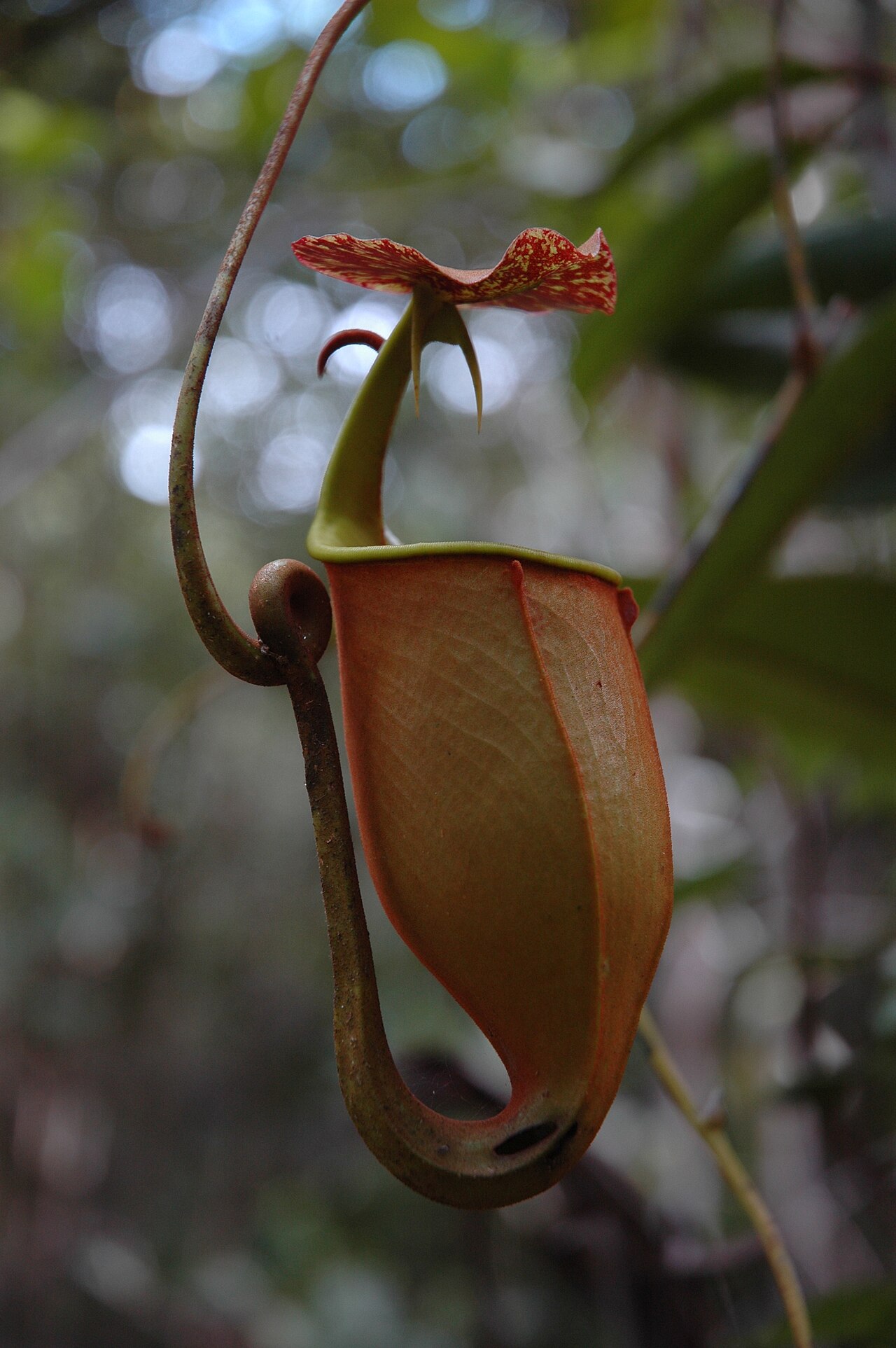
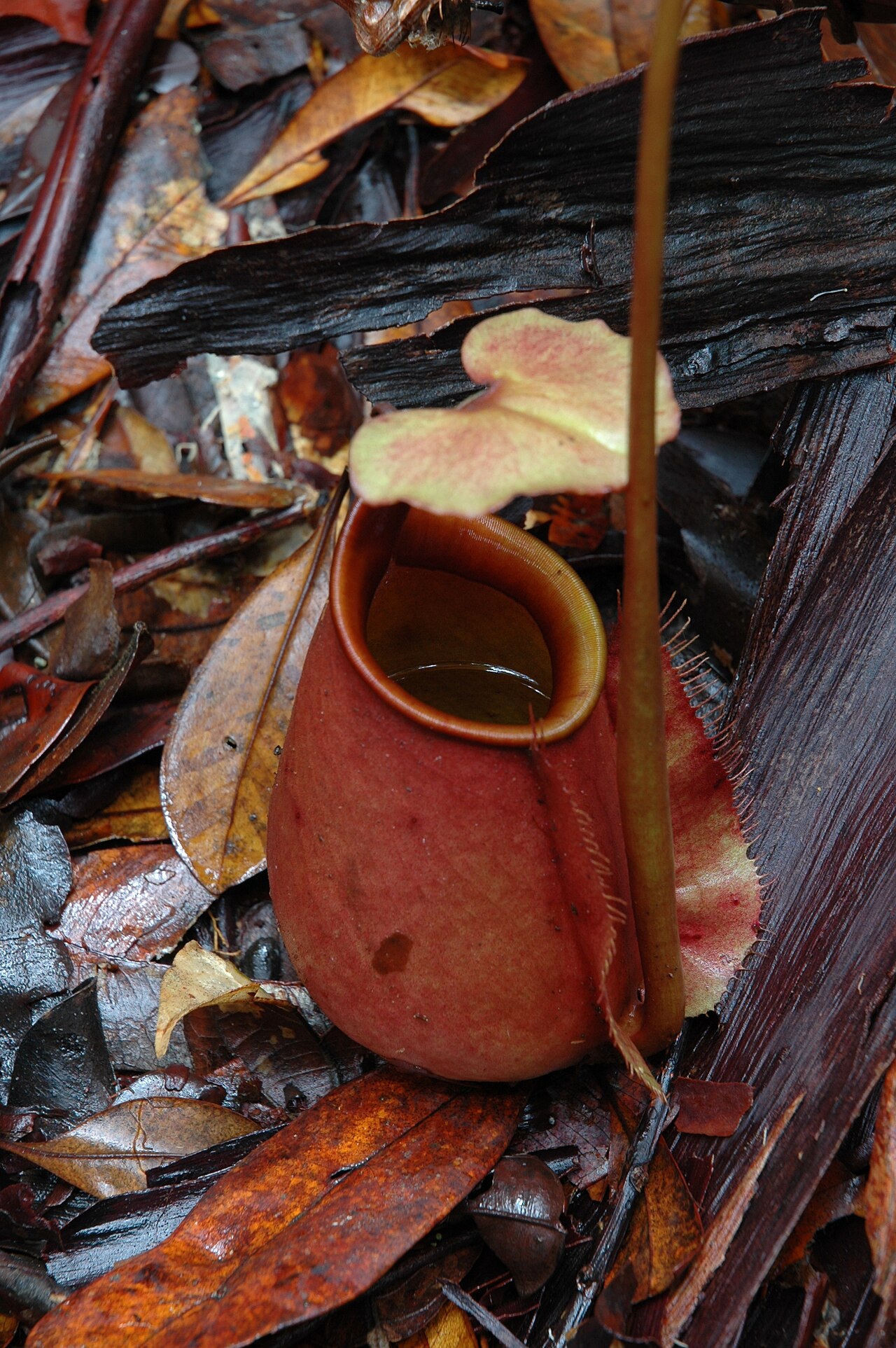
A heavy liana that climbs high into the trees. The stem is the thickest in the whole genus, up to 3.5 cm, with internodes up to 40 cm; the leaves are leathery and oblanceolate, up to 80 cm long and 12 cm wide. The pitchers are modest for such a plant: up to 25 cm high and 16 cm wide, holding more than a litre of fluid. The lower pitchers sit squat and broad on the forest floor, orange-red, with wide fringed wings down the front; the upper pitchers hang from the climbing stem, slimmer and more funnel-shaped, yellower to orange, with the wings reduced to ridges — two guises standing side by side on one plant. Both carry the mark: beneath the lid two hard, sharp thorns project up to 3 cm over the mouth, formed from two ribs of the rim. The rim itself is up to 20 mm wide, flattened and curved inwards. Nepenthes is dioecious; the inflorescence is a panicle with a peduncle to 40 cm and a rachis to 100 cm, shorter on female plants.
Similar species
With the thorns in view confusion is impossible: no other pitcher plant has them. Without them it is harder. Young plants and rosettes resemble N. rafflesiana and N. ampullaria, with which it often shares the same stands of peat swamp forest; then watch the thickness of the stem and the broad flattened rim. There are hybrids as well — N. × cantleyi from a cross with N. gracilis, and others with N. ampullaria and N. rafflesiana — and these carry the thorns in reduced form, as two blunt knobs.
The trap and how it works
The trap works as in any pitcher plant, but this species contracts most of the work out to an ant. Colobopsis schmitzi, formerly called Camponotus schmitzi, nests exclusively in the hollow tendrils of this plant and occurs nowhere else. What the ant does has been worked out step by step. It walks over the slippery rim without falling in, dives and swims in the digestive fluid and hauls out large prey that would otherwise putrefy; it attacks prey trying to escape, so that the catch is held better; it keeps the rim clear of mould and grime, which experiment shows improves capture over the longer run; and it drives off the weevils that bore into developing pitchers, since plants without ants prove to suffer more damage. What the plant gives back is lodging in the tendril, nectar at the rim and access to the prey. And it gains nitrogen in return: isotope work shows part of the nitrogen in the leaf arrives by way of the ants, and occupied plants carry more leaves and more leaf area than unoccupied ones. What the two thorns are for is less certain. They bear nectar glands and jut out directly over the mouth, so that an animal licking at them hangs above the trap; it has also been suggested that they stop larger animals tearing the lid away to get at the catch.
Habitat and ecology
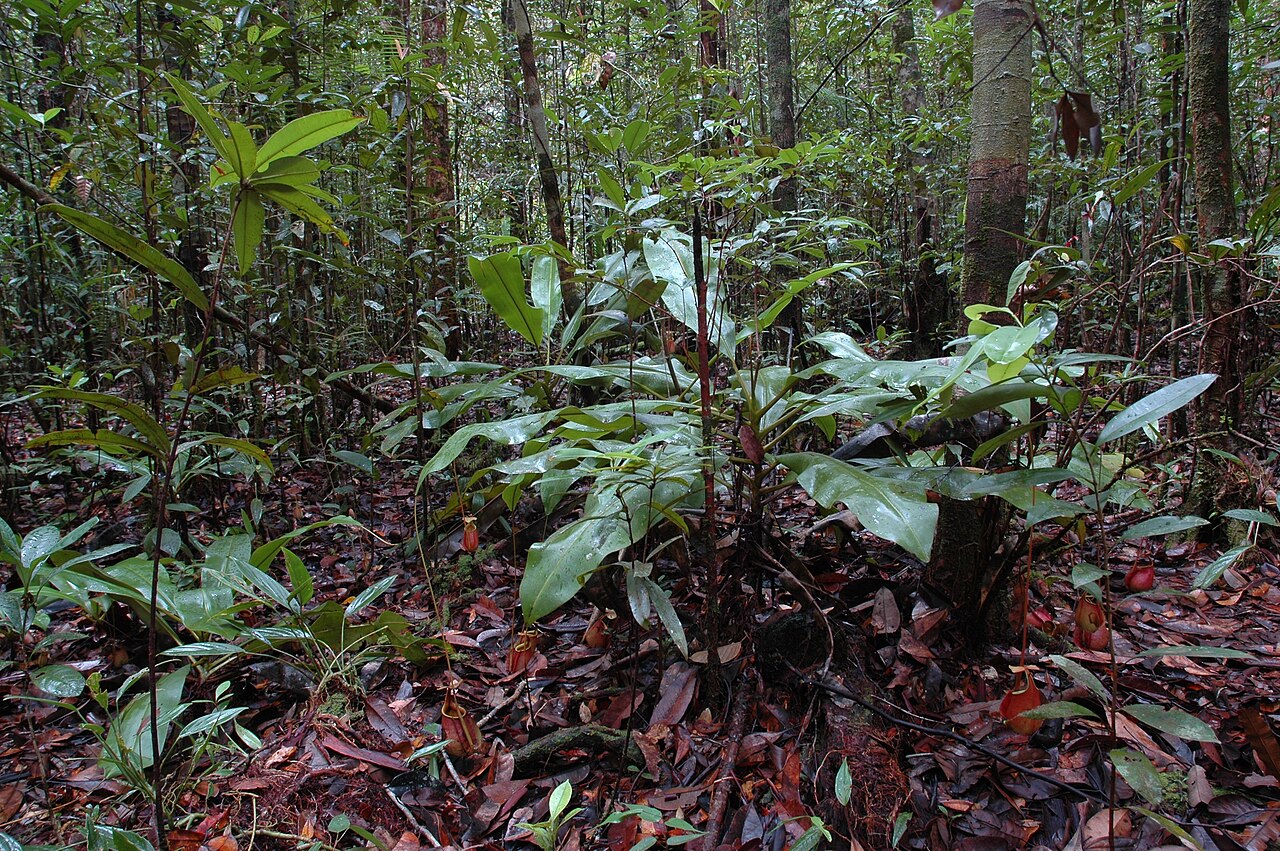
Lowland peat swamp forest, classically under Shorea albida, and besides that heath forest on white sand. The ground is waterlogged, acid and poor, and the plant roots only some 25 cm deep — below that the substrate is too toxic. Usually below 300 m, and no higher than about 950 m. That is a narrowly defined forest type, and it is precisely the forest type disappearing fastest in South-East Asia.
Distribution and elevation
Endemic to Borneo, and there most numerous in the peat swamp forest of the western side of the island. Outside Borneo it does not occur. The range is larger than that of the mountain species in this guide, but it is flat, low and easily reached, and that is no advantage.
- Recorded (one-degree cells)
Forms and variation
There is little to report on forms: variation is confined to pitcher colour, from yellow through orange to red, and to the length of the thorns, and that already differs within one stand. No varieties are recognised. What does stand in the wild are natural hybrids with relatives from the same swamp forest, known by reduced thorns and a slimmer pitcher.
Where and when to see it
Search the peat swamp forest of the western side, where several reserves have laid a boardwalk through the forest — otherwise you sink to the knee. Look first down at the squat pitchers on the peat and then up at the slender ones on the stem; they belong to the same plant. Then look at a pitcher's rim: if small ants are running over that slippery rim as though it were nothing, you have the whole story in front of you. Do not tear a pitcher open to see the ants; the nest is in the tendril and it will be destroyed.
Conservation status
Vulnerable on the Red List and, like all pitcher plants, listed in CITES Appendix II. The species itself is not heavily poached; it is its forest that is going. The lowland peat swamp forest of Borneo is being drained for plantation, logged and burned, and peat fire destroys not only the trees but the soil itself, which does not come back. And more than one species is lost with it: the ant that lives in the tendrils occurs nowhere else and goes with the plant.
Scientific name
Nepenthes bicalcarata | J.D. Hooker, 1873
Nepenthes bicalcarata was described in 1873 by Joseph Dalton Hooker in his monograph "Nepenthaceae", based on material collected by Hugh Low and Odoardo Beccari near the Lawas River in Borneo. The Lawas River in Borneo; the type material (Low s.n.) is held at the Royal Botanic Gardens, Kew. The name comes from Latin and means "two-spurred", referring to the characteristic pair of prominent thorns on the underside of the pitcher lid — hence also the common name "fanged pitcher-plant".
World Checklist of Vascular Plants (WCVP), via Plants of the World Online (POWO), Royal Botanic Gardens, Kew.