All species › Caryophyllales › Tropical pitcher plant family › Nepenthes ampullaria
Nepenthes ampullaria
A pitcher plant that lives largely on leaf litter. That sounds like a contradiction, and it very nearly is: of all the species in this guide, this is the one that runs closest to the line between a carnivore and an ordinary plant. It stays just inside it, and that is exactly why it is here — it shows where the line runs.


Natural hybrids
Identification
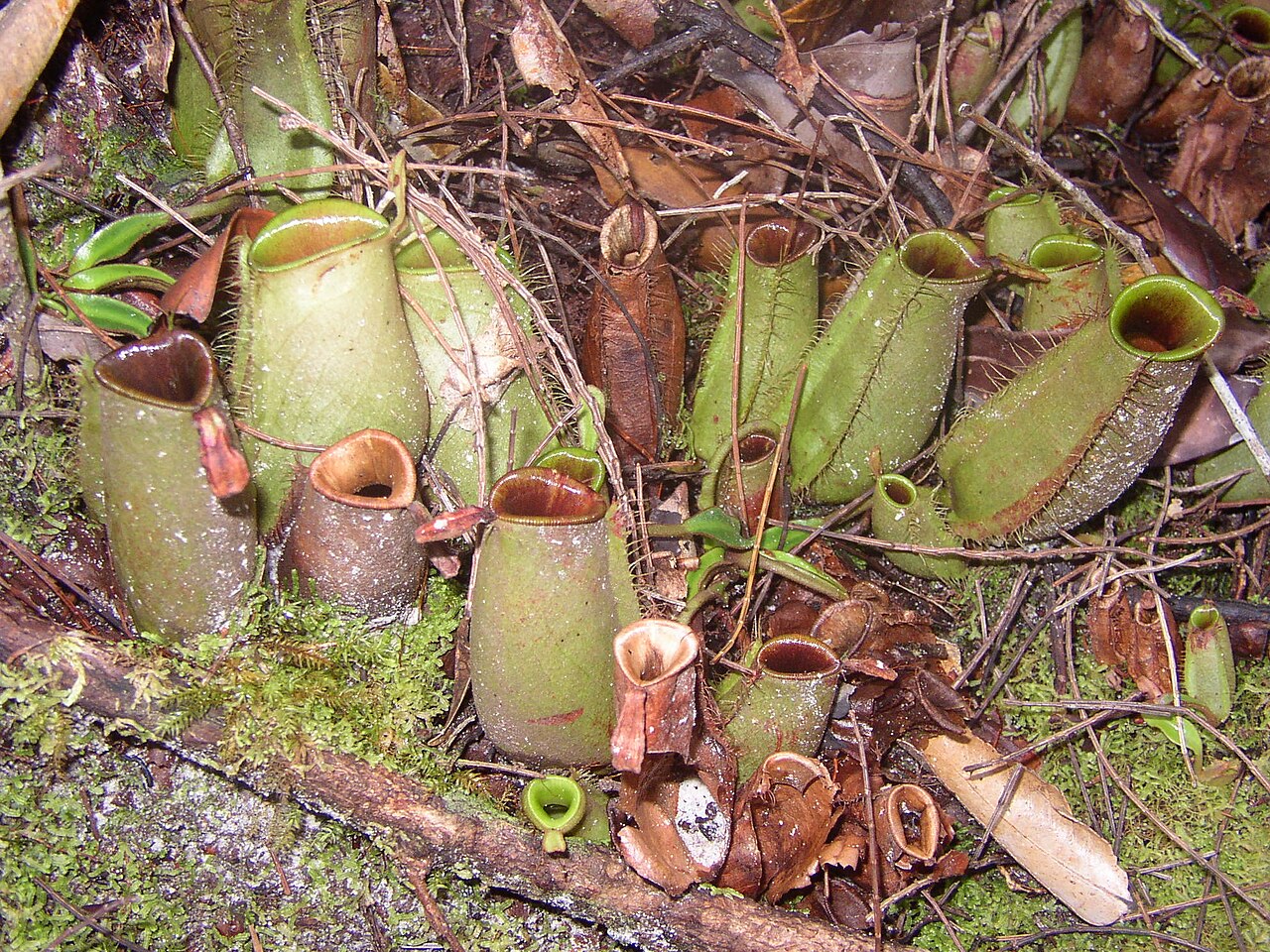
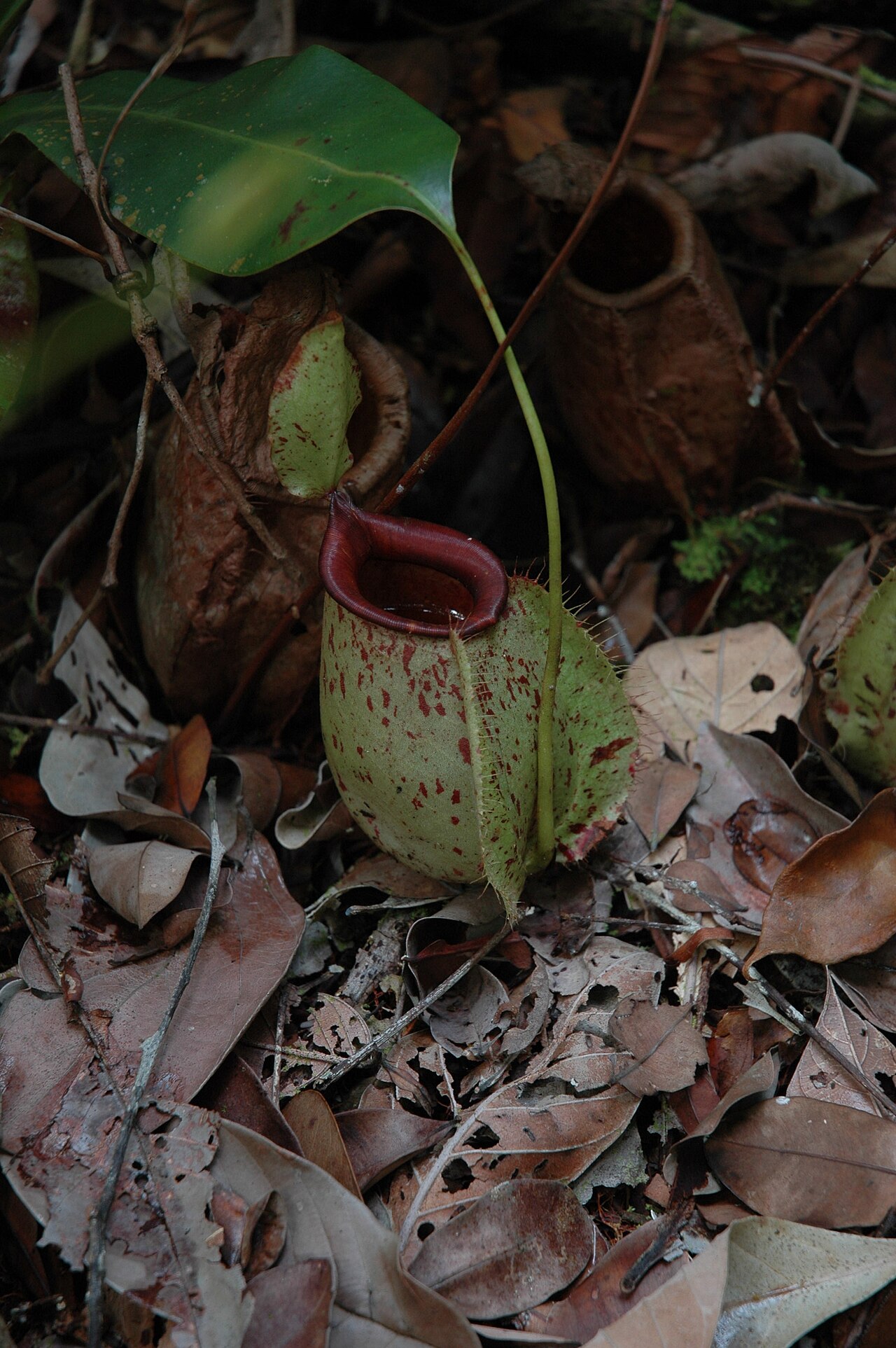
Do not look up, look down. The conspicuous pitchers of this species are not on the climbing stem but on the ground: from subsurface runners and shoots at the base of the plant come dense carpets of small squat jugs that can cover square metres of forest floor. They rarely exceed 10 cm in height and 7 cm in width, and run in colour from wholly light green to wholly dark red, with everything in between inside a single carpet. The lid is diagnostic: very small and reflexed outwards, so that it precisely does not cover the mouth. The rim is strongly incurved. Higher up it is a different plant: the light brown stem climbs to 15 m, carries leaves up to 25 cm long and 6 cm wide, and only rarely makes upper pitchers, which are then smaller still than those on the ground. The inflorescence is a dense panicle rather than the raceme most species have; Nepenthes is dioecious, so male and female panicles stand on different plants.
Similar species
No other pitcher plant carpets the forest floor with squat little jugs, and the reflexed lid alone settles it. The hybrids are harder, for the species crosses with nearly everything it grows beside: with N. rafflesiana that gives N. × hookeriana, with N. gracilis another cross, and more than a dozen have been described. In a hybrid the lid is always larger and does cover the mouth, and the pitchers are slimmer and taller. Watch the inflorescence too: a dense panicle points to this species or a cross with it.
The trap and how it works
Here is the interest of the thing. The reflexed lid lets rain and leaf litter fall straight into the pitcher, and the carpets sit exactly where litter from the canopy lands. Bacteria and mosquito larvae break that litter down and the plant takes up the nitrogen released. How much has been measured: a study in 2003 put plants under closed canopy at 35.7 per cent of their foliar nitrogen from leaf litter, and later work went higher — over 40 per cent in the leaf and nearly 55 per cent in the pitcher itself. The structure points the same way: the lid lacks the nectar glands with which other species lure insects. Yet this is not a plant that has given up carnivory. The whole apparatus is still there and still works: slippery rim, waxy inner wall, glands secreting digestive fluid, and insects are indeed caught and digested. What it has done is take on a second income, in a forest where leaf litter is endless and insects are scarce. Hence its place in this guide: the borderline case showing that the trap is the criterion, not the menu.
Habitat and ecology
Damp, shaded lowland forest: heath forest on white sand (kerangas), peat swamp forest and degraded swamp forest, and in New Guinea also Araucaria forest. It stands in shade rather than sun, and precisely where the leaf litter gathers. From sea level to 2100 m, but its weight lies low: in Borneo it stays almost entirely below 1000 m.
Distribution and elevation
Widespread across the wet half of South-East Asia and beyond: Thailand, the Malay Peninsula, Sumatra, Borneo, the Moluccas and New Guinea, with a great many smaller islands in between. That is the largest range of the four pitcher plants in this guide, and it explains why it stands in numbers locally where rarer species must make do with a handful of plants.
- Recorded (quarter-degree cells)
Forms and variation
The variation lies almost wholly in pitcher colour, and that runs from light green to nearly blackish red within a single carpet; no varieties are recognised, and the colour names that circulate in the trade are cultivars. What can be seen in the wild are hybrids: over a dozen have been described, with N. rafflesiana, N. gracilis, N. mirabilis and N. bicalcarata among others. They stand plainly between their parents and are known by the larger lid.
Where and when to see it
Look down. This species is overlooked because people search the trees for pitcher plants while the carpets lie under the litter; sweep a hand through the leaf layer beside a forest path in peat swamp or heath forest and the jugs appear. Findable all year. Look into the pitchers without pulling them loose: they often hold an entire community, from mosquito larvae to one of the smallest frogs of the Old World, which rears its tadpoles in them.
Conservation status
Least Concern on the Red List and, like all pitcher plants, listed in CITES Appendix II. That judgement rests on the large range and on the numbers: where it grows, it often grows in carpets. But the forest it grows in is going fast. Peat swamp and heath forest in Borneo and Sumatra are being drained, logged, burned and turned into plantation, and in such places it goes with them. A species can be widespread and locally exterminated at the same time; that is the case here.
Scientific name
Nepenthes ampullaria | Jack, 1835
Described by William Jack in 1835. The species occurs on Borneo, Sumatra and the Malay Peninsula. The name derives from the Latin ampulla (flask) and refers to this species' flask-shaped pitchers.
World Checklist of Vascular Plants (WCVP), via Plants of the World Online (POWO), Royal Botanic Gardens, Kew.