All species › Caryophyllales › Tropical pitcher plant family › Nepenthes khasiana
Nepenthes khasiana
The only pitcher plant of India, and of the whole genus the one that reaches furthest west: everything further east belongs to another world. It grows in the hills of the north-east, where the monsoon rains for months on end, and there it has earned names that say what people made of it — tiew-rakot to the Khasi, demon flower, and memang-koksi to the Garo, the devil's basket.
Identification
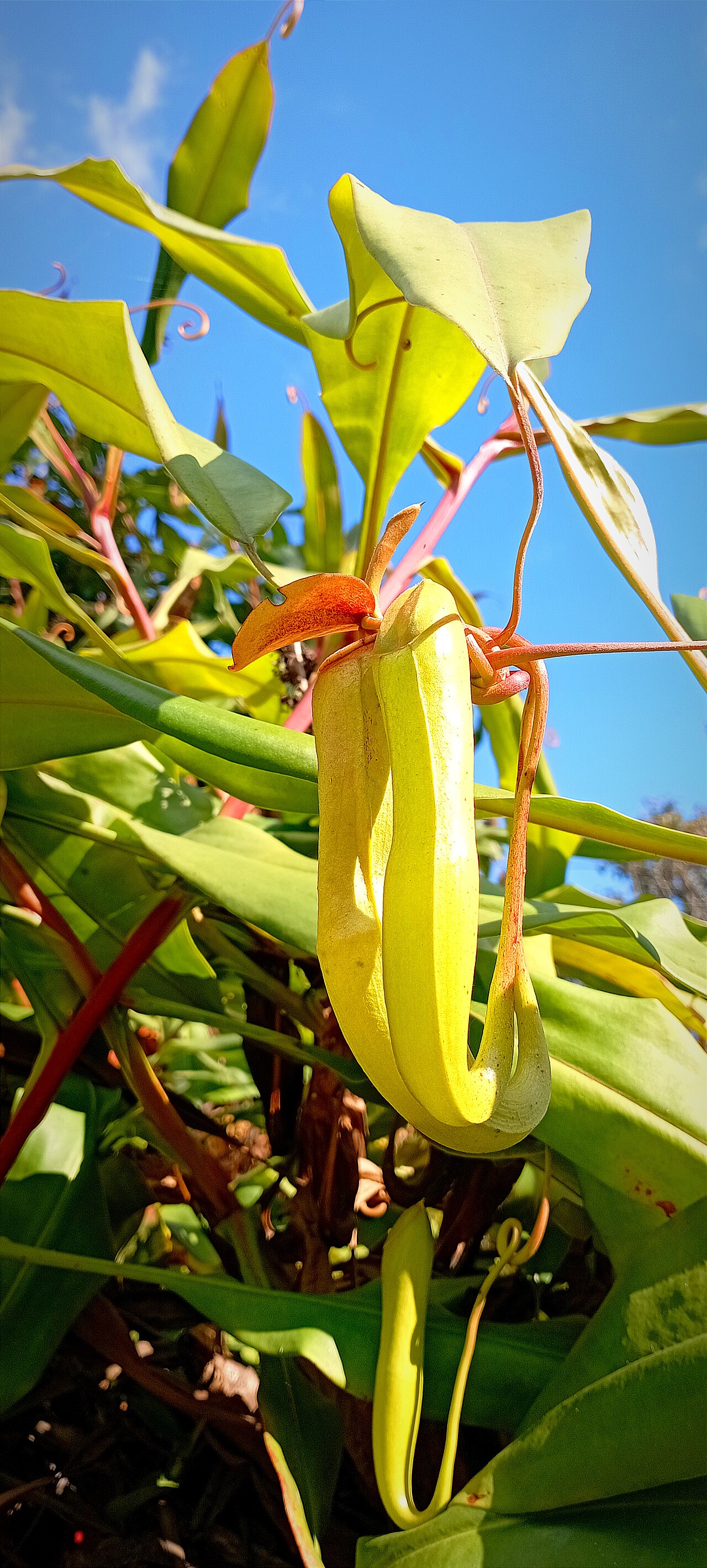
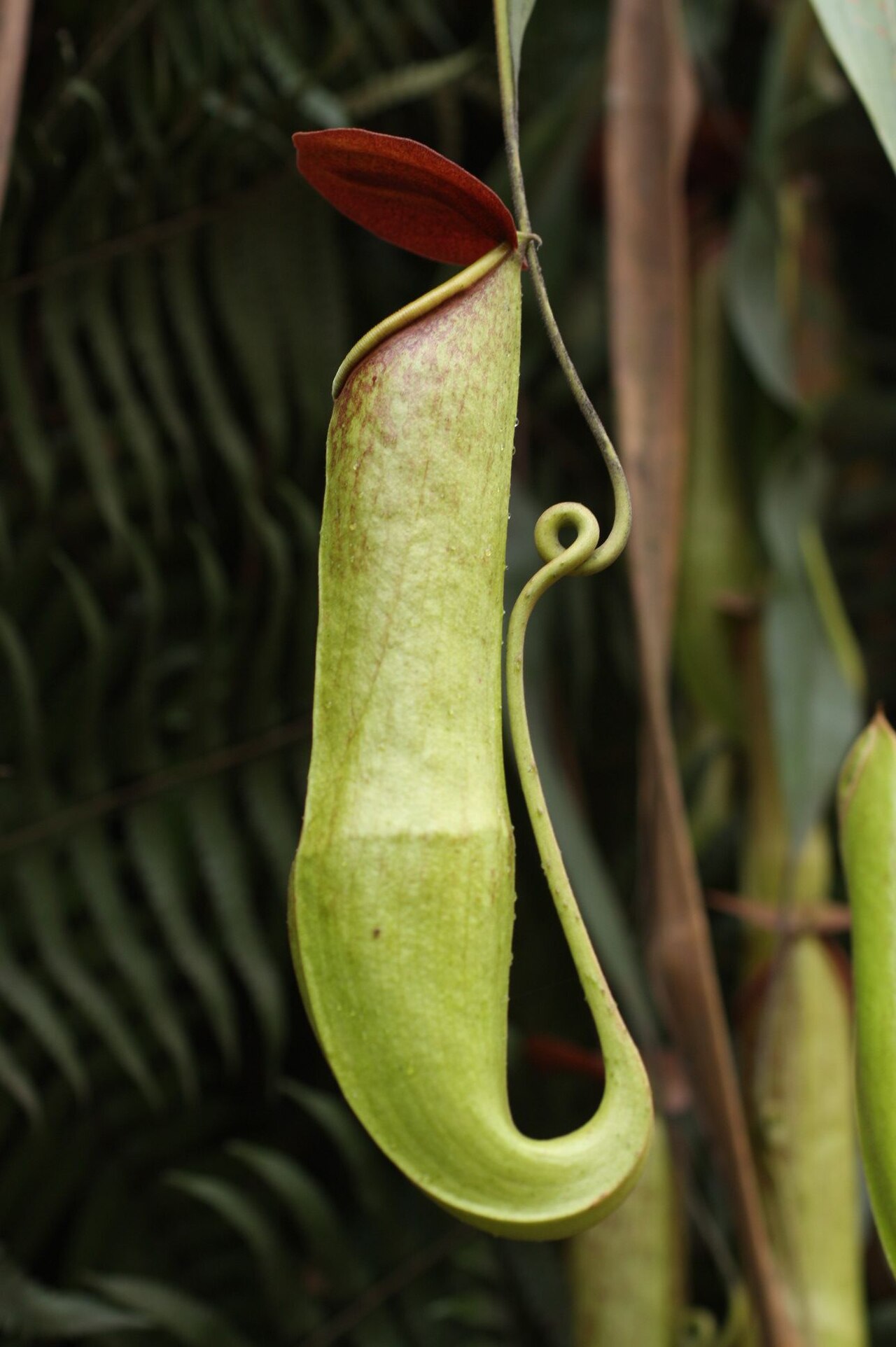
A climber that works its way up through scrub and forest edge on a woody stem; young plants stay a ground rosette for years. The leaves are oblong to lanceolate and taper at both ends. Low on the plant the lower pitchers hang just above the soil: bellied at the base, cylindrical above, green with red-purple speckling or blotches, with a narrow ribbed rim and two fringed wings down the front. Higher up the picture changes entirely — the upper pitchers are slender, funnel- to tube-shaped, paler, and the wings are reduced to two ridges; anyone who knows only those will walk straight past the pitchers on the ground. The lid is rounded to ovate and covers the mouth. Nepenthes is dioecious: there are male and female plants, and you will never see both kinds of flower on one.
Similar species
Confusion with another pitcher plant is impossible in the field, because there is none: this is the only Nepenthes of the Indian subcontinent, and its nearest relative stands far to the east. What does confuse is cultivated material. South-East Asian species and hybrids now stand in gardens and along roads in the region, and they part from the wild plant on rim and lid. And a young rosette without pitchers is barely distinguishable in the grass from any other herb.
The trap and how it works
An ordinary pitfall, and an efficient one: the rim goes slippery in wet weather, the upper inner wall carries a waxy layer that gives no purchase to a foot, and an acid fluid with digestive enzymes stands in the bottom. The catch is almost entirely insects, ants, flies and beetles foremost. Each pitcher also holds a small company of animals that thrive there instead — mosquito larvae, fly larvae, mites — and that help break the prey down. Unlike some of its relatives, this species shows no sign of anything but animals on the menu. The fluid from unopened pitchers has long been used locally as a medicine, and that is one reason the plant gets picked.
Habitat and ecology
Open slopes and forest edges in the subtropical hills, roughly between 500 and 1500 m. The soil is poor, acid and sandy to lateritic, and the plant seeks the places where water seeps out or lies: ditch banks, wet grassy patches, boggy ground in open scrub. It wants light and vanishes as soon as forest closes over it; at the same time it will not stand broken or fertilised ground. Fieldwork in Meghalaya brings out a clear preference for north-west-facing slopes, which hold their moisture longer.
Distribution and elevation
The hills of north-eastern India: the Khasi, Jaintia and Garo Hills of Meghalaya, with scattered sites in adjoining Assam and Nagaland, and on into the border country with Bangladesh. These are not continuous populations but separate colonies on ridges far apart. Beyond that the species does not occur in the wild.
- Recorded (one-degree cells)
Forms and variation
Little variation has been recorded. What does differ — the degree of red-purple speckling on the pitcher, the width of the rim — already differs from plant to plant within one colony, and there are no recognised varieties and no natural hybrids: there is simply no second species nearby to cross with. That is also a weakness, for the surviving colonies are small and cut off from one another, and genetic work shows little difference between populations.
Where and when to see it
Look in the wet season, when the pitchers are full and fresh; by the end of the dry months most have shrivelled. The plant stands on open sloping ground at the forest edge and along ditches — so search low, not in the canopy. Almost all wild colonies lie on village community land; ask permission and go with someone from the village. There are also managed plots and botanic gardens in the region where the species can be seen without putting weight on a wild site. Pick nothing and draw no fluid from the pitchers.
Conservation status
Endangered on the Red List and, with N. rajah, the only pitcher plant in CITES Appendix I: international trade in wild plants is forbidden. The reason is a small range plus heavy pressure. Coal mining and the acid drainage it produces have made whole hillsides uninhabitable; then limestone quarrying, road building, fire and conversion to farmland. And the plant itself is picked, for the ornamental trade and for the pitcher fluid as medicine. What remains are small, fragmented colonies, each vulnerable on its own.
Scientific name
Nepenthes khasiana | J.D. Hooker, 1873
Nepenthes khasiana was described in 1873 by Joseph Dalton Hooker, in his monograph "Nepenthaceae" (Prodromus Systematis Naturalis Regni Vegetabilis). The species occurs in isolated populations across several areas, including the Jarain area of the Jaintia Hills, the Baghmara area of the Garo Hills (adjacent to the Khasi Hills in Meghalaya), the Upper Kharthong area of Dima Hasao district (Assam) and parts of Nagaland, India; the Khasi Hills themselves are regarded as the primary, namesake locality. The specific epithet derives from the Khasi Hills, the region in north-eastern India to which the species is largely endemic.
World Checklist of Vascular Plants (WCVP), via Plants of the World Online (POWO), Royal Botanic Gardens, Kew.