All species › Caryophyllales › Tropical pitcher plant family › Nepenthes rajah
Nepenthes rajah
No plant on earth builds a bigger trap. A full-grown lower pitcher of this species is a bucket forty centimetres tall holding more than three litres, and pitchers have been found with a drowned rat inside. It grows on two mountains in Sabah and nowhere else, on ground so loaded with nickel and chromium that almost nothing else endures it.

Natural hybrids
Identification
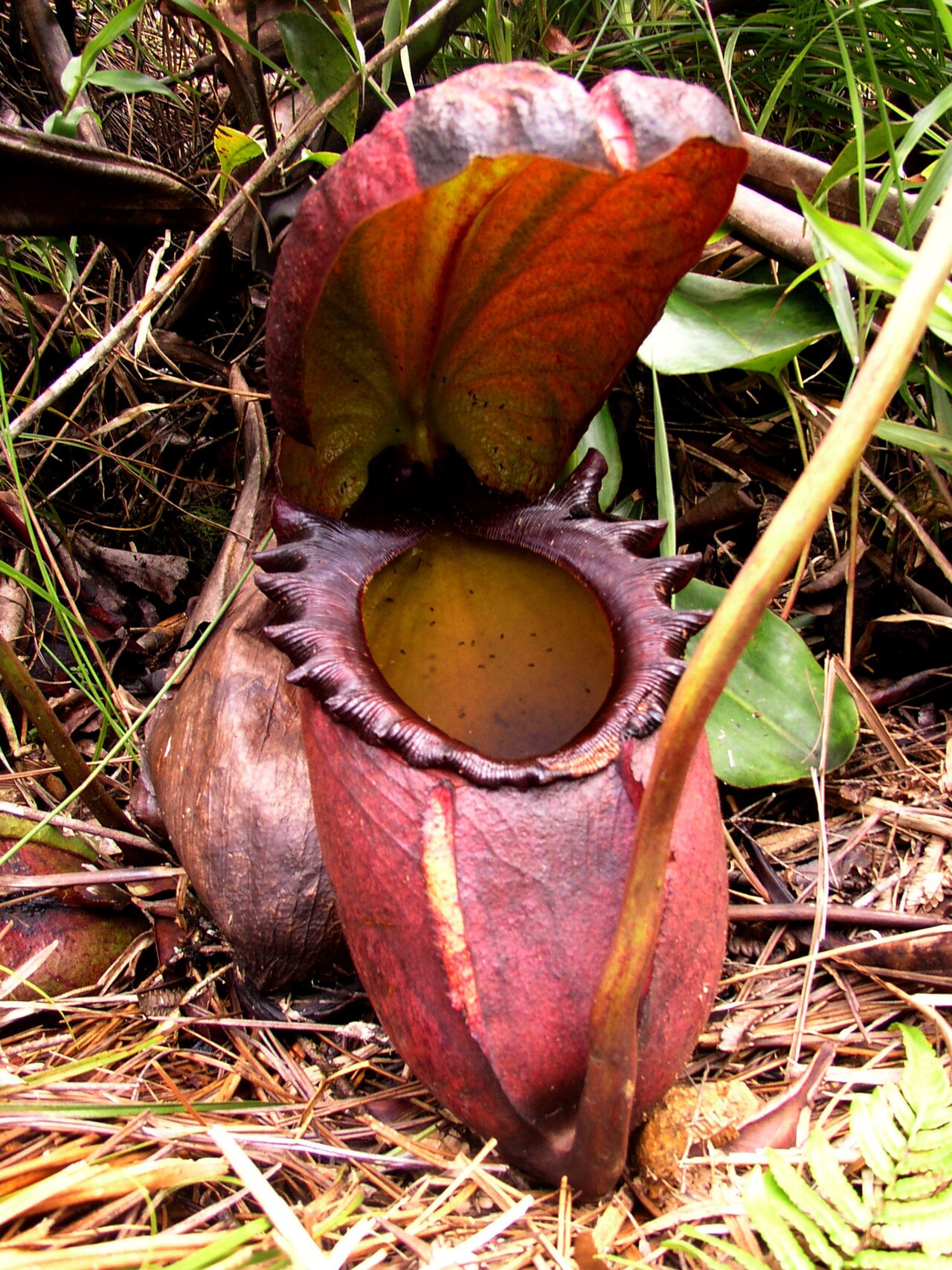
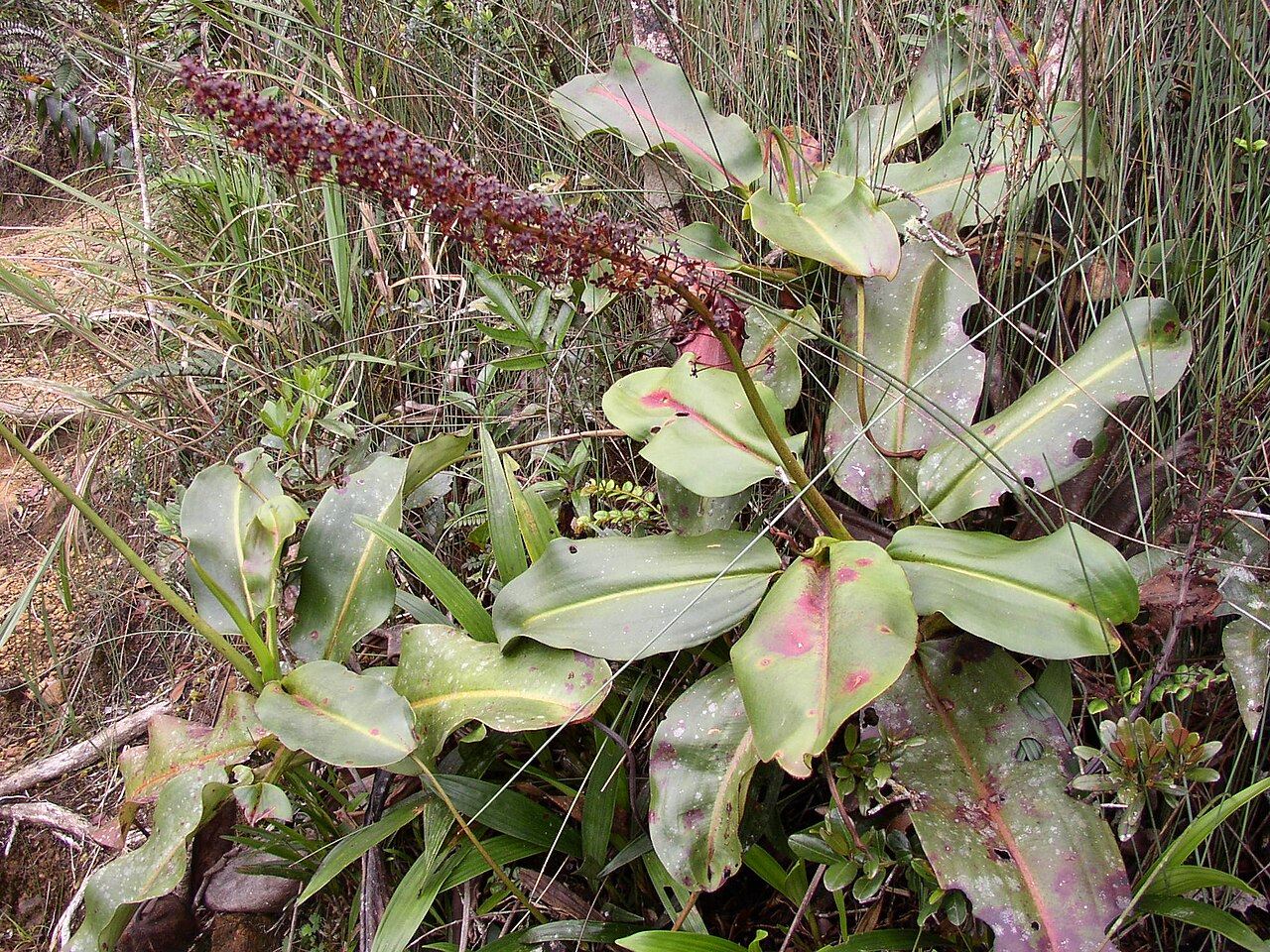
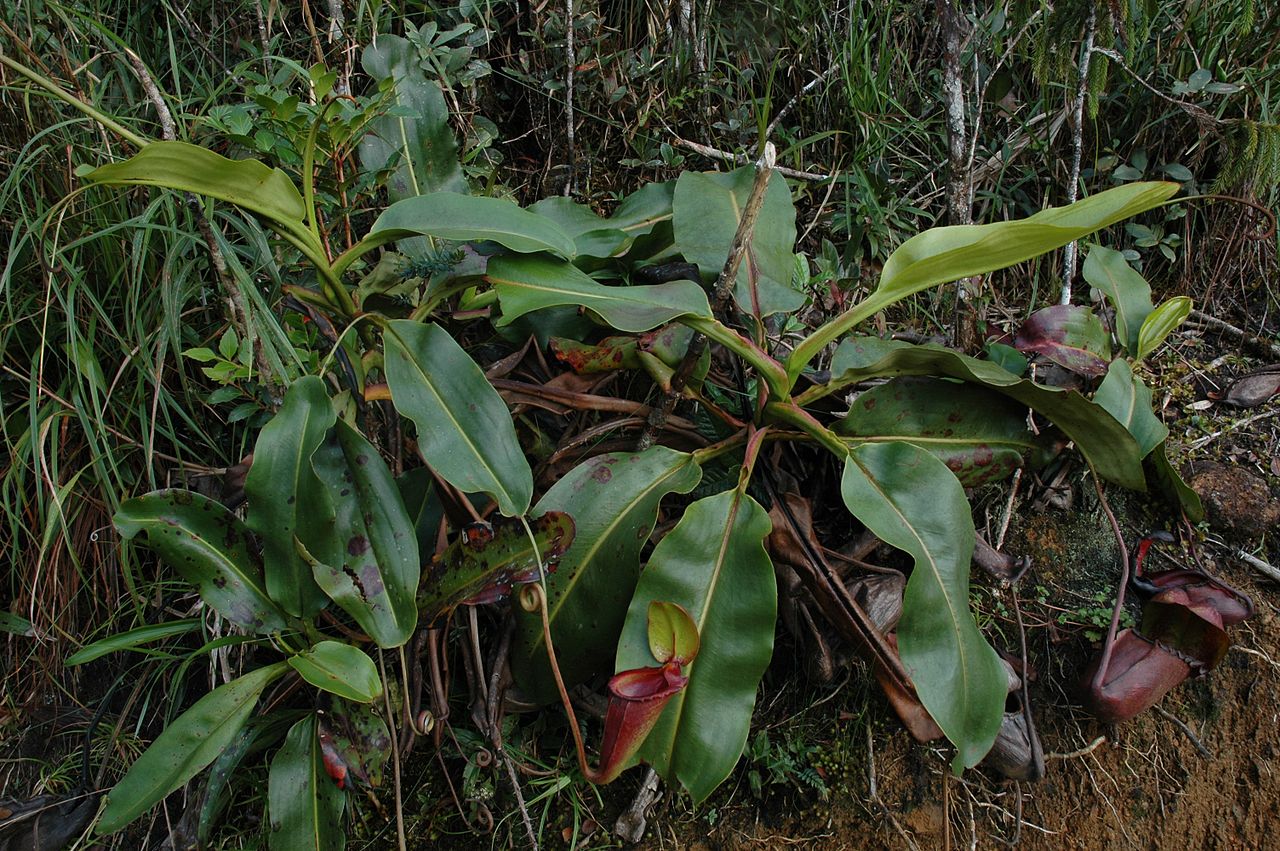
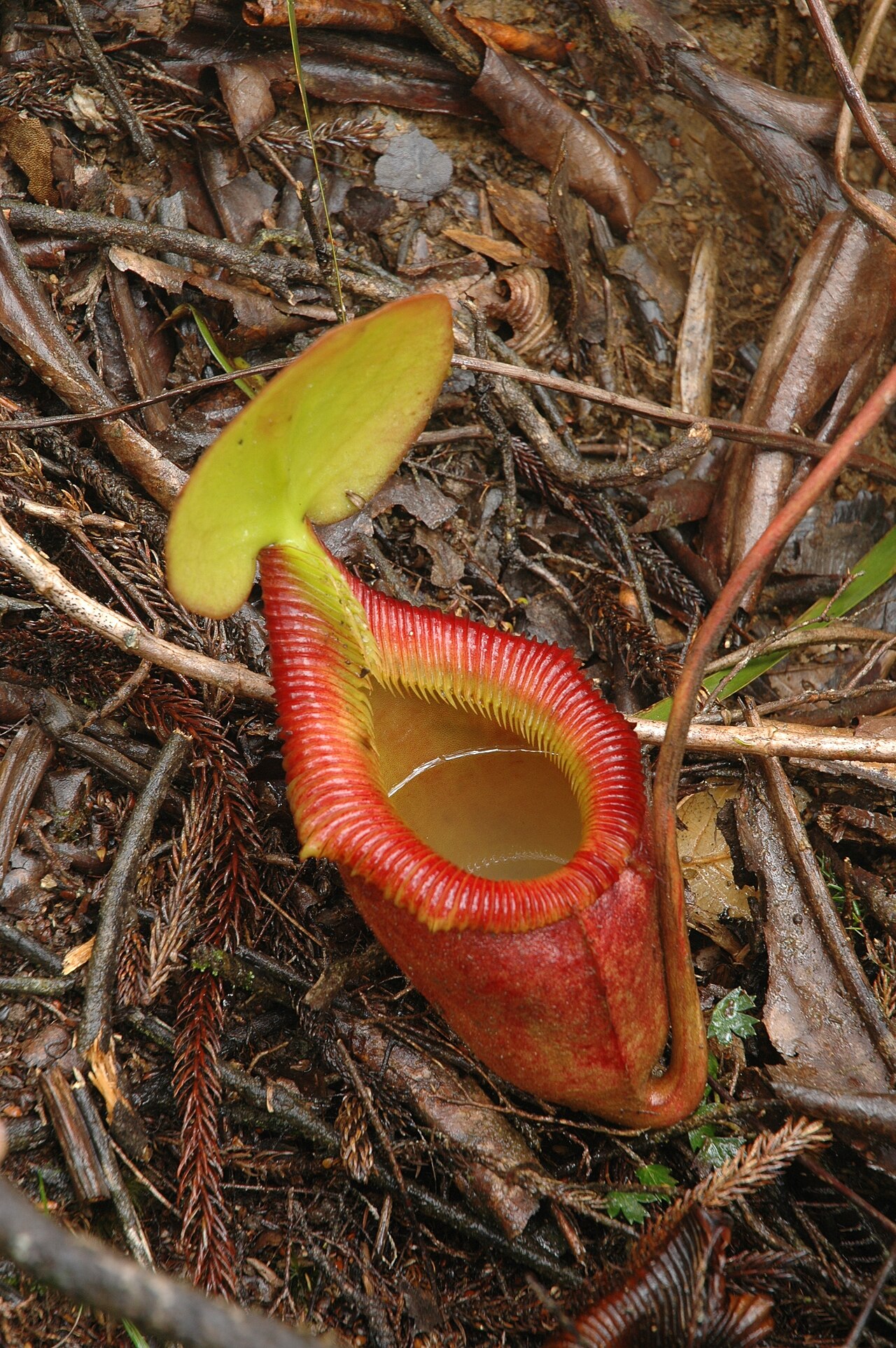
A heavy plant with a creeping to low-climbing stem of at most 6 m, up to 3 cm thick. The leaves are leathery, up to about 80 cm long, and peltate: the tendril springs from the underside a few centimetres below the tip rather than from the tip itself, and reaches some 50 cm. At the base of the plant the lower pitchers sit on the ground, ovoid to urn-shaped, up to 41 cm high and 20 cm wide, red-purple outside and green within, with a broadly flared ribbed rim whose outer edge undulates like a scalloped collar, and a large oval lid held upright and thrown back. Upper pitchers are rare, because the stem seldom grows long enough to carry them: they are funnel-shaped, smaller and more vividly coloured, and anyone who knows only those will not recognise the plant on the ground. Nepenthes is dioecious — male and female flowers stand on separate plants — and the inflorescence is a branched raceme up to 80 and sometimes 120 cm tall bearing brownish-yellow flowers whose sepals reach 8 mm.
Similar species
Other pitcher plants share these slopes, and at a distance they are not to be told apart. Nepenthes villosa has smaller pitchers with an enormous, heavily toothed rim that curls inward like a screw thread; N. burbidgeae is pale with red-purple speckling and a far narrower rim. The real difficulty is the hybrids: this species crosses with practically every pitcher plant beside it, and both N. × alisaputrana and N. × kinabaluensis inherit something of the scalloped rim. When in doubt take the combination: a scalloped, broadly flared rim on a pitcher forty centimetres tall belongs to this species alone.
The trap and how it works
The pitcher is a classic pitfall — slippery rim, waxy inner wall, digestive fluid below — and the great bulk of the prey is simply insects, ants above all. What made the species famous is something else. The plant secretes nectar on the underside of its upright lid, and the distance from the pitcher mouth to that nectar matches the body length of the mountain treeshrew Tupaia montana exactly. Camera traps on the mountain recorded what follows: the treeshrew licks at the lid by day and defecates into the pitcher, and by night the much shyer summit rat Rattus baluensis does the same. The droppings supply nitrogen. So the evidence is geometric (the pitcher fits the animal), photographic (the animals were caught at it) and chemical (the nitrogen demonstrably arrives) — not anecdote. One other Bornean mountain species, N. lowii, does the same. The drowned rats occasionally found in a pitcher are no part of this story: those are accidents.
Habitat and ecology
Upper montane forest and the open, stunted vegetation above it, between 1500 and 2650 m. The species grows exclusively on ultramafic ground — serpentine soil rich in nickel and chromium — and within that on the seepages where groundwater surfaces and the soil stays loose and permanently wet. That soil is toxic to most plants, and therein lies the gain: the competition stays away. High on the mountain night temperatures approach freezing and daytime maxima rarely pass 25 degrees, with fierce sun, hard wind and days of cloud by turns.
Distribution and elevation
Endemic to Borneo, and within it confined to the Kinabalu massif and neighbouring Mount Tambuyukon in Sabah. That is the whole range: a handful of square kilometres of suitable serpentine ground on two mountains. Outside it the species has never been found wild; what circulates elsewhere comes from tissue culture.
- Recorded (one-degree cells)
Forms and variation
There is little to report on forms: within populations it is chiefly the degree of red colouring and the shape of the rim that vary, and no varieties are recognised. What does exist are natural hybrids — the species crosses with nearly every other pitcher plant on the mountain, and its pollen has been shown to travel some ten kilometres. Those hybrids arose in the wild and belong to the field picture; the many names that circulate in the trade do not.
Where and when to see it
Do not go looking. The species stands at a few spots on two mountains, and those spots are not broadcast, for good reason. Within the national park covering the massif there is one managed site where visitors can see it in its own surroundings; ask at the park gate and go with a guide. Look at the ground: the great pitchers sit low, among moss and roots, and the upright lid catches the eye sooner than the pitcher does. Do not look into a pitcher with your hand inside it — the rim is slippery and the fluid smells of what has been drowning in it for weeks.
Conservation status
Endangered on the Red List and, with N. khasiana, the only pitcher plant in CITES Appendix I: trade in wild plants is forbidden, not merely regulated. That heavy listing dates from the 1970s, when collectors stripped whole colonies; the CITES listing followed in 1981. The pressure has since shifted. Tissue culture has made the plant cheap, which has largely ended the poaching, and the main threat now is damage to the habitat itself plus drought: the El Niño of 1997/98 tore holes in the mountain's pitcher plants. In Sabah the species is additionally protected under state wildlife law.
Scientific name
Nepenthes rajah | J.D. Hooker, 1859
Nepenthes rajah was described in 1859 by Joseph Dalton Hooker, in The Transactions of the Linnean Society of London. Hugh Low collected the initial specimen on Mount Kinabalu in 1858, which Hooker subsequently used for the formal description. Mount Kinabalu and Mount Tambuyukon, Sabah, Malaysian Borneo — the same mountains as earlier species in this series, including N. lowii (golf 26) and N. edwardsiana (golf 21). The species is named in honour of James Brooke, the first White Rajah of Sarawak; "rajah" means "king" in Malay. This name, combined with the plant's impressive pitcher size, led to it being called the "King of Nepenthes".
World Checklist of Vascular Plants (WCVP), via Plants of the World Online (POWO), Royal Botanic Gardens, Kew.