All species › Caryophyllales › Tropical pitcher plant family › Nepenthes mirabilis
Nepenthes mirabilis
The most widely distributed pitcher plant in the world, and thereby the counterweight to all the island endemics in this genus: from southern China to northern Australia, across virtually every island of the Malay Archipelago. And unlike its relatives, tied to a single mountain or a single sand flat, this one also simply stands by the roadside.
Identification
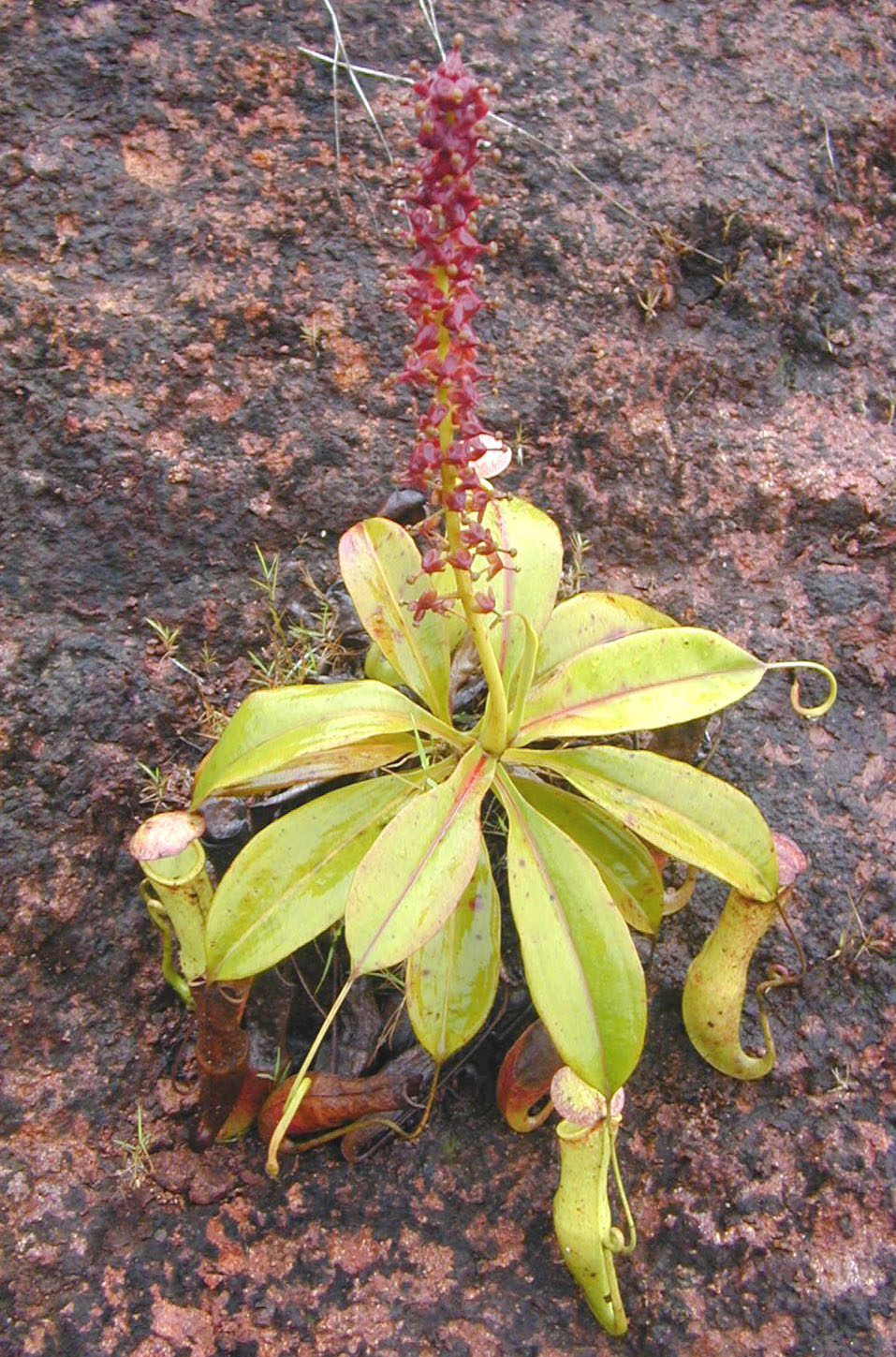
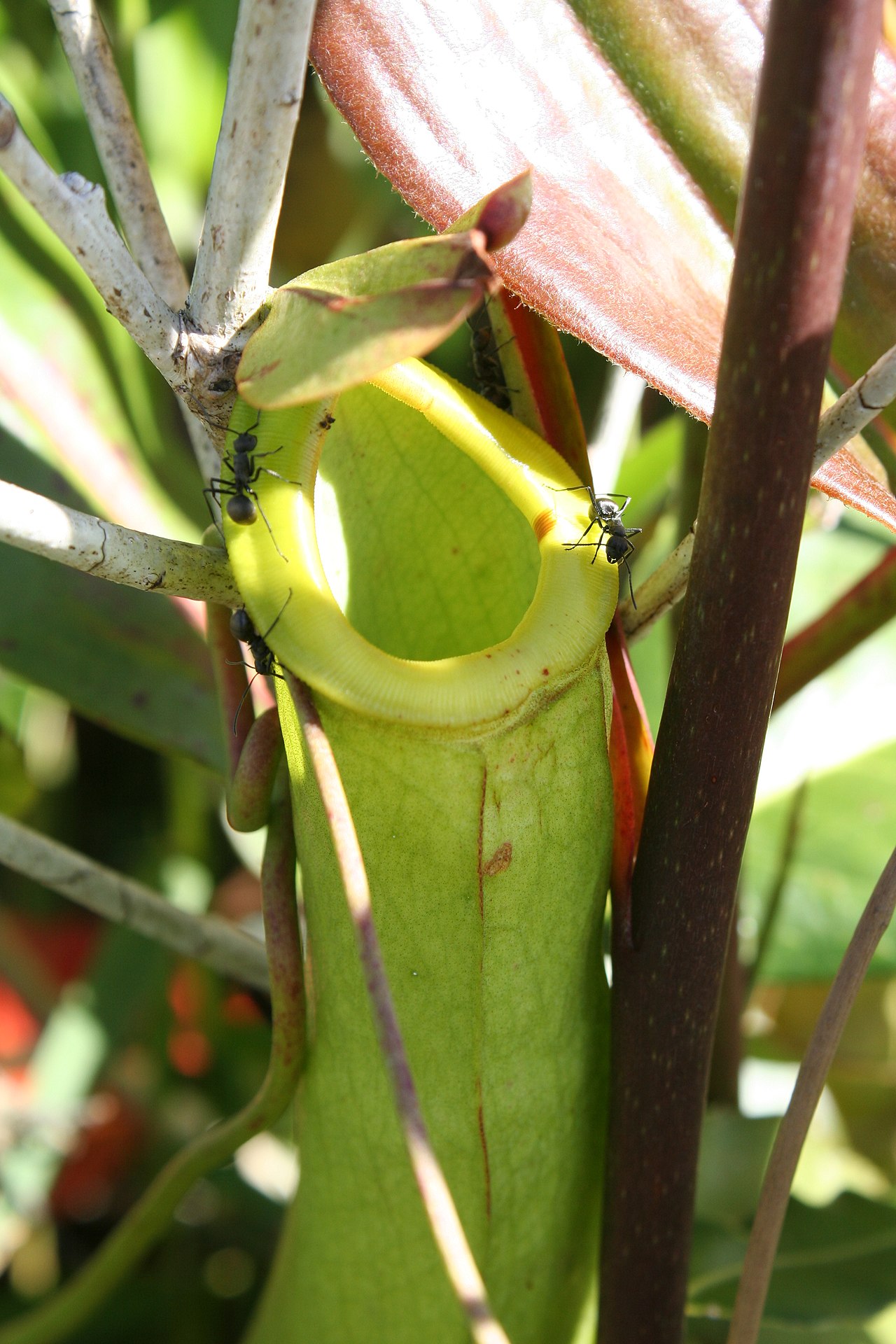
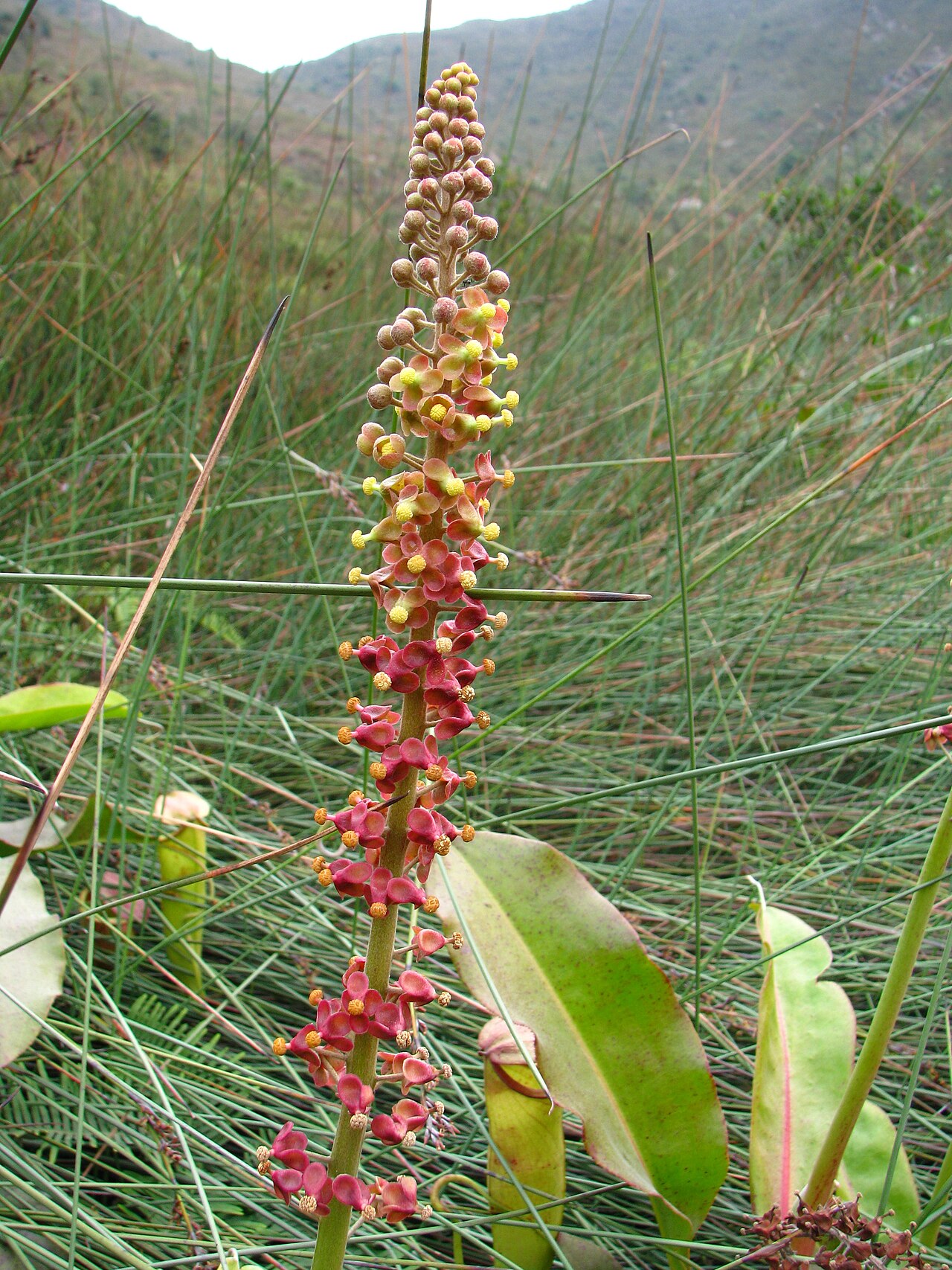
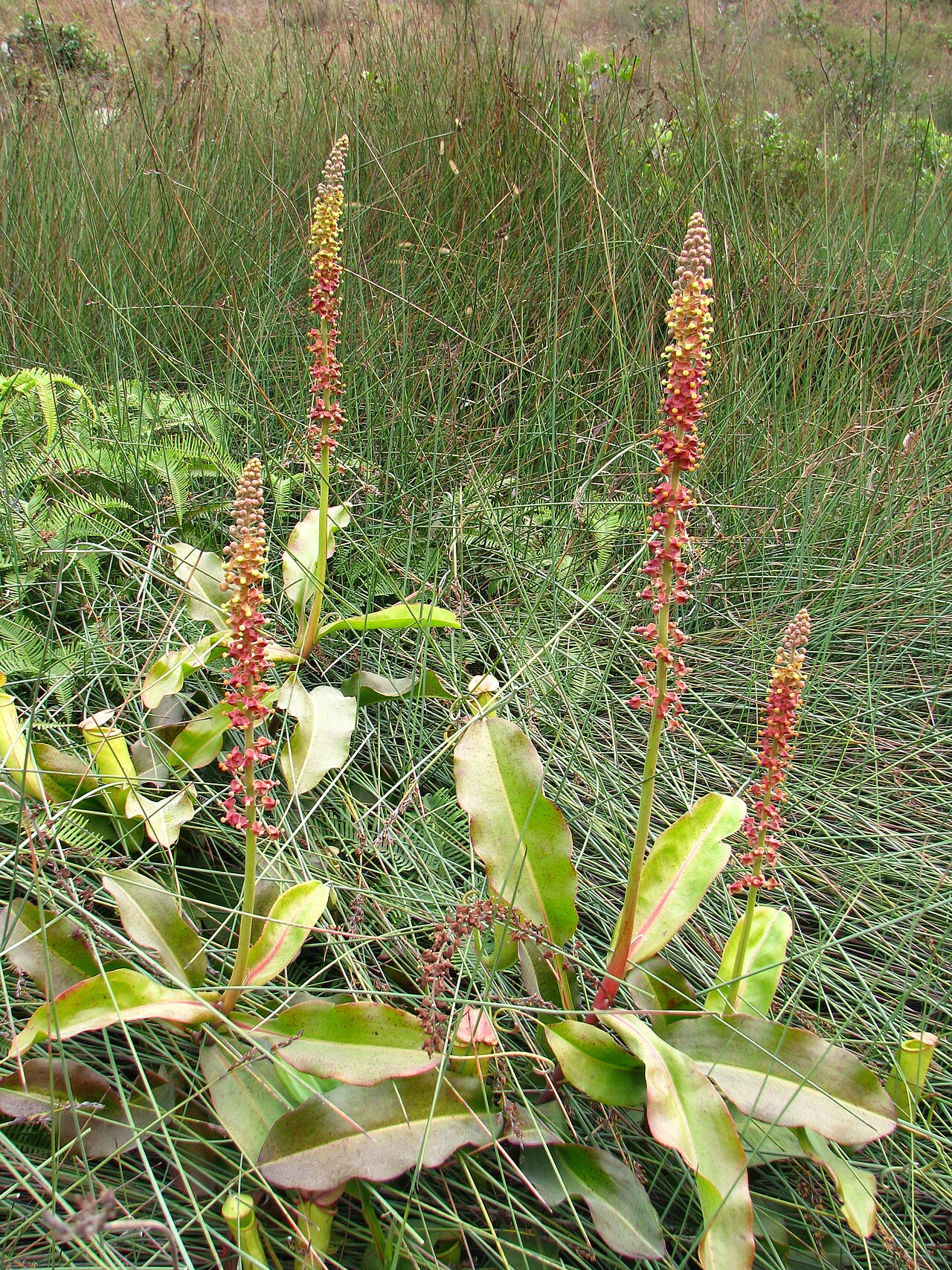
A shrub or climber reaching ten metres. The best character is not on the pitcher but on the leaf: the leaves of the rosette and of short stems have a fringed margin, the fringes about 2 mm long — no other Nepenthes has this. On the climbing stem the leaves become broader and entire, obovate to lanceolate, (15–)20–40 by 4–10 cm, on a channelled petiole 3 to 20 cm long with many parallel veins. The lower pitchers are ovoid at the base and cylindrical above, with two fringed wings; the upper pitchers are narrower and funnel-shaped, the wings reduced to ribs. The peristome is narrow and cylindrical, with no teeth worth the name. The lid is elliptic to orbicular and is held close over the mouth; the spur behind it is flattened, silky-haired and blunt. The flowers are red to purple-red, the tepals about 4 to 7 mm.
Similar species
Two characters settle it: the fringed margin of the rosette leaves and the flattened, silky spur with its rounded tip. N. rafflesiana, which often grows beside it, has the long neck behind the peristome and far squatter lower pitchers. N. gracilis is smaller and glossy with a narrow, striped peristome. On Cape York in Australia stands N. rowaniae, which resembles it closely; Clarke and Kruger set out the differences in 2005, among them the shape of the leaf blade, the insertion of the tendril, the gland density in the lower part of the pitcher and the position of the pitcher hip. Beyond that, any plant that half looks like it is suspect: more natural crosses are known from this species than from any other Nepenthes.
The trap and how it works
An ordinary pitfall trap without tricks, and that is exactly what makes it the measure against which the rest can be read. There are two pitcher types: squat lower pitchers on the ground, taking mainly ants and other crawling prey, and narrower funnels on the climbing stem for flying insects. The peristome is narrow and without heavy teeth; the plant relies on the slippery rim and on the waxy zone inside. Because it stands in full light on wet, open ground the pitchers fill quickly with rainwater, and in that water lives a whole community of mosquito and midge larvae that help break the prey down — the fluid of this species has been studied as a small ecosystem in its own right. Like all Nepenthes the plant is dioecious: male and female racemes stand on different plants.
Habitat and ecology
Open, permanently wet and nutrient-poor ground in full sun: grassy marshes, the margins of peat swamp forest, seasonally waterlogged savanna, sandy stream and pool banks. And then the unusual part: this species also stands on ground people have just turned over. Road cuttings, ditches, drained peat, abandoned mine workings — it is often the first pitcher plant back after clearance, and in many places the last to hold on. Where the other species of the genus vanish at the first disturbance, this one keeps its footing, as long as the ground stays wet.
Distribution and elevation
The largest range in the genus, by a distance. The distribution data list eighteen regions: Myanmar, Thailand, Laos, Cambodia and Vietnam, south-eastern China and Hainan, then the Malay Peninsula, Sumatra, Java, Borneo, the Lesser Sunda Islands, Sulawesi, the Moluccas, the Philippines, New Guinea and the Caroline Islands, and finally Queensland in northern Australia. That runs from about twenty-five degrees north to some fifteen degrees south, across two continents and the whole archipelago between them. Cheek and Jebb note that within Malesia it occurs almost everywhere except the northern Philippines and the eastern Lesser Sundas. No other Nepenthes covers more than a fraction of it; most sit on one island or one mountain.
- Recorded (quarter-degree cells)
Forms and variation
Over a range like that the variation is great, but it seldom resolves into fixed forms: pitchers differ from site to site in size, colour and slenderness without a line to be drawn anywhere. Two varieties do hold. Var. echinostoma is confined to Borneo and has an extraordinarily broad, widely flared peristome — Beccari found it in 1865 and Hooker described it in 1873 as a species in its own right. Var. globosa comes from the Andaman Sea coast of Thailand, near Trang and on an island off Phang Nga, and has short, globose pitchers. Older names such as var. biflora, var. simensis and var. smilesii are no longer maintained. Beyond this the species forms more natural hybrids than any other Nepenthes, among them with N. ampullaria, N. gracilis, N. rafflesiana and N. alata.
Where and when to see it
The easiest pitcher plant there is to find: drive along a wet verge or a drainage ditch in the lowlands and look to the side. At the northern edge of the range it grows in Hong Kong, where it is protected under the forestry regulations; at the southern edge on Cape York in Queensland. Find the rosette on the ground and hold a leaf up to the light: the fringed margin of the rosette leaves is visible to the naked eye and settles the identification at once.
Conservation status
Least Concern on the Red List and, like all Nepenthes, listed in CITES Appendix II. Of all the species in this guide it is the least vulnerable: widespread, tolerant of sun, disturbance and cutting, and quick to settle on freshly turned ground. That does not mean it stays everywhere. At the edges of its range — southern China, Hong Kong, Australia — the sites are small and countable, and drainage, building and the filling-in of marshes remove them one by one; in Hong Kong the species is protected separately for that reason. What keeps it going is not that it never loses ground, but that it keeps starting again somewhere else.
Scientific name
Nepenthes mirabilis | (Loureiro) Druce, 1917
The species was already described in 1790 by João de Loureiro, as Phyllamphora mirabilis. It was later transferred to the genus Nepenthes; the correct combination Nepenthes mirabilis is usually attributed to George Claridge Druce (1916), although Jan Schlauer's database records an earlier publication by Rafarin in 1869. The precise type locality could not be established with certainty; the species has by far the widest distribution of any Nepenthes species, stretching from China in the north to Australia in the south. The Latin epithet means "wonderful" — the scientific name literally translates to "the wonderful pitcher plant".
World Checklist of Vascular Plants (WCVP), via Plants of the World Online (POWO), Royal Botanic Gardens, Kew.