All species › Caryophyllales › Tropical pitcher plant family › Nepenthes villosa
Nepenthes villosa
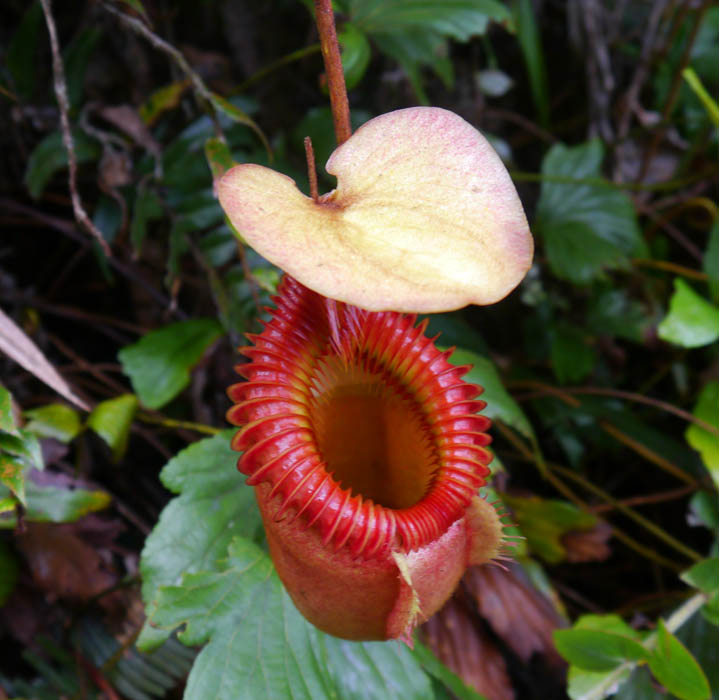
The highest-growing pitcher plant in Borneo, and the only one that reaches above 3,200 metres. Everything about it is covered in long brown hair — hence the name — and around the pitcher mouth lies a peristome like a ribbed collar, every rib ending in a tooth curved inwards. It grows on two mountains and nowhere else.
Natural hybrids
Identification
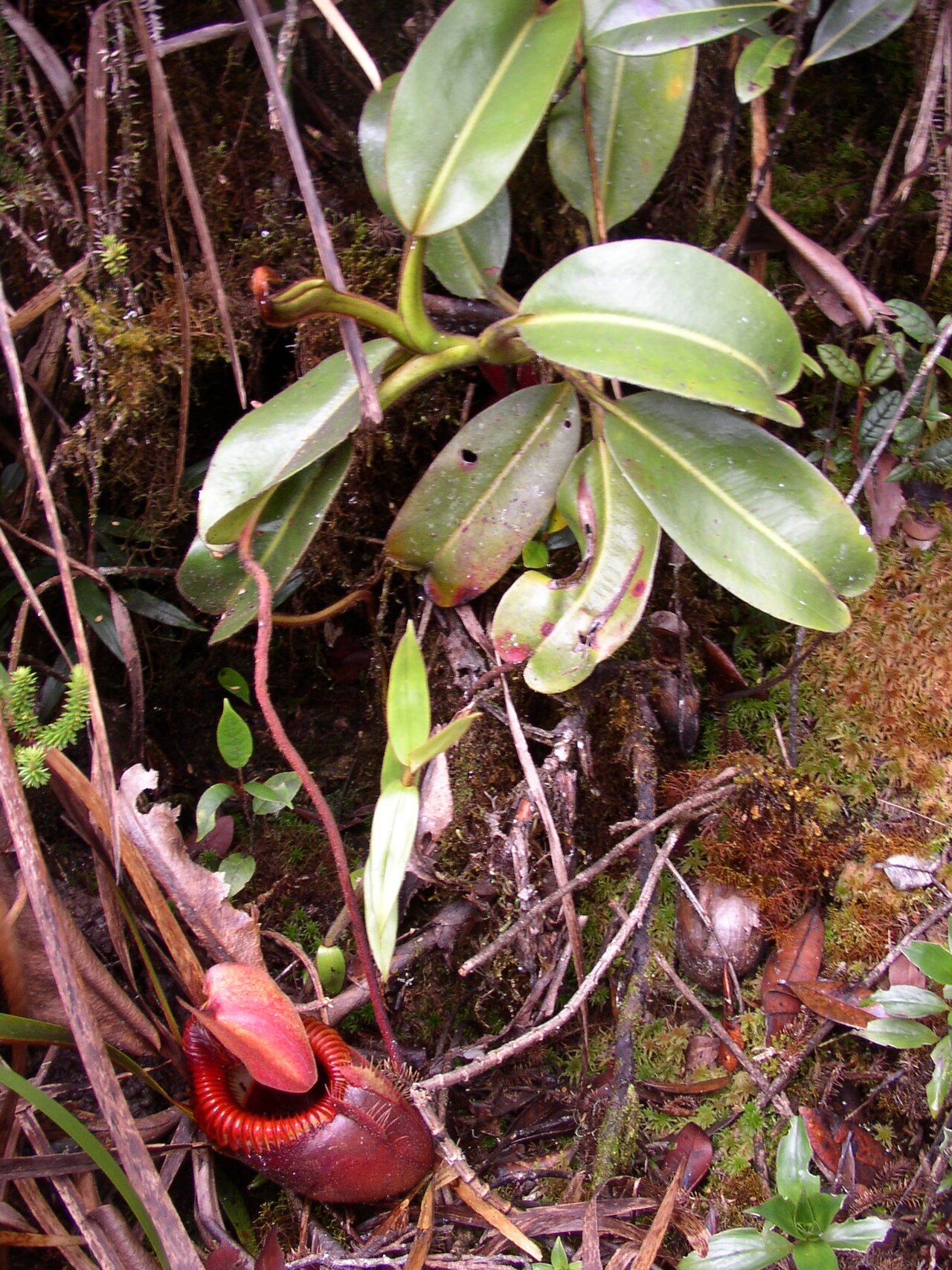
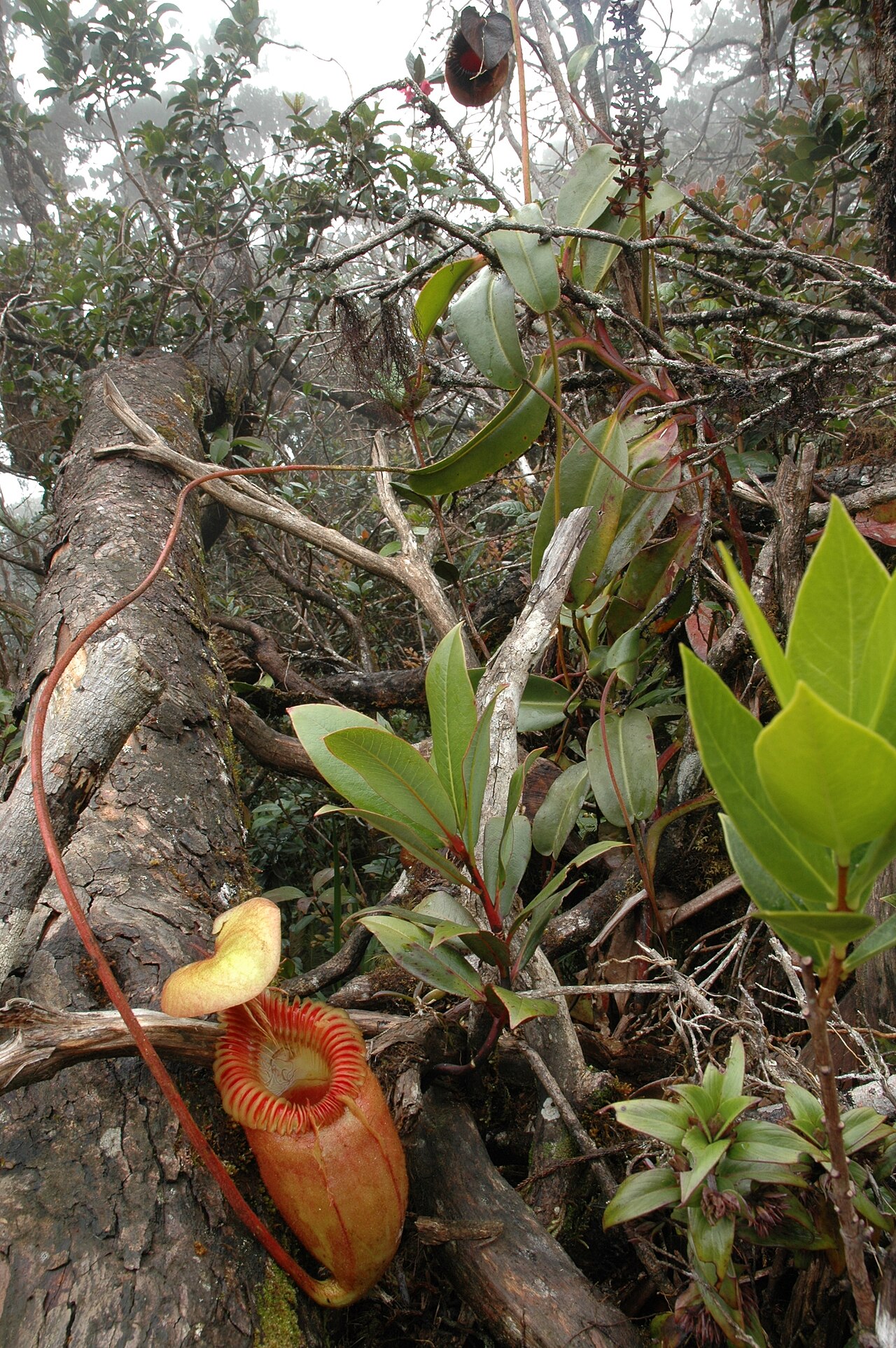
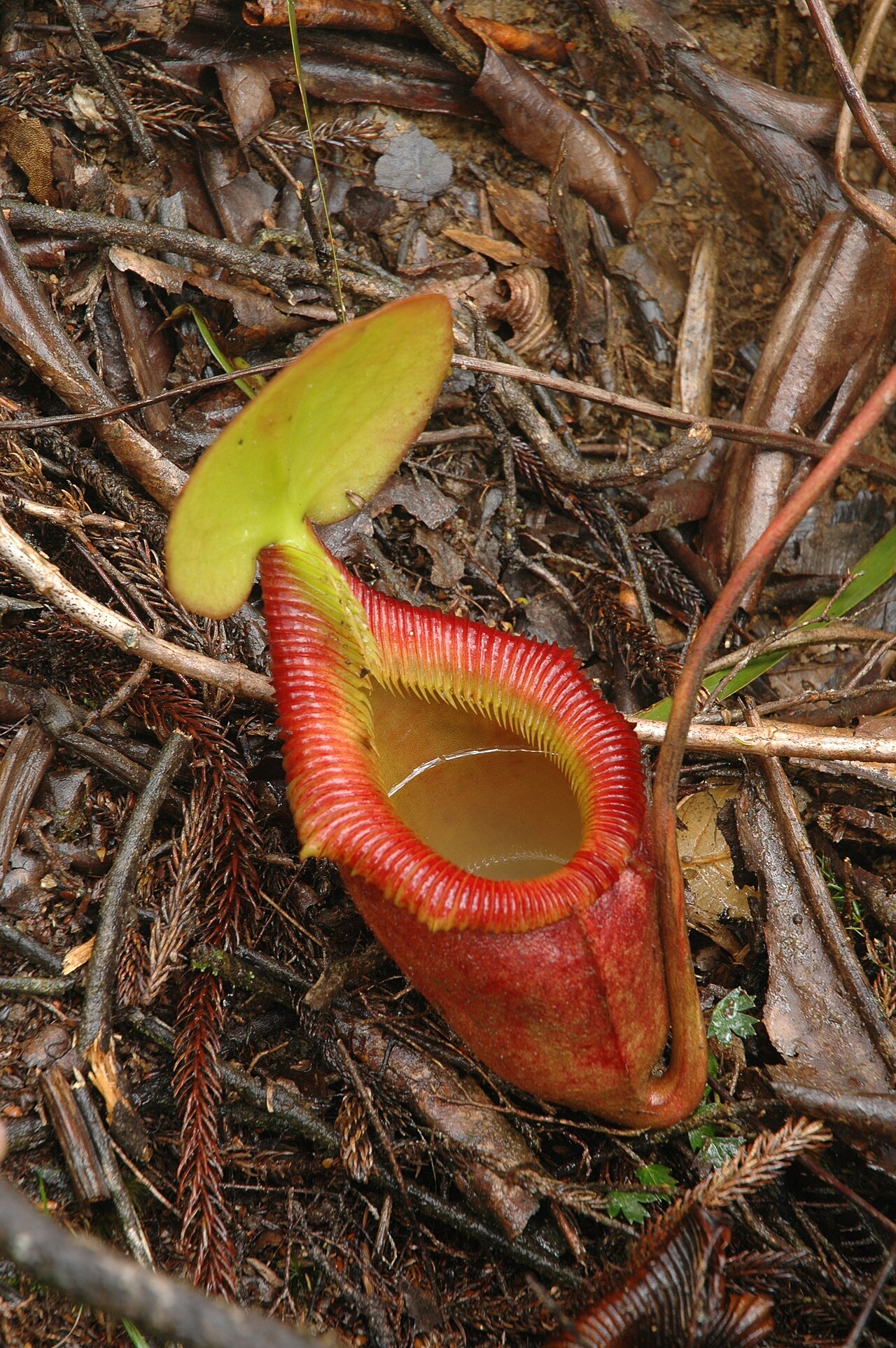
A short, squat plant: the stem grows up to eight metres long and 10 mm thick, but seldom climbs and usually stands no higher than half a metre, creeping among moss and boulders. Every part is densely clothed in long brown hairs. The leaf is spathulate to oblong, up to 25 by 6 cm, on a channelled petiole to 10 cm with a tendril to 50 cm. Lower and upper pitchers differ strikingly little in this species: both are urn-shaped, up to 25 cm high and 9 cm wide, with two fringed wings up to 15 mm broad. The peristome is the mark of it — cylindrical in section, up to 20 mm wide, with deep parallel ribs each running out into a sharp tooth that curves into the pitcher. The lid is cordate with a pointed apex; the spur behind it reaches 20 mm. The inflorescence has a peduncle to 40 cm and a rachis to 20 cm, with sepals to 4 mm.
Similar species
The two species it can be confused with grow on the same mountains. N. edwardsiana has an equally heavily ribbed peristome but a long, narrow, cylindrical pitcher and is virtually hairless; the natural hybrid between them, N. × harryana, sits exactly between the two and was long taken for a species of its own. N. rajah is larger and broader, with an enormous lid held over the mouth and far shorter hairs; there is a hybrid with that one too, N. × kinabaluensis, whose pitchers are larger than those of N. villosa itself. Lower down on the same ultramafic ground grows N. macrovulgaris, with a smooth, narrow, toothless peristome. In case of doubt the hair decides: no neighbour is as woolly.
The trap and how it works
An ordinary pitfall trap, but the peristome does nearly all the work. That broad ribbed collar is threaded with fine channels and is wetted by rain, dew and its own nectar; on such a wet, ribbed edge an insect loses its footing, and the inward-curving teeth make the way back impassable. The prey is unremarkable: ants, beetles and whatever else crosses the rim. Unlike its two neighbours N. lowii and N. rajah, which on these same slopes let mammals lick at the lid, this species has no relationship with vertebrates at all — it catches and digests for itself. The pitchers are long-lived: in the cool, wet climate they stay in service for months. Like all Nepenthes the plant is dioecious; male and female racemes stand on different plants and differ little from the outside.
Habitat and ecology
Mossy forest and sub-alpine growth with Leptospermum recurvum and Dacrydium, and higher up among shrubs, grass and boulders in the open. The species is confined to ultramafic ground: serpentine soil, poor in phosphate and calcium and rich in nickel and magnesium, where most other plants give up. Humidity stands near a hundred per cent almost continuously, even when the soil itself dries out for a while; above 3,000 metres there is regular night frost.
Distribution and elevation
Endemic to Borneo, and there only on Mount Kinabalu and Mount Tambuyukon in Sabah — two neighbouring mountains, both on serpentine. On Kinabalu it grows high, between about 2,300 and 3,240 metres, higher than any other Nepenthes on the island. On Tambuyukon the order is reversed: there it is common at 1,600 to 1,900 metres and is replaced towards the summit by N. rajah. The whole range lies inside Kinabalu Park. The distribution data give no more as a region than 'Borneo'.
- Recorded (one-degree cells)
Forms and variation
No varieties are recognised and variation within the species is slight: peristome colour runs from yellow-green and orange to deep red, and one plant is more hairy than the next, but that already differs within a single slope. The only genuinely different plants to be met with are the two natural hybrids: N. × harryana with N. edwardsiana and N. × kinabaluensis with N. rajah, which stands between 2,400 and 3,000 metres. Both were described in the past as separate species and only later recognised as crosses.
Where and when to see it
The highest slopes of Kinabalu, above the mossy forest: along the summit path and on the Mesilau route, where it grows among boulders and low scrub. Look low — the plant barely climbs here and the pitchers lie half in the moss, the densely hairy leaves being the best mark at a distance. Do not dig in the rock crevices; the entire range lies within a national park and taking plants or seed is forbidden.
Conservation status
Least Concern on the Red List and, like all Nepenthes, listed in CITES Appendix II. That 'least concern' rests largely on protection: every population lies within Kinabalu Park. A survey in 2002 counted 1,180 plants in eleven plots of a hundredth of a hectare between 2,610 and 2,970 metres, making it by far the commonest pitcher plant there. Clarke proposed in 1997 that it be treated as conservation dependent, and that remains the heart of the matter: two mountains, a narrow altitudinal band and a soil that lies nowhere else. The threats are digging for collectors and years of drought and fire on the open slopes.
Scientific name
Nepenthes villosa | J.D. Hooker, 1852
Described by Joseph Dalton Hooker in "Icones Plantarum" (London), volume 9, plate 888 (sources differ slightly on the exact year: 1851 or 1852). First collected in 1858 by Hugh Low during his second ascent of Kinabalu, accompanied by Spenser St. John. Mount Kinabalu, Sabah, Borneo (Malaysia). Hooker's original description gives the habitat as "Kina Balu, alt. 8,000-9,000 feet" (approximately 2440-2740 m). The species is endemic to the upper slopes of Kinabalu and the neighbouring Mount Tambuyukon; the currently known elevational range (2300-3240 m) is the highest of any Bornean Nepenthes species. From the Latin villosus ("hairy") — refers to the dense covering of long, brown hairs on all parts of the plant.
World Checklist of Vascular Plants (WCVP), via Plants of the World Online (POWO), Royal Botanic Gardens, Kew.