All species › Caryophyllales › Tropical pitcher plant family › Nepenthes madagascariensis
Nepenthes madagascariensis
The centre of gravity of Nepenthes lies in Borneo and Sumatra, but the written history of the genus begins here: the first pitcher plant ever described in western literature was a plant from Madagascar, recorded by the French governor Étienne de Flacourt in 1658. Nepenthes madagascariensis is also an outlier in the genus's geography — it stands five thousand kilometres from its nearest relatives in Southeast Asia, in the wet lowlands of the east coast, and shares the island with only one other species.
Identification
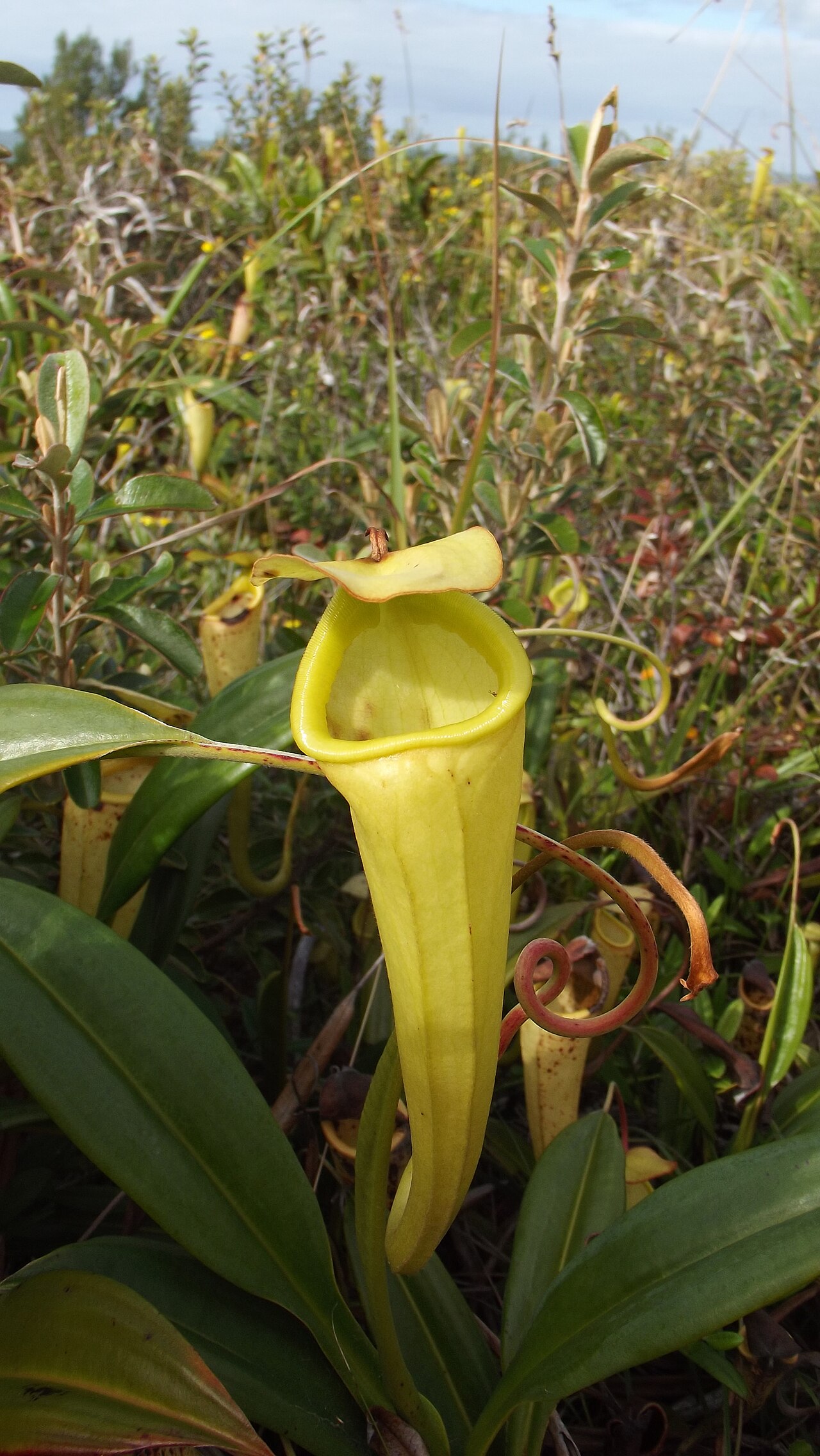
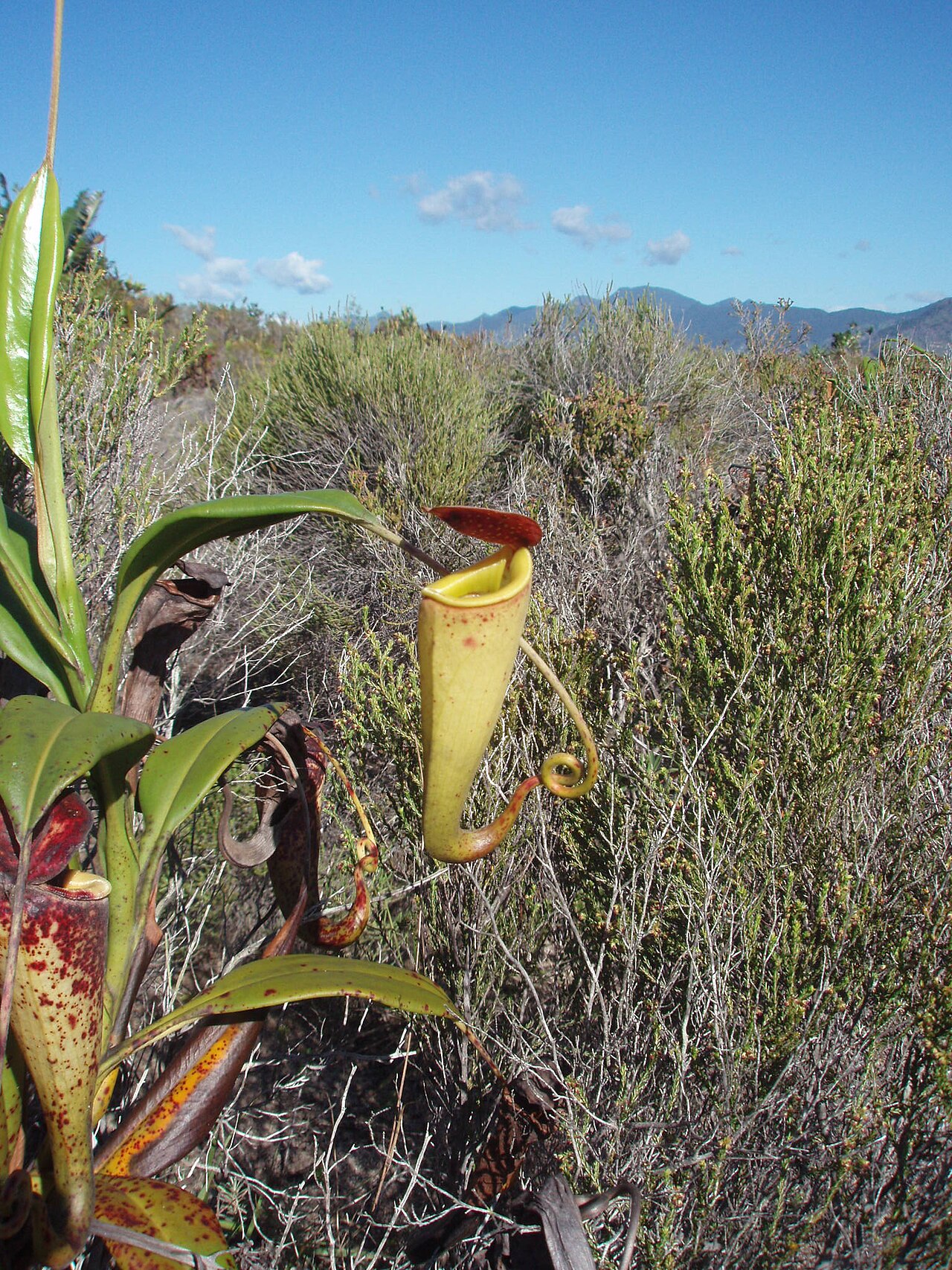
A plant that appears in two guises, which makes field recognition less simple than it sounds. Young and non-climbing plants form a dense tuft with an erect stem to about 1.5 m; older plants send a climbing stem up into the surrounding scrub, to nine metres long. The leaves are linear to elliptic, to 28 cm long and 8 cm wide, with four to seven veins running parallel to the margin, and a winged petiole clasping the stem for half its circumference. From the leaf tip runs a tendril ending in a pitcher. Lower pitchers are ovoid, swollen below and narrowing to a cylindrical mouth, to 14 cm tall, with two fringed wings down the front; they are reddish pink to reddish purple. Upper pitchers are wholly narrowly funnel-shaped, to 18 cm tall and 7 cm wide, and usually plain bright yellow, sometimes with a red lid and an orange-red peristome.
Similar species
Madagascar holds only one other species of the genus, Nepenthes masoalensis, confined to the Masoala peninsula in the north-east. That species has broader, distinctly stalked leaves and pitchers with a much wider, more flaring peristome. Outside that zone of overlap there is nothing on the island to confuse this plant with. Carrying two such different pitcher forms on one plant is normal for the genus and is no indication of two species here.
The trap and how it works
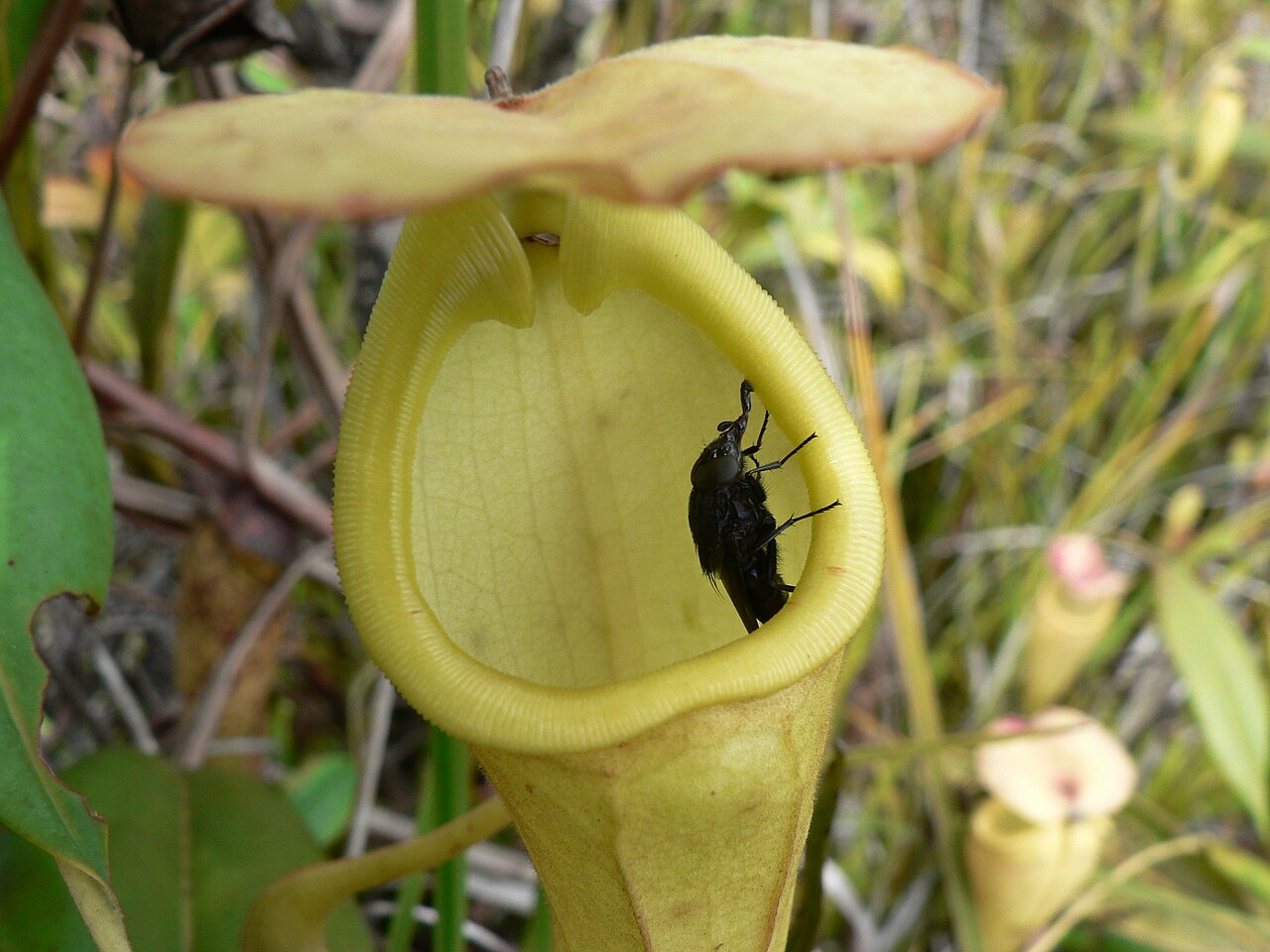
A pitfall trap that changes its job over the plant's life. Lower pitchers sit on or just above the ground, carry two fringed wings down the front that work as a ramp, and catch mainly walking animals: ants, beetles, centipedes. Upper pitchers hang free in the air, have lost the wings in favour of a narrow ridge, and catch flying insects. In both the lure sits on the peristome, the ribbed collar around the mouth: nectar glands lie there, and the ribs — here up to 0.4 mm high and half a millimetre apart — turn frictionless once a film of water lies over them, so an insect walking on them loses its grip in a single step. The lid bears nectar glands too, one to two hundred of them in the upper pitchers. Inside, just under the peristome, run short upward-pointing hairs and a narrow zone of branched hairs; at the bottom stands fluid carrying digestive enzymes. The prey of this species has been studied: ants make up by far the largest share.
Habitat and ecology
Lowland ground that stays wet the year round: swamp margins, peaty and sandy soils along standing water, and open, acid heath-like vegetation on coastal sand (W2, D1). The plant takes full sun and often grows in vegetation that burns regularly; the underground parts resprout after fire, and it is precisely on such open, impoverished ground that it meets least competition. Shaded forest is not its place — at most it climbs along the edge. What defines the habitat is that the soil is soaked and extremely nutrient-poor at the same time: the water is acid and washes nitrogen away, so what the plant needs has to come out of the air.
Distribution and elevation
Endemic to Madagascar, and there confined to the eastern half: from the far south-east around Fort-Dauphin, where it is commonest, north along the east coast as far as the Masoala peninsula. It is one of only two Nepenthes in the western part of the genus's range, and how the ancestors of the Malagasy species reached the island from Asia remains an open question — long-distance dispersal of very light seed is the usual explanation. The species stays in the lowlands; no reliably published altitudinal limit was found for this guide, so the elevation field is left empty.
- Recorded (one-degree cells)
Forms and variation
No wild varieties or colour forms are recognised, and the species is fairly uniform across its range. The most striking colour difference is not between plants but within one plant: the lower pitchers are reddish pink to reddish purple, the upper ones usually plain bright yellow, and that contrast is easily mistaken for variation between individuals. Beyond it there is the ordinary gradient between plants in full sun, which are redder and stockier, and plants in shelter. No natural hybrids are known from Madagascar, which follows from the only other species on the island occupying a restricted and largely separate area.
Where and when to see it
The country around Fort-Dauphin in the south-east is the easiest place: there the species grows along waterways and on open sand flats within reach of the road, and is locally abundant. Walk the margins of swamps and look down before you look up — in non-climbing plants the lower pitchers lie in the litter, and from above all you see is a tuft of narrow leaves. Climbing plants give themselves away instead by the yellow funnels hanging free in the scrub, often at eye level. The east-coast rainy season runs from November to March; the months after it are more practical and the pitchers are full grown by then.
Conservation status
The Red List assesses the species as Least Concern: the coastal range is long, the plant is locally abundant, and it persists on open and even disturbed ground where the original vegetation has gone. As a member of Nepenthes it is nonetheless listed in CITES Appendix II, so international trade in wild plants requires a permit; in practice the trade rests almost entirely on cultivated material. The risks usually named apply to the Malagasy lowlands as a whole: the draining of coastal wetlands for agriculture, mining of the heavy mineral sands of the south-eastern coast, and changes in the fire regime.
Scientific name
Nepenthes madagascariensis | Poiret, 1797
Nepenthes madagascariensis was described in 1797 by Jean Louis Marie Poiret — the first Nepenthes species to be scientifically described. Étienne de Flacourt had already documented the plant in 1658 under the pre-Linnaean name "Amramatico", in his work Histoire de la Grande Isle de Madagascar. The eastern coast of Madagascar, where the species is most common in the south, around Tôlanaro, with records extending north to the Masoala Peninsula; the precise type locality could not be established with certainty. The specific epithet derives from Madagascar, the island to which the species is native.
World Checklist of Vascular Plants (WCVP), via Plants of the World Online (POWO), Royal Botanic Gardens, Kew.