All species › Caryophyllales › Tropical pitcher plant family › Nepenthes pervillei
Nepenthes pervillei
Look at a distribution map of Nepenthes and you see a dense cloud of species between Sumatra and New Guinea, with a few isolated dots outside it. The most remote lies in the middle of the Indian Ocean: the granite islands of the Seychelles, where Nepenthes pervillei is the only pitcher plant. It is an outlier in more than geography. In DNA-based phylogenies this species sits at the base of the genus, as the branch that split off earliest from all the others — and its seeds are so unusual that it was for a time placed in a genus of its own.


Identification
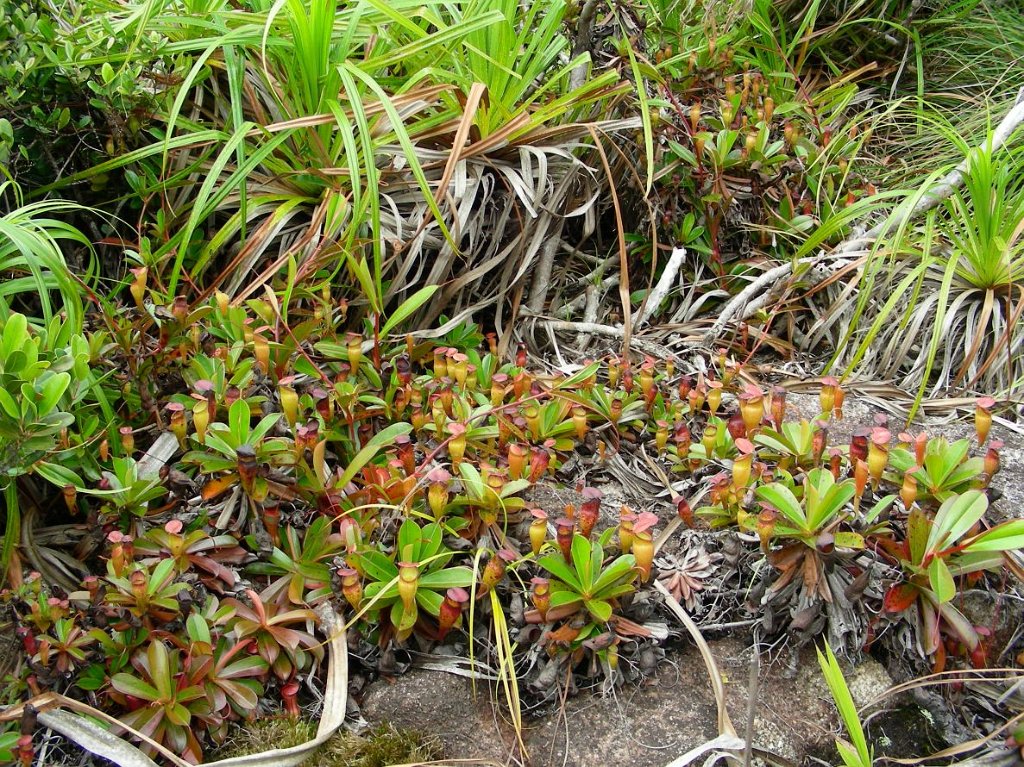
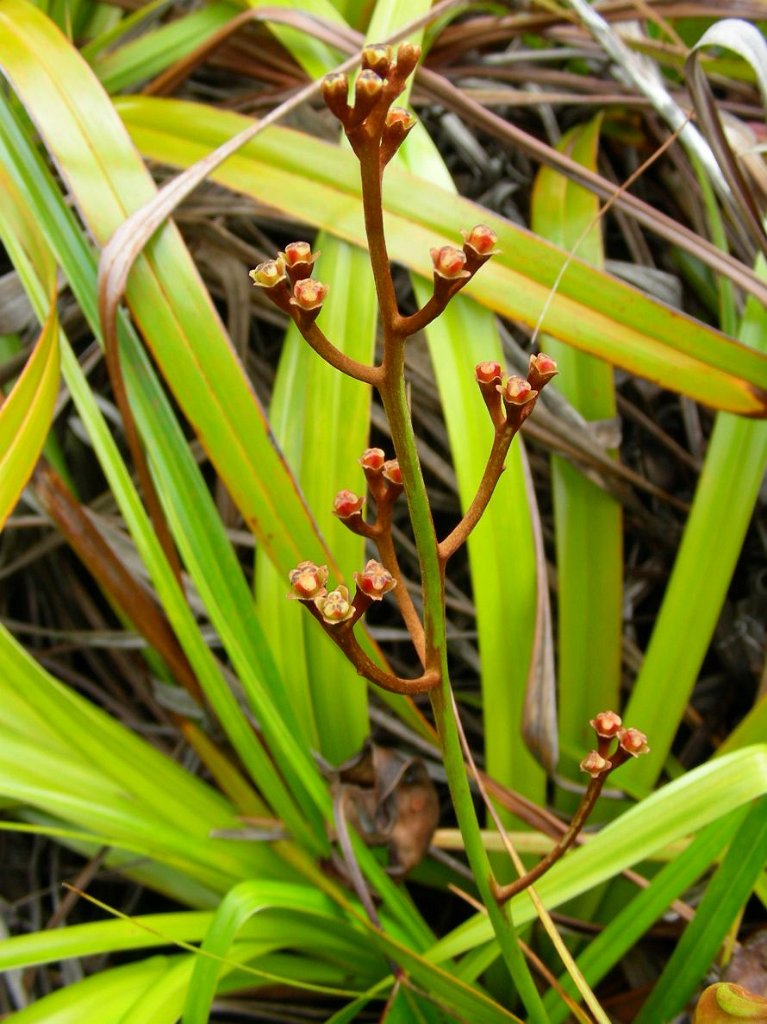
A climbing and scrambling plant with stems up to eight metres long. Young plants first form a compact rosette; mature plants send climbing stems into the scrub and form small aerial rosettes there, from which the upper pitchers hang. The leaves are elliptic to oblong, to 29 cm long and 6 cm wide, with a rounded to obtuse tip, glossy dark or bright green, with a yellow to orange midrib and tendril. Lower pitchers reach 12 cm tall and 4 cm wide, ovate and swollen below and narrowing towards the mouth; two wings to 8 mm wide, fringed with filaments to 4 mm, run down the front. Outside they are reddish orange to purple. Upper pitchers are slimmer, to 16 cm long and 4.5 cm wide, usually yellow to yellowish green and suffused with orange or red as they age. They hang from short, rigid tendrils that do not coil — an unusual trait, since in most species the tendrils of upper pitchers wind around a support.
Similar species
In the Seychelles there is nothing to confuse it with: it is the only species of the genus in the archipelago, and the nearest other Nepenthes grow on Madagascar, over a thousand kilometres to the south-west. Set beside the two Malagasy species, the difference shows mainly in the upper pitchers: in N. pervillei they hang from short, straight tendrils and the peristome is narrow, to 3 mm. In cultivation the seed is the best character: black, ovoid to truncate, only 2 to 4 mm long, and lacking the long thread-like ends that make the seed of other species so light.
The trap and how it works
A classic pitfall trap with a narrow, glossy peristome. In lower pitchers the peristome is up to 6 mm wide and finely ribbed; the lid is almost round and flat, up to 5.5 cm across, carrying thirty to a hundred nectar glands underneath. The spur behind the lid is up to 7 mm long and usually forked. Upper pitchers have a narrower peristome, to 3 mm, but a lid evenly lined with one to two hundred nectar glands; at the bottom the digestive glands reach a density of four to six hundred per square centimetre. Walking prey reaches the mouth of the lower pitchers along the wings, while flying insects are lured to the upper pitchers by nectar and colour. The pitcher fluid holds a community of its own; the mite Creutzeria seychellensis, for one, was described from this plant.
Habitat and ecology
Rocky ground near the granite summits of the Seychelles: low, dense scrub on granite slabs and mountain slopes, usually in strong or direct sunlight (R1, R4). The roots work into fissures in the rock where a little humus and moisture collect; on the bare slabs themselves rainwater runs straight off and there is scarcely any soil. It is one of the most distinctive habitats in the genus: not peat or swamp forest, but the slopes and domes of ancient granite inselbergs, where the plant stands in the wind among low shrubs and ferns. The species grows from about 350 to 750 m.
Distribution and elevation
Endemic to the Seychelles, and there known only from the two highest granite islands, Mahé and Silhouette. On both it is confined to the higher ground, between about 350 and 750 m. How a pitcher plant came to be here is one of the open questions of the genus; since the seed has no threads for flight, wind transport across the sea is less obvious than in other species. Its unusual position in the family tree makes the Seychelles populations important to anyone trying to understand the early history of the genus.
- Native
Forms and variation
No wild varieties or forms are recognised. The species does have a taxonomic history of its own: Blume described it in the nineteenth century as Nepenthes pervillei, after the French collector Auguste Pervillé; it was later moved to a genus of its own, Anurosperma — literally ‘tailless seed’ — on account of its seed. That genus is no longer used and the species is back in Nepenthes. Pitcher colour varies with light and age, from yellowish green to deep orange-red. Natural hybrids are impossible: there is no other species to cross with.
Where and when to see it
Mahé is the most accessible island: the national park in the mountainous interior has footpaths running over the granite ridges to the higher ground, and the open, rocky stretches above about 400 m give the best chance. Look at the low scrub on sunlit granite slabs, where the yellow to orange-red upper pitchers stand out well. Keep to the paths: the vegetation on bare rock is fragile and slow to recover. Silhouette is harder to reach and largely protected.
Conservation status
The Red List assesses the species as Least Concern, but numbers are modest: a count from 2015 put it at fewer than a thousand plants in the Seychelles. Much of its habitat lies in protected areas in the mountains of Mahé and on Silhouette, and the rocky summits are of little use for farming or building. As a member of Nepenthes it is listed in CITES Appendix II; international trade in wild plants requires a permit. The risks are mainly local: introduced plants overgrowing the open granite vegetation, fire, and trampling at popular viewpoints.
Scientific name
Nepenthes pervillei | Blume, 1852
Nepenthes pervillei was described in 1852 by Carl Ludwig von Blume, in Museum Botanicum Lugduno-Batavum. The Seychelles islands of Mahé and Silhouette, in rocky areas near granitic mountain summits, at 350-750 m elevation; a more precise type locality could not be established. The species is named after the French plant collector Auguste Pervillé.
World Checklist of Vascular Plants (WCVP), via Plants of the World Online (POWO), Royal Botanic Gardens, Kew.