All species › Caryophyllales › Tropical pitcher plant family › Nepenthes sanguinea
Nepenthes sanguinea
'Sanguinea' means blood-red, and the name refers to the deep red colour the pitchers of this species often have. Nepenthes sanguinea was described as early as 1849 by the English botanist John Lindley, in the early days of European interest in pitcher plants, and is thus one of the longest-known species of the Malay Peninsula. It is a plant of the cool mountain ridges of the peninsula and adjacent southern Thailand, where it forms its robust, often red or orange pitchers among low scrub and at the margins of montane forest.
Identification
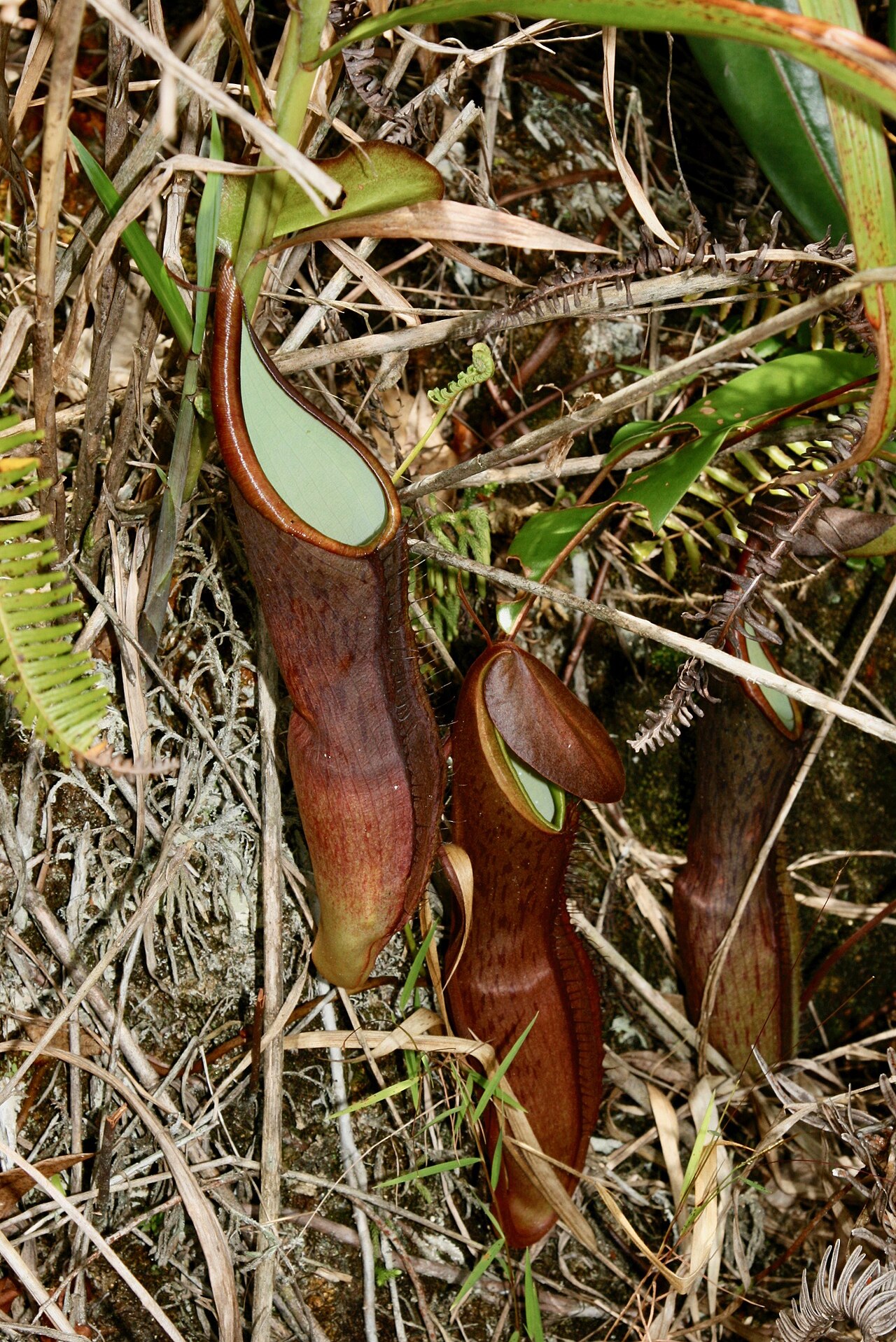
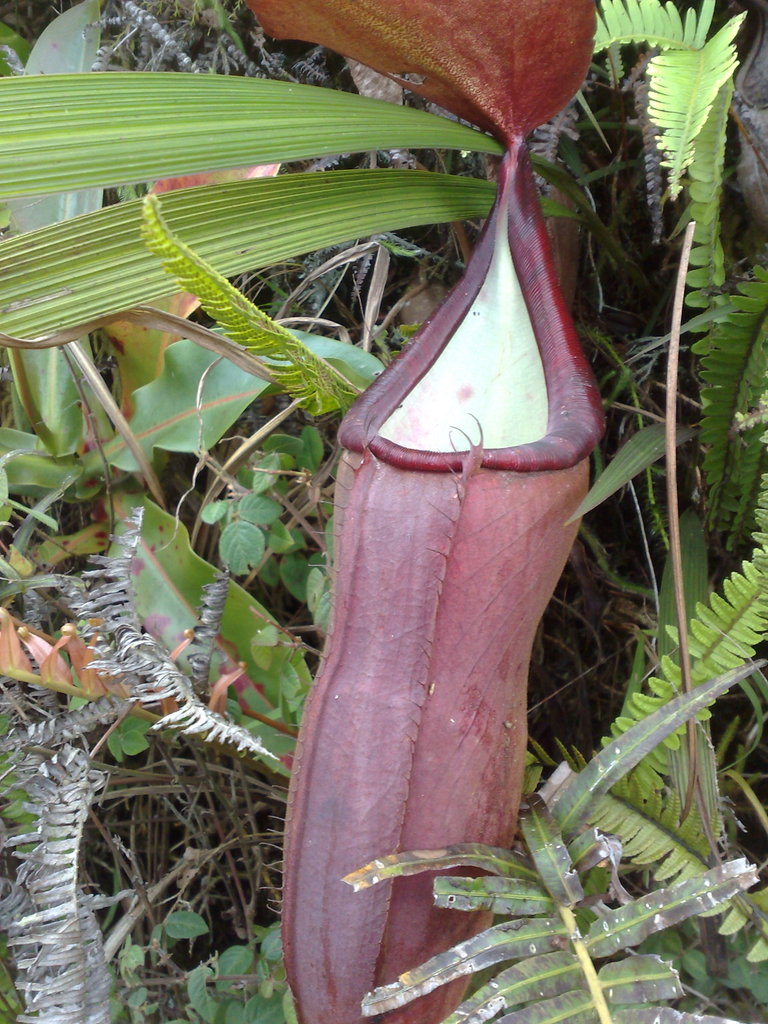
A climber with obtusely angular, sometimes round stems five to nine millimetres thick and sessile, leathery leaves: at the base of the plant long-spathulate to 20 cm, higher on the stem oblong, 10 to 15.5 cm long. Lower pitchers are broadly ellipsoid and robust, mostly 13 to 21.5 cm tall but occasionally over 26 cm, and five to eight centimetres wide at the base. The peristome is flattened and may reach a centimetre and a half wide; the lid is broadly elliptic to ovate. Upper pitchers are subcylindrical to funnel-shaped, 13 to 27.5 cm tall, with a narrower peristome than the lower ones. Colour ranges from plain green to suffused and spotted reddish brown, and the inside is blotched red. It is the red forms that gave the species its name.
Similar species
Two species of the peninsula are regularly confused with it. Nepenthes benstonei has a round stem, much larger and often shortly stalked leaves and usually grows lower, in secondary vegetation. Nepenthes malayensis, described only in 2020 from the eastern mountains of the peninsula, was at first taken for a green sanguinea; it has a round to broadly angular stem (more sharply angular in sanguinea), finely hairy leaves and pitchers, conspicuously striped peristomes, and grows on moss banks and humus-covered rocks. From Nepenthes macfarlanei, which grows in the same mountains, it differs by lacking the dense white hairs under the lid.
The trap and how it works
A pitfall trap with a broad, slippery peristome. The lower pitchers are roomy and pot-bellied, with plenty of fluid, and stand on or against the ground; they catch mainly ants and other crawling animals. Upper pitchers hang higher in the vegetation and are slimmer. Nectar glands on the peristome and under the lid lure insects to the rim, where they slip on the wet ribs. The blotched red inner wall is a pattern found in many species of the genus and may help attract flying insects; no specific study of this species' prey was found in the literature consulted.
Habitat and ecology
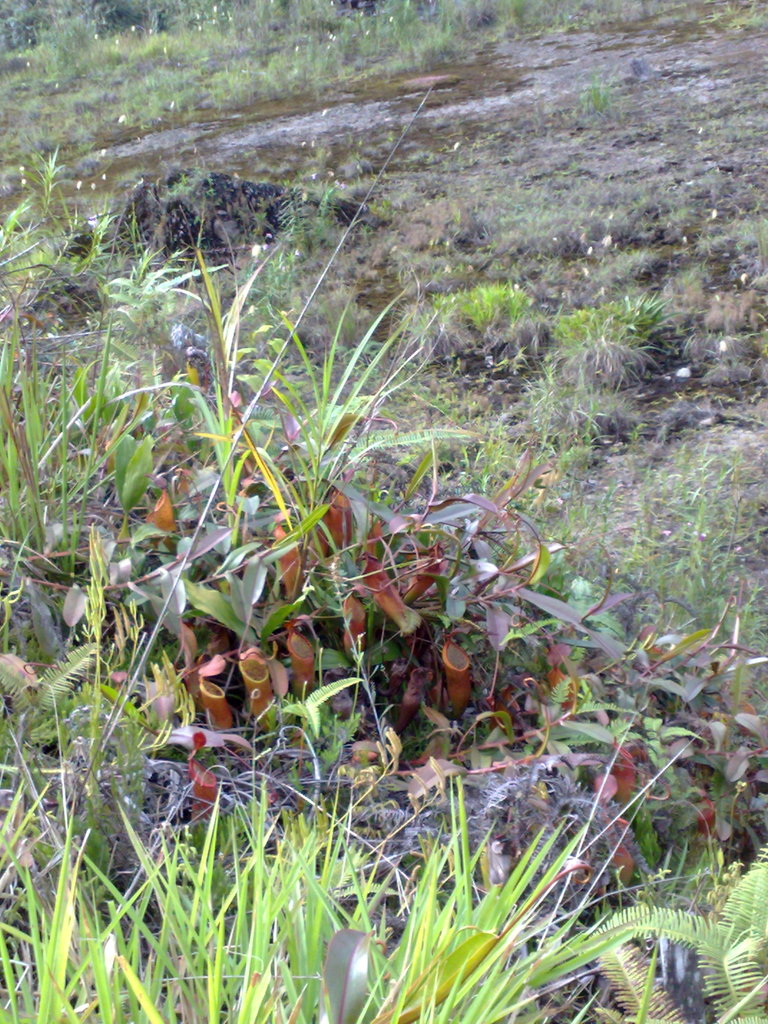
Mountain ridges among scrub of conifers of the genus Dacrydium and rhododendrons, from 900 to 1800 m (B1, B5). That is typical ridge vegetation of the peninsula's cool, humid uplands: low, open enough for light, and permanently humid. The plant climbs through the shrubs and along forest edges, and also takes advantage of open ground along trails and roads in the highlands.
Distribution and elevation
The Malay Peninsula and adjacent southern Thailand. Within Malaysia the species is spread over the mountain ranges of the peninsula, especially the Main Range. Because it also occurs in Thailand, it is not endemic to one country. Our own list names only the Malay Peninsula; according to the literature the Thai part of the range belongs to it as well.
- Recorded (one-degree cells)
Forms and variation
The species is notoriously variable in colour: there are plain green, orange, red and almost blackish-red plants, and the speckling varies too. This variation has never been formalised in varieties. Nepenthes pumila, a name from 1854, is regarded as the same species. In the wild Nepenthes sanguinea forms hybrids with Nepenthes macfarlanei where the two meet. Cultivated forms with trade names do not belong in this account.
Where and when to see it
The hill stations of Malaysia's Main Range, with their roads and trails through montane forest, are the easiest places to see the species. Walk forest edges, ridges and embankments, and look for robust, pot-bellied pitchers in red or green among the scrub. The highlands are humid all year; mornings are usually clearer than afternoons, when cloud and rain build up. Leave the plants be: even along tourist trails pitcher plants disappear through picking.
Conservation status
The Red List assesses the species as Least Concern. It is widespread on the peninsula and persists in open, disturbed vegetation along roads. The peninsula's mountain ridges are nonetheless under pressure from the expansion of hill stations, agriculture and infrastructure. As a member of Nepenthes it is listed in CITES Appendix II, so international trade in wild plants requires a permit; the trade relies largely on cultivated material, and the species is one of the classic glasshouse plants.
Scientific name
Nepenthes sanguinea | Lindley, 1849
Nepenthes sanguinea was described in 1849 by John Lindley, in The Gardeners' Chronicle and Agricultural Gazette (1849, volume 37, pp. 580-581). Peninsular Malaysia and southernmost Thailand, at 300-1,800 m elevation; the precise type locality could not be established more precisely. The specific epithet derives from the Latin "sanguineus" ("blood red"), referring to the characteristic colouring of the pitchers.
World Checklist of Vascular Plants (WCVP), via Plants of the World Online (POWO), Royal Botanic Gardens, Kew.