All species › Caryophyllales › Tropical pitcher plant family › Nepenthes maxima
Nepenthes maxima
The 'great pitcher plant', and the namesake of a whole group of related species, the N. maxima complex. Nepenthes maxima was described in 1824 from material collected in the Netherlands Indies by the German-born botanist Caspar Reinwardt, and has one of the largest ranges in the genus: from Sulawesi via the Moluccas to New Guinea. Across that range the plant varies greatly, from slender pitchers with a narrow peristome in drier areas to pitchers with a broadly flaring peristome in permanently wet ones. Many of the relatives in this complex have been described only in recent decades.
Identification
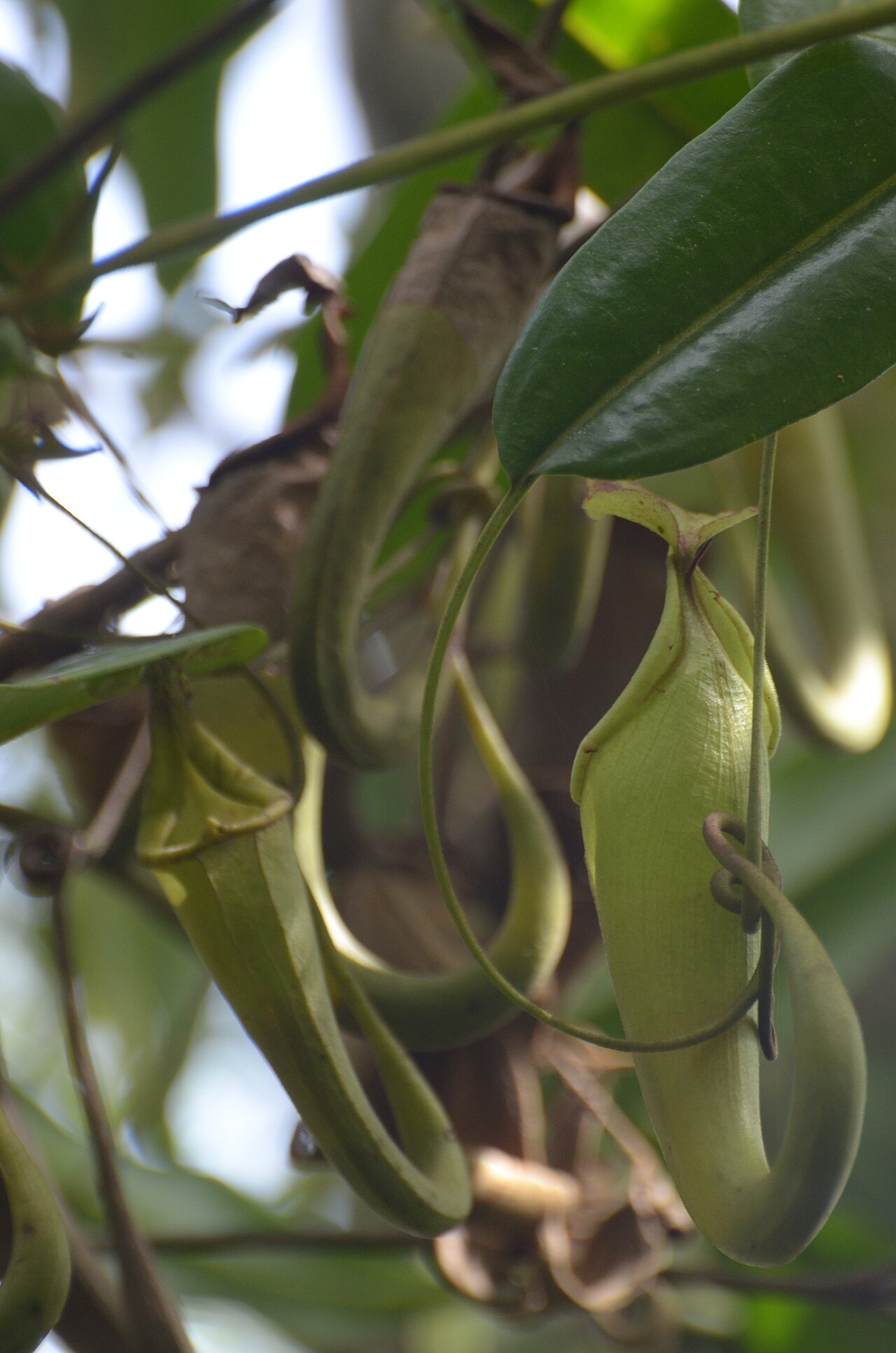
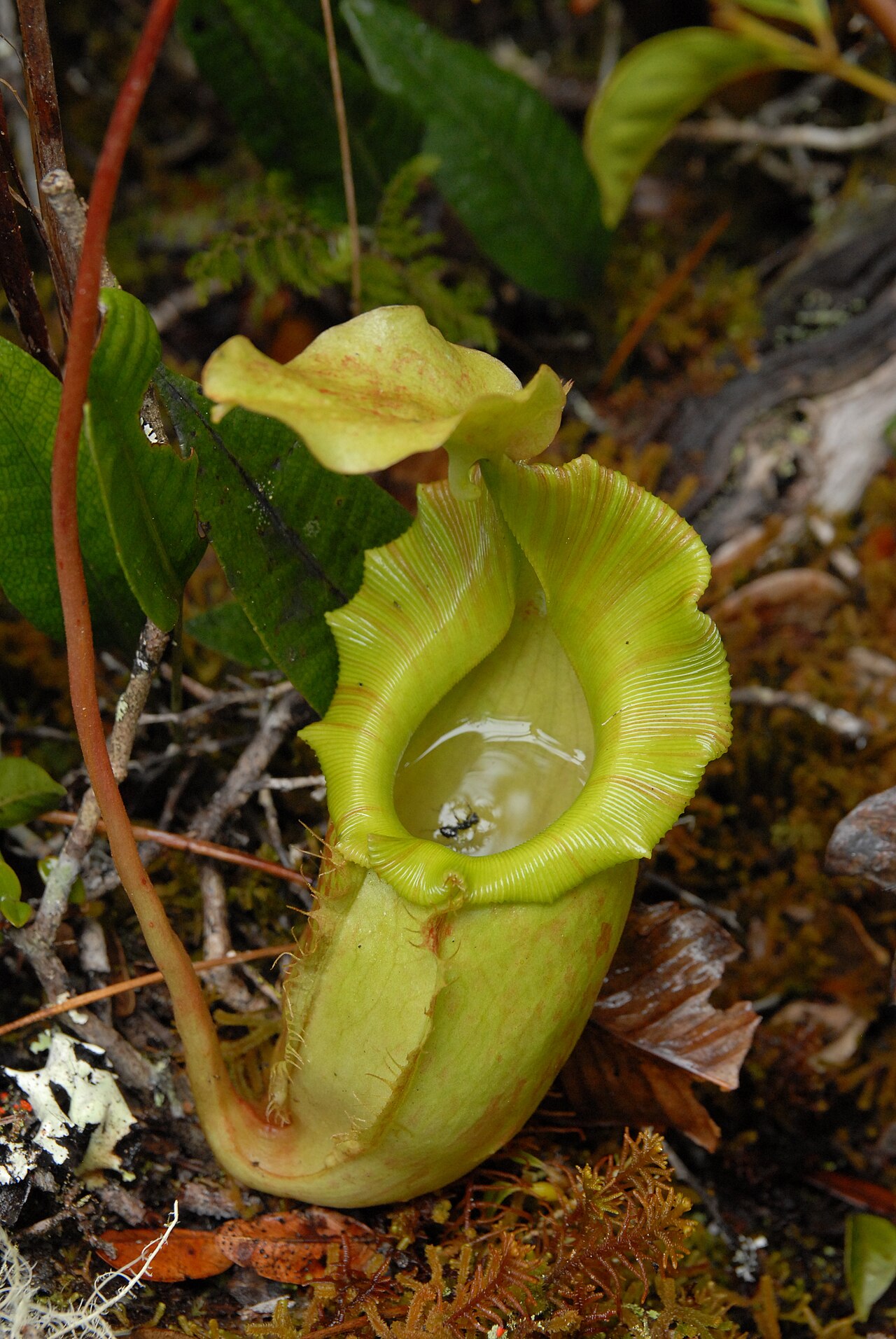
A climber with stems 3 mm to 1 cm thick, often winged on two angles, and leaves 15 to 30 cm long. The lower pitchers are narrowly ovoid, cylindrical above, sometimes slightly waisted, 8 to 20 cm long, and carry fringed wings. The upper pitchers are the best known: narrowly funnel-shaped, usually 6 to 19 cm but sometimes up to 30 cm long, often cream to green with red or purple stripes and blotches. The peristome is narrow and almost cylindrical at the front, 2 to 5 mm wide, flattening towards the lid; in wet areas it is often much broader. The lid is ovate, about 2.5 cm long. On Sulawesi many plants have a distinctly wavy leaf margin.
Similar species
The N. maxima complex comprises some ten related species, including N. boschiana, N. chaniana, N. epiphytica, N. eymae, N. fusca, N. klossii, N. platychila and N. vogelii. On Sulawesi, Nepenthes eymae is the species most confused with N. maxima: it has wingless, funnel-shaped and relatively small upper pitchers that suddenly widen into a broad bowl above, and a triangular lid. Nepenthes undulatifolia of South-East Sulawesi also has wavy leaf margins, but much shorter, broad pitchers.
The trap and how it works
A pitfall whose shape shifts with climate. In drier, seasonal areas the upper pitchers are long and narrow, with a narrow peristome and a well-developed waxy zone inside on which insects find no grip. In permanently wet areas the peristome is broader and the waxy zone smaller. These two strategies reflect how the peristome works: it is slippery only when wet, so a plant in a dry climate relies more on wax, and a plant in a wet climate on a broad peristome. Digestive fluid stands at the bottom, and nectar glands lie under the lid.
Habitat and ecology
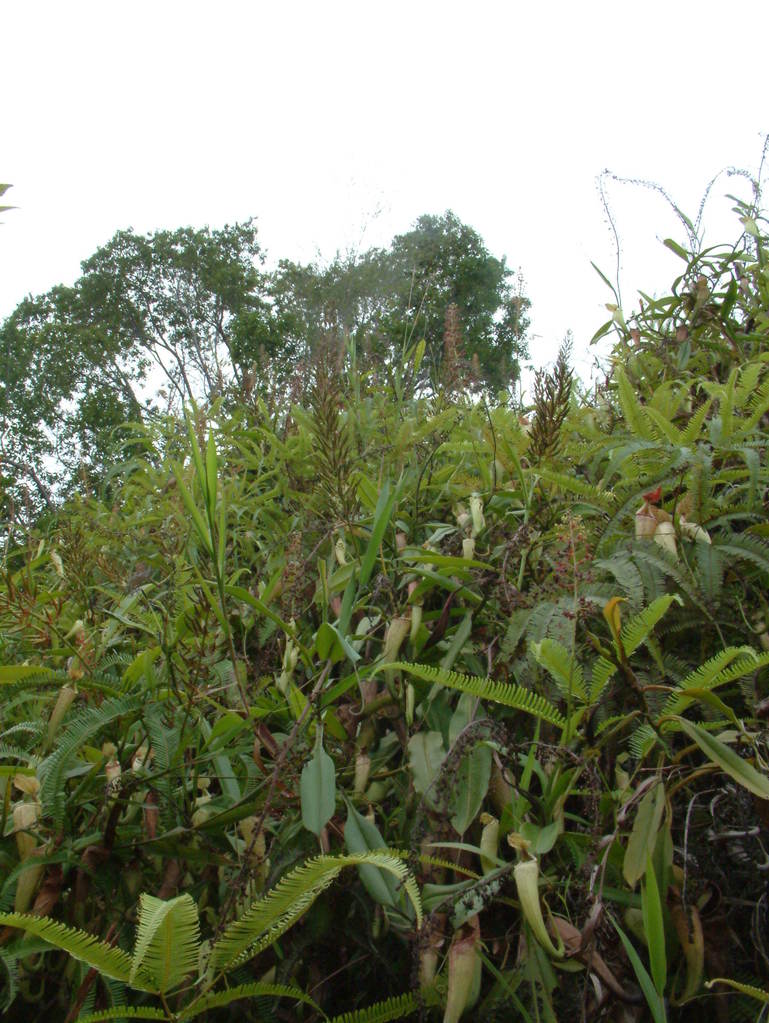
A wide range of habitats: epiphytic in mossy mountain forest, terrestrial in swampy grassland, and along forest edges and clearings (B1, W6, B5). The species occurs from about 400 m on Sulawesi to above 2600 m in New Guinea. It grows in both permanently wet and seasonally drier climates, making it one of the most adaptable species in the genus.
Distribution and elevation
Sulawesi, the Moluccas and New Guinea, with a possible record from Wowoni, an island off the coast of South-East Sulawesi. Not endemic to a single island. The guide's own species list gives 'Sulawesi to New Guinea', which is correct. Older records of N. maxima from Borneo mostly refer to related species of the complex.
- Recorded (quarter-degree cells)
Forms and variation
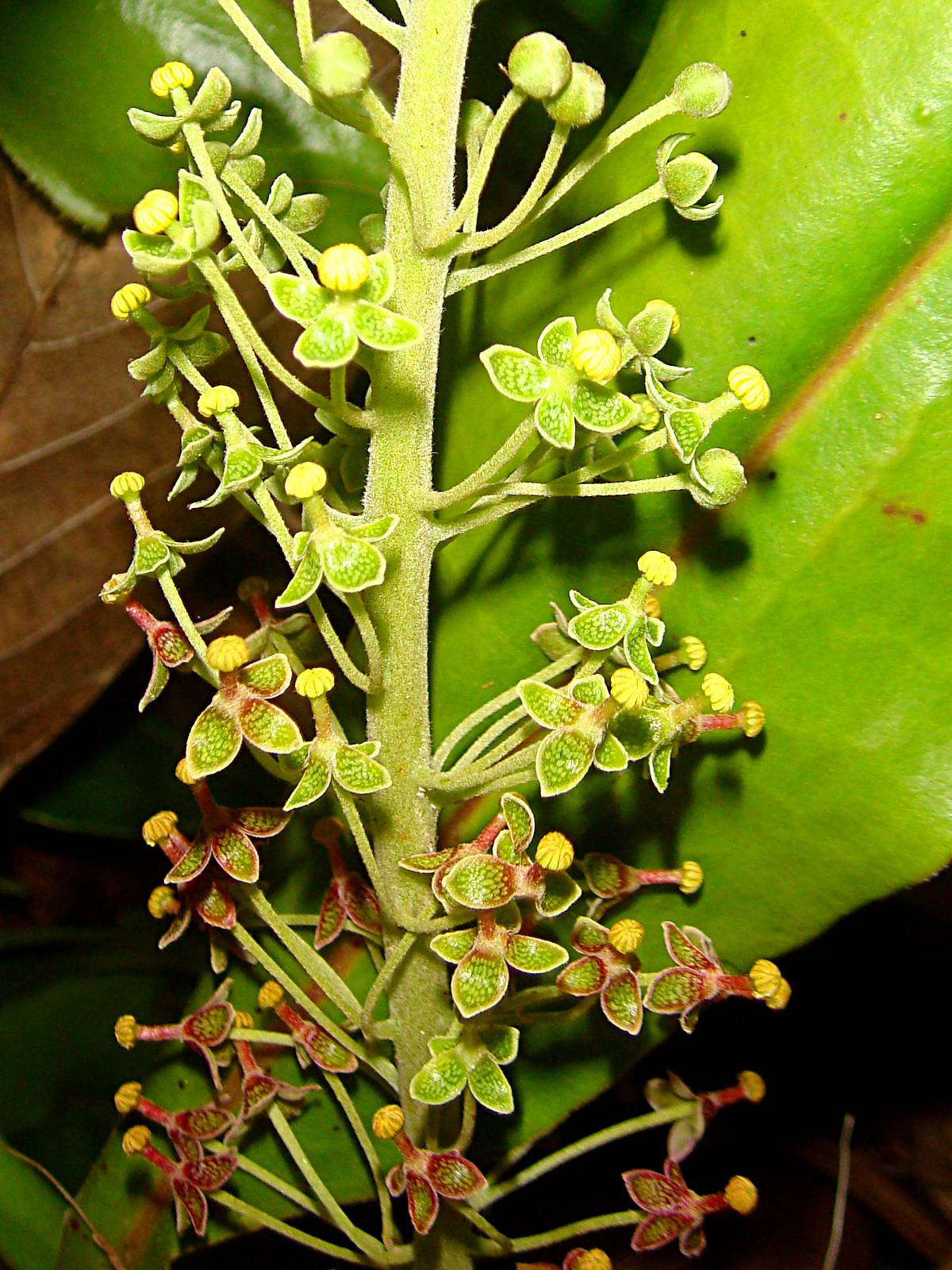
The species is markedly variable, and the variation is partly geographical: plants from drier areas have long, narrow pitchers with a narrow peristome, plants from wetter areas broader pitchers with a broad peristome, and many Sulawesi plants have wavy leaf margins. These forms are not accepted as separate varieties. Natural hybrids have been reported with, among others, N. neoguineensis, N. tentaculata and N. glabrata. Like all pitcher plants the species is dioecious: there are male and female plants, and both must be in flower for seed to set. The small, inconspicuous flowers are borne in racemes or panicles and are pollinated by insects; the seeds are light and dispersed by wind.
Where and when to see it
On Sulawesi the species is easy to see on several mountains, among them in and around Lore Lindu National Park in Central Sulawesi, where it grows along trails and forest edges in the mountains. Look along clearings and in the scrub for the long, striped upper pitchers; the lower pitchers are often hidden in the litter. In New Guinea it grows high up in the central ranges. In the mountains expect daily rain, cold nights and leeches on the trails, and allow plenty of time: most pitchers are found only by walking slowly and searching the vegetation systematically.
Conservation status
No IUCN assessment is included in the data this guide uses (Not Evaluated), although the species is listed elsewhere as Least Concern. What is known: its range is large, it occurs on many mountains and in varied habitats, and it tolerates disturbance such as forest edges and clearings. A serious short-term threat is therefore unlikely. As a member of Nepenthes it is listed in CITES Appendix II.
Scientific name
Nepenthes maxima | Reinwardt, 1824
Nepenthes maxima was described in 1824 by Caspar Georg Carl Reinwardt (published by Christian Gottfried Nees von Esenbeck) — the same year and the same author combination as N. gymnamphora (golf 23). The precise type locality could not be established with certainty; the species has a relatively wide distribution across New Guinea, Sulawesi and the Maluku Islands. The name is Latin for "greatest", referring to this species' relatively large pitcher size compared to related species.
World Checklist of Vascular Plants (WCVP), via Plants of the World Online (POWO), Royal Botanic Gardens, Kew.