All species › Caryophyllales › Tropical pitcher plant family › Nepenthes truncata
Nepenthes truncata
A giant among the pitcher plants of the Philippines, recognisable by leaves that look cut off at the tip. Nepenthes truncata was described in 1911 by John Muirhead Macfarlane; the name comes from the Latin truncatus, 'ending abruptly', after the truncate to deeply notched leaf tip. A later herbarium name, Nepenthes megamphora, referred to the large pitchers. For a long time the species was known only from a few fragmentary collections from north-eastern Mindanao. A dark highland plant formerly included in it has since been described as a separate species: Nepenthes robcantleyi.
Identification
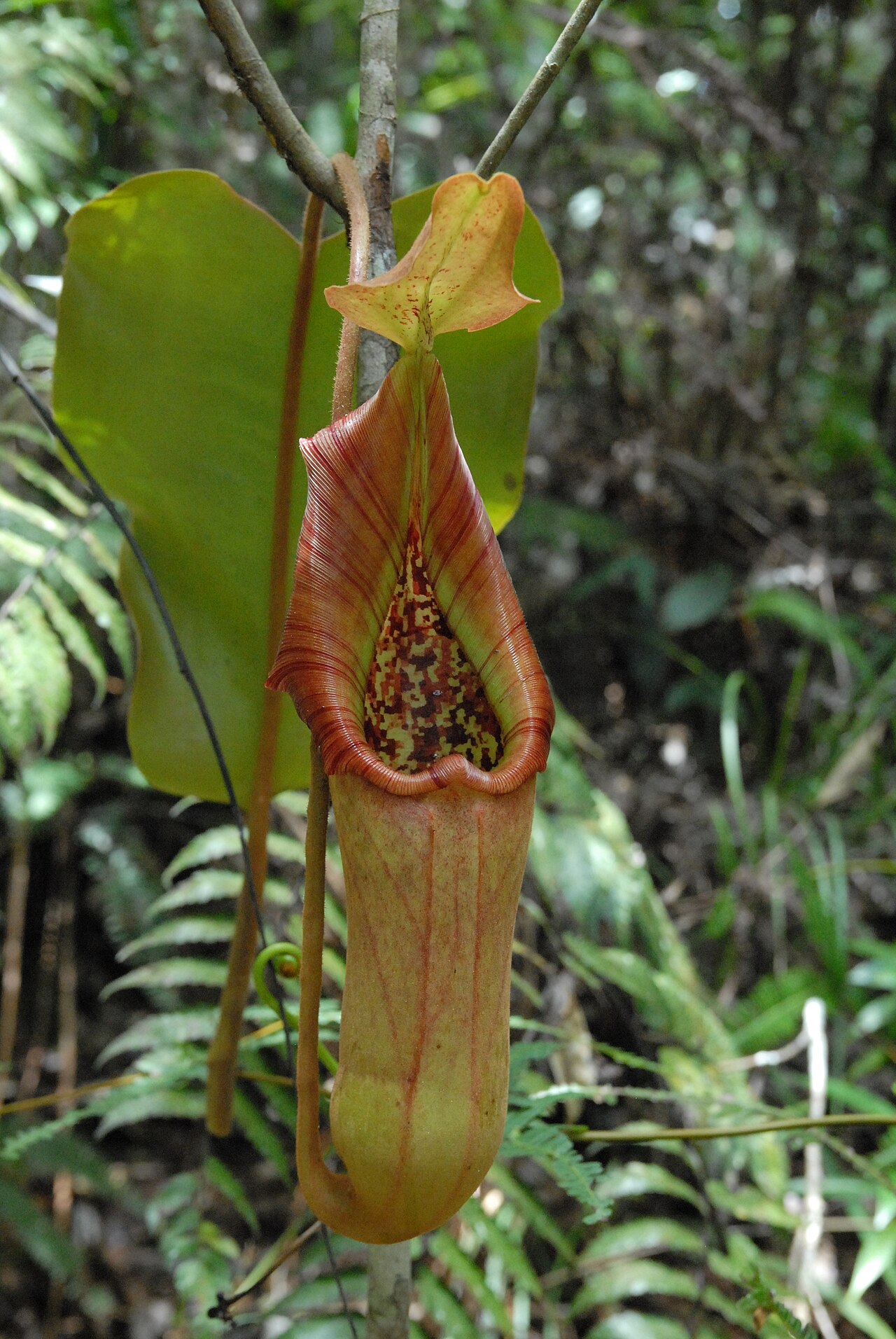
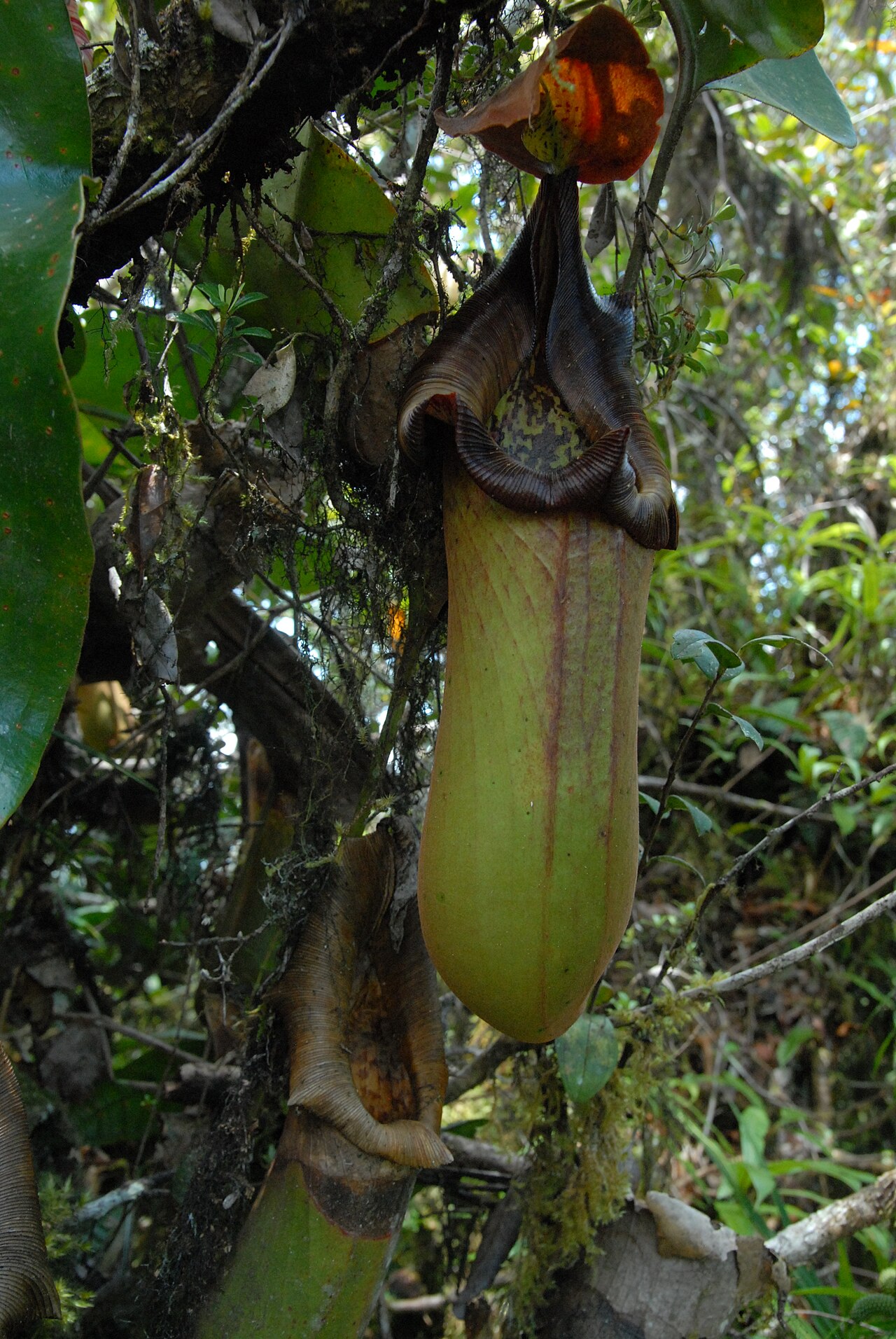
A robust, terrestrial shrub of at least one metre, which according to Flora Malesiana probably does not climb, with stems 1.5 to 3 cm thick. The leaves are thick and leathery and borne on long, channelled-winged petioles up to 27 cm. The blade reaches 45 cm long and 22 cm wide; the tip is more or less deeply notched or emarginate, the base truncate to shallowly heart-shaped. That is the field character par excellence. The leaf margin bears a dense fringe of red, branched hairs, while stem and leaf are otherwise hairless. Upper pitchers are cylindrical, up to 30 cm tall and 10 cm wide, wingless and rusty-hairy outside. The peristome is flattened and up to six centimetres wide, with coarse ribs, red striped with green. The lid is large, up to 9.5 cm long, and bears a rounded glandular crest at the base of its underside. Lower pitchers have two fringed wings.
Similar species
No other species combines such a truncate or notched leaf tip with such large, long-stalked leaves. Flora Malesiana sees affinity with the Nepenthes maxima group, on account of the strongly petiolate leaves, the appendaged lid and the two-flowered pedicels. The closest relative is Nepenthes robcantleyi, formerly considered a dark highland form of this species and now kept separate. Other large species of Mindanao, such as Nepenthes merrilliana, have narrow, linear leaves with a pointed tip and pitchers with a narrower peristome.
The trap and how it works
A large, cylindrical trap with an exceptionally broad peristome. The peristome, up to six centimetres wide and coarsely ribbed, offers a large slippery surface on which insects land and slip once it is wet. The lid carries on its underside a rounded crest rich in nectar glands, which lures prey exactly above the mouth. Upper pitchers lack wings and hang or stand among the leaves; lower pitchers do have fringed wings, which serve as a ramp for crawling animals. The pitchers can become large enough to catch small vertebrates occasionally, but for wild plants this is not documented in the literature consulted; the usual prey is insects.
Habitat and ecology
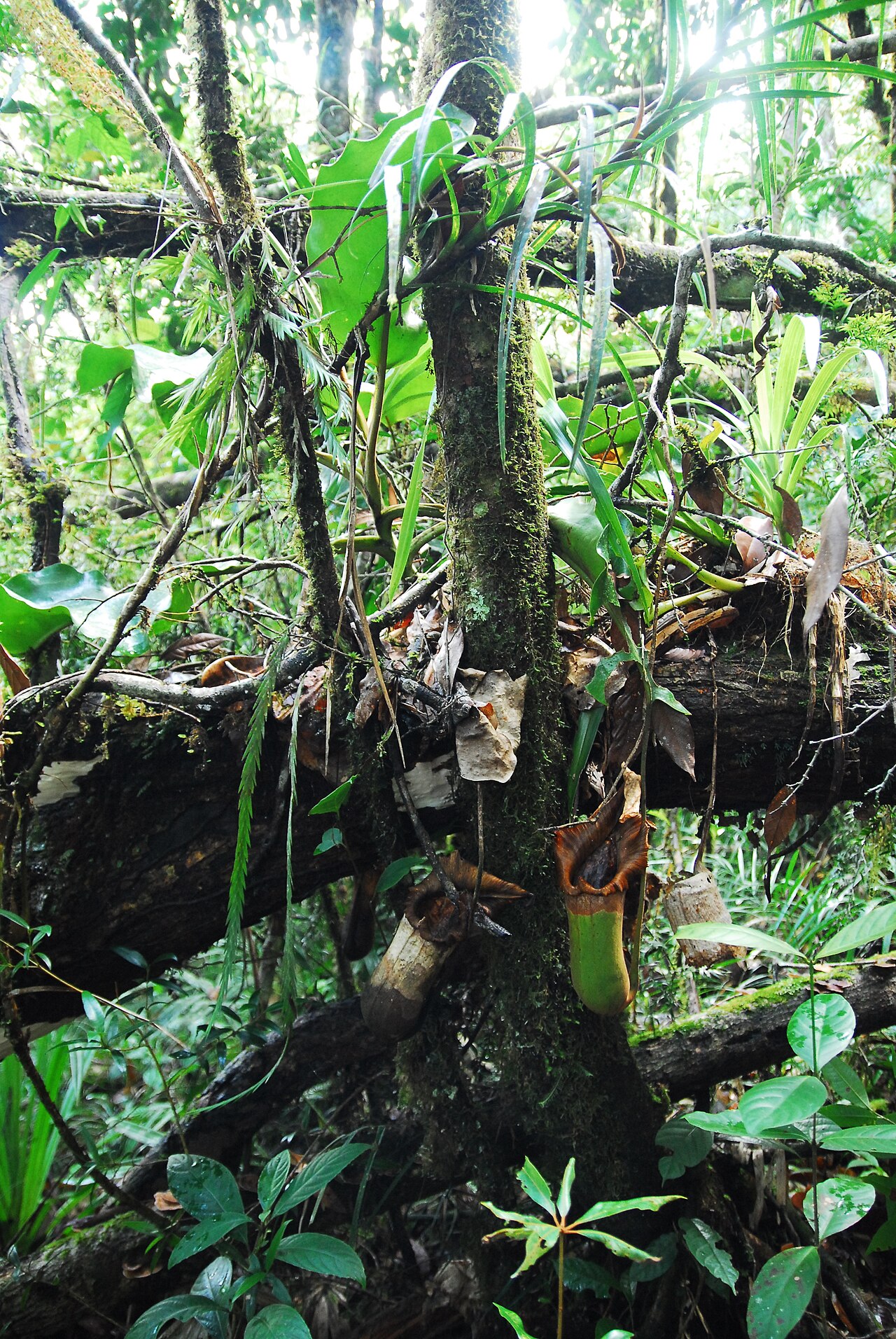
Open mountainsides, probably on ultramafic substrate, at 230 to 600 m according to Flora Malesiana (R3, B5). Later overviews give a much wider altitudinal range, from sea level to 1500 m, but these may include plants now referred to Nepenthes robcantleyi. North-eastern Mindanao and the islands of Dinagat and Leyte have large ultramafic areas with open, nutrient-poor vegetation where light-loving pitcher plants thrive.
Distribution and elevation
Endemic to the Philippines. Flora Malesiana gives north-eastern Mindanao; later overviews also report the species from the islands of Dinagat and Leyte. Our own species list gives Mindanao, which matches the core of the range. Because the species is listed as Endangered, this guide gives no more precise location than the islands and the region.
- Recorded (one-degree cells)
Forms and variation
No varieties or forms have been described. The dark highland plant formerly treated as a form of this species is now Nepenthes robcantleyi. Natural hybrids have been reported with Nepenthes mindanaoensis and with plants that fell under the old, broad name Nepenthes alata; a cross with Nepenthes petiolata is suspected. Newly opened pitchers are greener and plainer; older pitchers develop more strongly coloured peristomes, red striped with green.
Where and when to see it
This species is endangered and sought after by collectors; a site tip is therefore not appropriate. Anyone travelling in north-eastern Mindanao or on Dinagat can watch on open, rocky slopes with low scrub for the unmistakable leaves with notched tips and the large, cylindrical pitchers with a broad red-and-green peristome. Take no plants or seed, share no exact locations and respect the rules of local authorities and landowners. The security situation in parts of Mindanao varies; inform yourself well beforehand.
Conservation status
Listed on the Red List as Endangered, based on an older assessment (version 2.3 of the criteria). At the time of that assessment the species was known only from a few fragmentary collections. North-eastern Mindanao and Dinagat have been heavily affected by mining on ultramafic rock, notably for nickel and chromium, and by deforestation. As a member of Nepenthes it is listed in CITES Appendix II, so international trade in wild plants requires a permit; trade in this popular species rests largely on cultivated material.
Scientific name
Nepenthes truncata | Macfarlane, 1911
Described by John Muirhead Macfarlane in 1911, in "New species of Nepenthes", Contributions from the Botanical Laboratory of the University of Pennsylvania, volume 3, no. 3, p. 207-210. The precise type locality (island/site, coordinates) could not be established with certainty. The species occurs on the Philippine islands of Dinagat, Leyte and Mindanao. From the Latin truncatus ("abruptly cut off") — refers to the heart-shaped leaf base that ends abruptly rather than tapering gradually.
World Checklist of Vascular Plants (WCVP), via Plants of the World Online (POWO), Royal Botanic Gardens, Kew.