All species › Caryophyllales › Tropical pitcher plant family › Nepenthes burbidgeae
Nepenthes burbidgeae
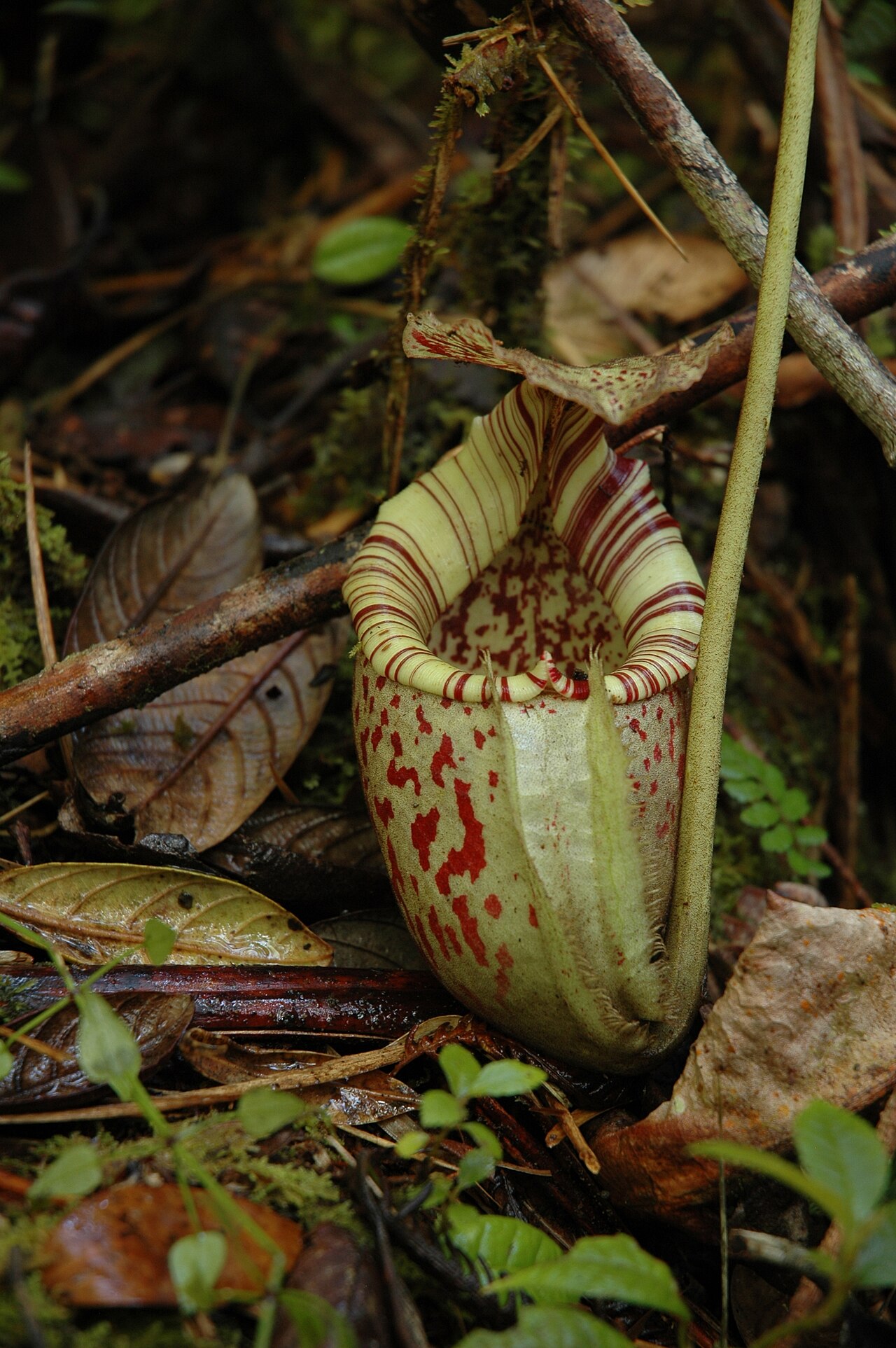
The 'porcelain' pitcher plant of the Kinabalu area in Sabah. When Frederick Burbidge collected it on the mountain in 1878, he described the pitchers as pure white, semi-translucent like eggshell, with crimson or blood-tinted blotches; Hooker named the species after Burbidge's wife. Nepenthes burbidgeae is one of the three classic pitcher plants of Kinabalu, alongside N. rajah and N. edwardsiana, and parent of the famous natural hybrid N. ×alisaputrana. It grows exclusively on ultramafic ground.


Identification
A vigorous climber that soon reaches the climbing stage, with stems to 15 m long and 18 mm thick and internodes to 12 cm. The leaves are leathery and stalked; the blade is oblong, to 40 cm long and 10 cm wide, with an acute tip, and the winged petiole, to 15 cm, often runs down the stem as two narrow wings. The tendril reaches 30 cm. Lower pitchers are rounded-infundibular to conical, without a clear constriction, to 25 cm tall and 10 cm wide, with fringed wings to 10 mm. The peristome is flattened and expanded, to 30 mm, with small teeth. The ovate lid, to 8 cm wide, has a distinct keel and a hooked appendage beneath. Upper pitchers are smaller, to 13 cm tall and 7 cm wide, funnel-shaped in the lower third and globose above, with two ribs.
Similar species
The hooked appendage under the lid, together with the pitcher shape and the porcelain-white colour with red blotches, makes the species easy to recognise. On Borneo only N. chaniana and N. pilosa have a comparable appendage; Danser considered N. pilosa its closest relative. The upper pitchers of N. burbidgeae are short and funnel-shaped, those of N. chaniana elongated and densely white-haired. On the same slopes the hybrid N. ×alisaputrana may grow: it has much larger pitchers, to 35 cm tall, yellow-green with red blotches and a purple-striped peristome.
The trap and how it works
A pitfall with a broad, flattened rim. The peristome, to 3 cm wide, forms a spacious slippery platform with small teeth on the inner edge, where nectar lures; about half its surface lies on the inside of the mouth. The lid stands open above the pitcher and bears a hooked appendage beneath. Inside, the lower half is lined with small, overarched digestive glands. The pale, almost translucent colour of the pitchers, with red blotches, stands out against dark moss and may attract insects. Little has been published on the prey of this species.
Habitat and ecology
Mossy montane forest and low scrub on steep ridges, exclusively on ultramafic soil (R3, B1). This soil, rich in magnesium, nickel and chromium and poor in the usual nutrients, keeps the vegetation low and open, and the species grows in the scrub and along forest edges. The usual altitude is 1200 to 1800 m; some sources give a lower limit of 1100 m and an upper limit above 2200 m. At its sites it shares the ground with N. rajah and N. tentaculata.
Distribution and elevation
Endemic to Borneo, and there confined to the Kinabalu area in Sabah, Malaysia: the slopes of Kinabalu itself and of neighbouring Mount Tambuyukon, almost all within the national park. The distribution is patchy, tied to ultramafic outcrops. Because the species is listed as endangered, this guide gives no precise localities. The world checklist holds no distribution data under this name; the range given follows Clarke (1997).
Forms and variation
No varieties have been described; the species varies little. Four natural hybrids are known: with N. edwardsiana, N. fusca and N. tentaculata, which have received little attention, and with N. rajah, the famous N. ×alisaputrana. The spelling N. burbidgei, which appeared in Burbidge's own articles of 1894 and 1896 and was long repeated, is a misprint; the correct name honours Burbidge's wife and therefore ends in -eae.
Where and when to see it
The species can be seen only within Kinabalu National Park, and park rules apply: keep to official trails, go with a guide, and do not touch plants. This guide names no specific sites. On ultramafic ridges in montane forest between about 1200 and 1800 m, the pitchers are recognised by their porcelain-white colour with red blotches; lower pitchers lie in the moss, upper pitchers hang in the scrub. The park also has visitor centres where the mountain's pitcher plants are explained.
Conservation status
The Red List assesses the species as Endangered (2000 assessment). In 1997 Clarke proposed a less severe status: almost all known populations lie within Kinabalu National Park and are hard for collectors to reach, so the species faces little danger in the near future as long as protection holds. Its small, fragmented range on a single soil type nevertheless leaves it vulnerable to fire, drought and road or mine building at the park's edges. It is listed in CITES Appendix II.
Scientific name
Nepenthes burbidgeae | J.D. Hooker ex Burbidge, 1882
The name was coined by Joseph Dalton Hooker, but it initially appeared only in an unpublished manuscript; the specific epithet was formally published by Frederick William Burbidge, in a letter to The Gardeners' Chronicle in 1882, in which he described the plant as "a lovely thing, as yet unintroduced: pitchers pure white, semi-translucent like egg-shell". The species was originally discovered on Mount Kinabalu in 1858 by Hugh Low and Spenser St. John, at approximately 1,200 m elevation; Burbidge carried out the formal type collection in 1878. The Marai Parai plateau on Mount Kinabalu, Borneo; the type material is held at the Royal Botanic Gardens, Kew, with a duplicate at the New York Botanical Garden. The specific epithet honours Burbidge's wife; Hooker made this dedication in recognition of Burbidge's contributions to knowledge of the genus Nepenthes.
World Checklist of Vascular Plants (WCVP), via Plants of the World Online (POWO), Royal Botanic Gardens, Kew.