All species › Caryophyllales › Tropical pitcher plant family › Nepenthes stenophylla
Nepenthes stenophylla
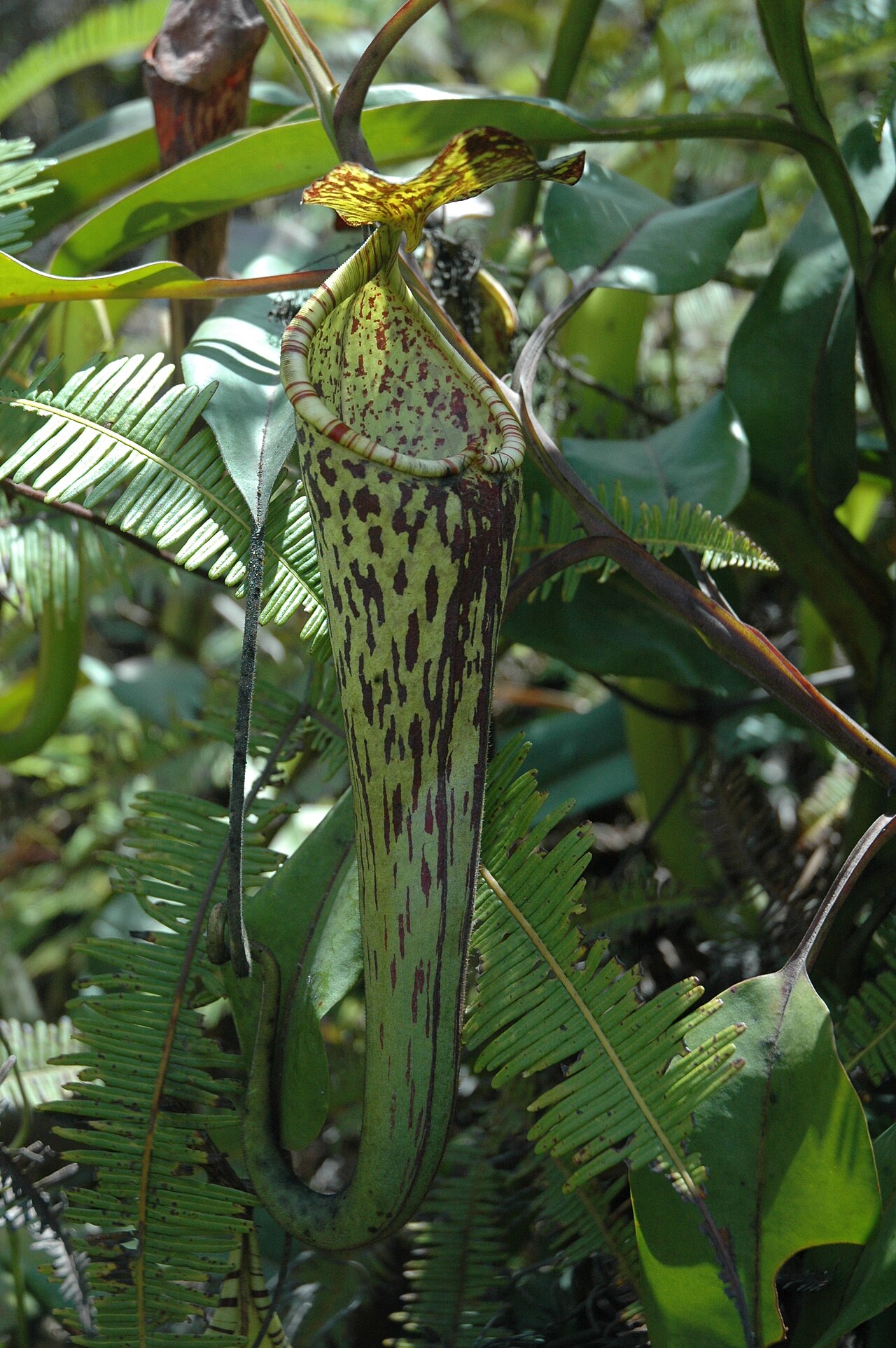
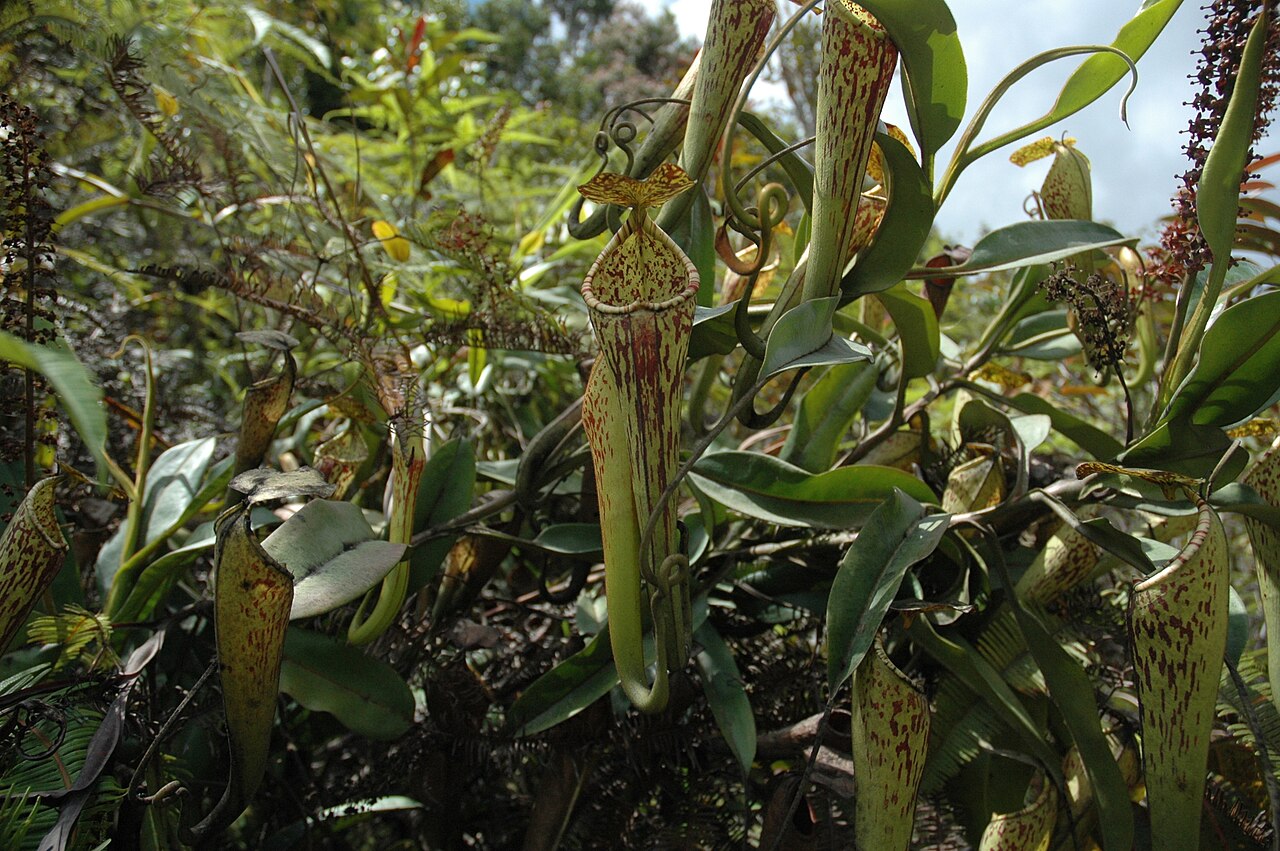
The 'narrow-leaved' pitcher plant, described by Masters in 1890, and one of the Bornean montane species with the most tangled nomenclatural history. Nepenthes stenophylla has been published under various names over time and often misidentified, and its relation to the taxon N. fallax is still debated. It is a widespread species of montane forest, with funnel-shaped pitchers to a quarter of a metre tall and a narrow lid, and belongs to the circle around N. maxima.

Identification
A climber of montane forest with, as the name says, narrow leaves. The pitchers are funnel-shaped and reach 25 cm tall. The lid is narrow, and that is the character by which, in the most widely used view, the species is distinguished from N. fallax, which has a round lid. No verifiable measurements of stem, leaves and separate lower and upper pitchers could be gathered for this guide; the size fields therefore hold only the pitcher height. Anyone wanting a firm identification should consult the monograph by Clarke (1997) or Phillipps, Lamb and Lee (2008).
Similar species
The species belongs to the N. maxima group, which on Borneo also includes Nepenthes fusca, N. faizaliana, N. chaniana, N. epiphytica, N. platychila and N. vogelii. N. faizaliana, which grows with N. stenophylla on the limestone mountains of Mulu, has more lanceolate leaves, larger inflorescences, a broader and more colourful peristome, one-flowered bracteate pedicels and lower pitchers bulbous at the base. N. fusca has a very narrow, triangular lid with down-curled margins. N. fallax is treated as a synonym by Danser and most later authors, but kept separate by Schlauer on account of its round lid.
The trap and how it works
A pitfall of the ordinary kind, with funnel-shaped upper pitchers aimed at flying insects: a funnel widening upwards gives an insect slipping on the smooth peristome little purchase. The narrow lid stands over the mouth and leaves the opening largely clear; it therefore offers the pitcher only limited protection from rain. No published data on the prey, or on the fine structure of peristome and glandular zone of this species, were found for this guide.
Habitat and ecology
Montane forest (B1), between 900 and 2100 m. The species grows in mossy montane forest and, according to the available literature, is often found with other montane species: with N. fusca, N. reinwardtiana and N. tentaculata, and at Gunung Mulu with N. faizaliana and N. vogelii. Its many natural hybrids point to a species that often grows alongside other Nepenthes.
Distribution and elevation
Endemic to Borneo. The species is widespread in the island's mountains, between 900 and 2100 m; the world checklist gives Borneo only. A finer breakdown over Sabah, Sarawak, Brunei and Kalimantan was not found in a verifiable source for this guide and is therefore not given. The area in our species list (Borneo) is correct.
- Recorded (one-degree cells)
Forms and variation
No varieties are recognised, but the naming is untidy: the species has a long list of synonyms and misidentifications, and an invalid subspecies name under N. fusca belongs here. The biggest question is the status of N. fallax. Natural hybrids are known with N. fusca, N. lowii, N. rajah, N. reinwardtiana, N. tentaculata and N. veitchii.
Where and when to see it
Because the species is widespread in Bornean montane forest, there is a good chance of meeting it in the montane national parks, for example on the limestone mountains of Gunung Mulu or in the montane forest of Sabah. Confusion with related species and the many hybrids make field identification difficult; look at the funnel-shaped upper pitchers and the narrow lid, and compare with N. fusca and N. faizaliana. Photographs of lid, peristome and leaf shape allow later checking.
Conservation status
The Red List assesses the species as Least Concern; the taxon N. fallax, regarded by some as a separate species, has its own assessment as Vulnerable. The wide range and altitudinal span make the species as a whole little vulnerable; loss of montane forest to logging is the main threat. It is listed in CITES Appendix II.
Scientific name
Nepenthes stenophylla | Masters, 1890
Described by Maxwell T. Masters in 1890, in The Gardeners' Chronicle (series 3, volume 8, p. 240), under the heading "New or noteworthy plants". An unusual case: the type material was not a wild-collected plant but a specimen raised from seed in an English greenhouse. There is therefore no wild type locality in the protologue. The species is now known to be endemic to Borneo, at 900-2100 m elevation. From the Greek steno- ("narrow") and -phylla ("leaved") — "narrow-leaved", referring to this species' characteristically narrow leaves.
World Checklist of Vascular Plants (WCVP), via Plants of the World Online (POWO), Royal Botanic Gardens, Kew.