All species › Caryophyllales › Tropical pitcher plant family › Nepenthes muluensis
Nepenthes muluensis
A small pitcher plant of the summits of the highest mountains in northern Sarawak, and the first Nepenthes described after the Second World War: the Japanese botanist Mitsuru Hotta collected it on Gunung Mulu in March 1964 and published it in 1966, after a gap of 26 years in which no new species had been added. Nepenthes muluensis stands out for its dark purple pitchers with yellow or white speckles and a bright white peristome and lid on the upper pitchers.

Identification
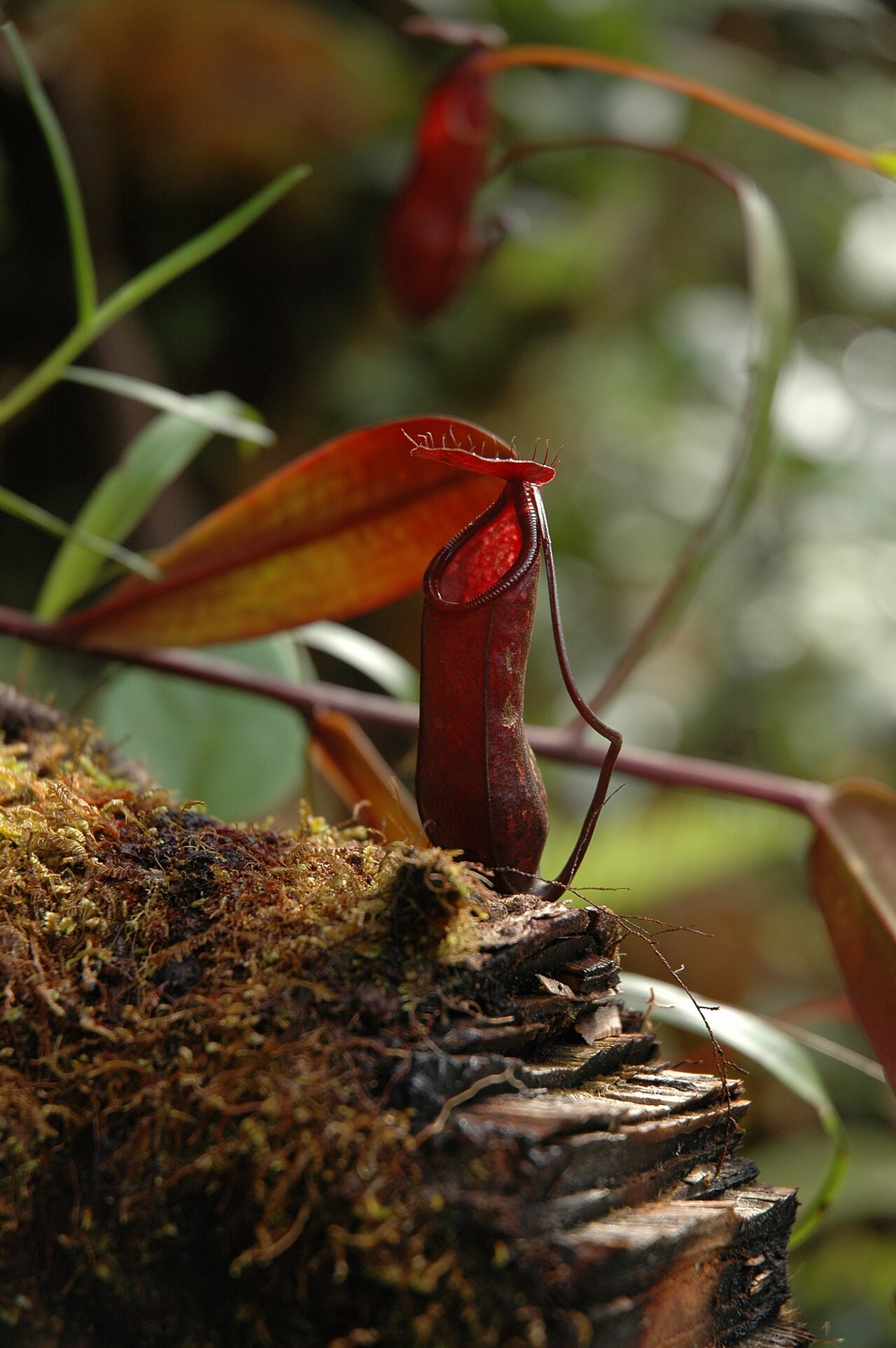
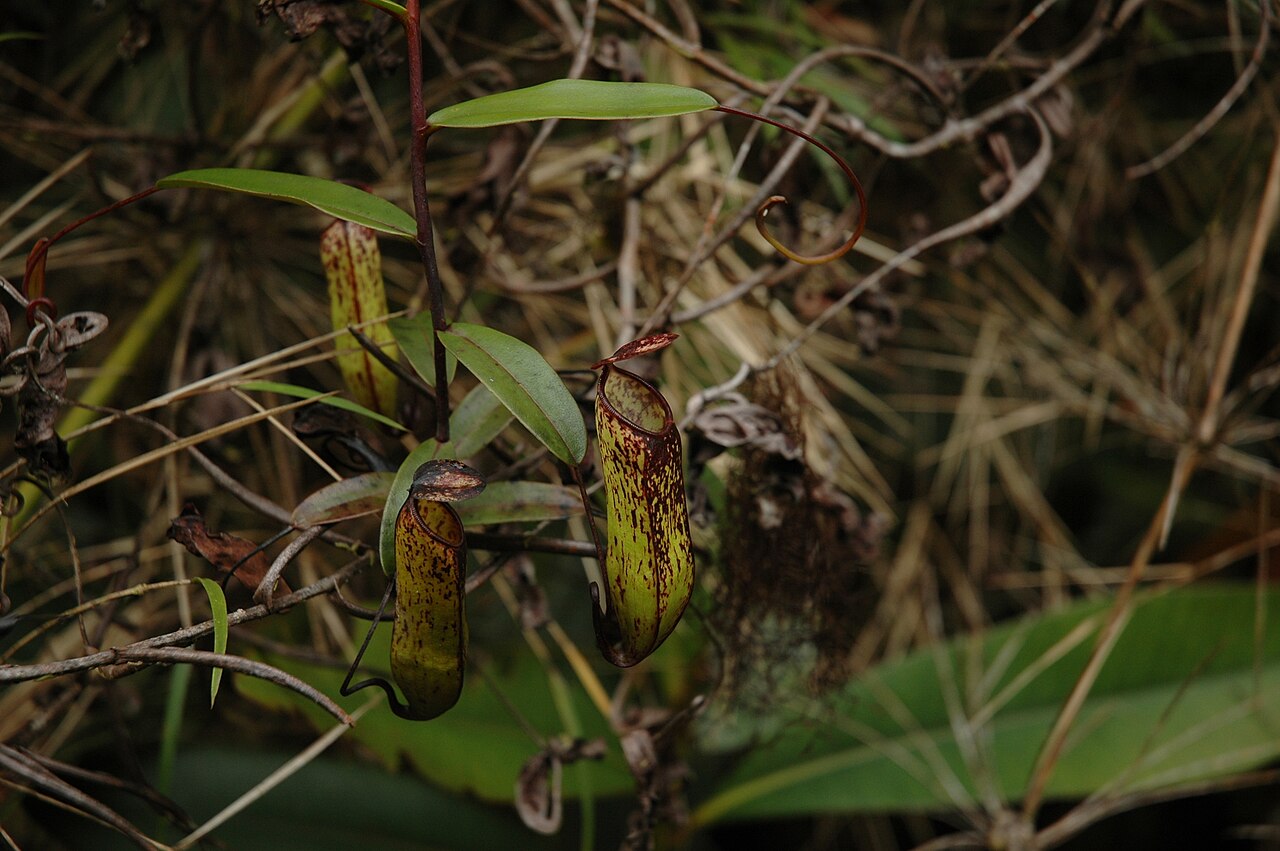
A climber with thin stems to 4 m long and 5 mm thick, with cylindrical internodes to 8 cm. The leaves are stalkless and leathery, lanceolate, to 8 cm long and only 1.5 cm wide, with an acute tip and a clasping base; the tendril reaches 8 cm. Lower pitchers are to 7 cm tall and 3 cm wide, ovoid in the lower third and cylindrical or conical above, with a round to ovate, obliquely set mouth and a cylindrical peristome of about 5 mm with small teeth. The ovate lid bears filiform appendages to 5 mm. Upper pitchers are cylindrical with an often bulbous base, to 10 cm tall and 2 cm wide, with ribs instead of wings, a round mouth, a peristome to 3 mm and a round lid without appendages. The plant is wholly hairless.
Similar species
The species is most easily confused with Nepenthes tentaculata, which occurs in the same area, often a little lower. The lower pitchers are nearly identical, but those of N. muluensis have a rounder mouth; the leaves are usually narrower. The best character is the upper pitcher: in N. muluensis with a white lid, a round mouth and greatly reduced or no wings, in N. tentaculata with an ovate lid that often bears filiform hairs. Like N. tentaculata, the species belongs to the Hamata group.
The trap and how it works
A small pitfall in two forms. Lower pitchers sit in the moss and, as in N. tentaculata, carry filiform appendages on the lid. Upper pitchers have a well-developed waxy zone on the inner wall, on which insects find no grip, and a white peristome and lid that contrast sharply with the dark purple pitcher; the contrast shows up well in the half-light of the mist and may serve as a lure. The digestive glands lie at the bottom. Little has been published on the prey; the plant's chemistry has been studied, however, showing that it lacks certain flavonoids and cyanidin found in N. tentaculata.
Habitat and ecology
Open places in mossy upper montane forest and ridge-top vegetation (B1), on nutrient-poor soils, between 1700 and 2400 m. On the summit of Gunung Mulu the vegetation is greatly stunted, rarely over a metre tall, and dominated by Rhododendron ericoides and species of Diplycosia and Vaccinium. On Mount Murud, populations grow in shaded mossy forest, and there the pitchers are darker. The plant climbs through the low shrubs with its thin stems.
Distribution and elevation
Endemic to Borneo. Known from Gunung Mulu, Gunung Api, Mount Murud and Bukit Batu Lawi in Sarawak, and from south-western Sabah. On Mulu it grows from about 1900 m to the summit at 2376 m. It is not known from the nearby summit of Benarat. Altitude: 1700 to 2400 m. Our species list names only Gunung Mulu; the species is now known from several mountains in Sarawak and from Sabah as well.
- Recorded (one-degree cells)
Forms and variation
No varieties have been described. Populations do differ in colour: on Mulu the lower pitchers are dark purple with sparse yellow speckles and the upper pitchers purple with many yellowish-white speckles and a white peristome and lid; on Murud the pitchers are darker, possibly because of stronger ultraviolet at higher altitude. Two natural hybrids have been reported: with N. lowii, and with N. tentaculata, described in 1993 as N. ×sarawakiensis; the existence of the latter is doubted.
Where and when to see it
The climb to the summit of Gunung Mulu is a trek of several days within the national park, only with a park guide and after booking with the park administration. Above about 1900 m, in the low scrub on the ridge, the dark purple pitchers with their white lids can be found among moss and rhododendrons. The plants are small; look low and carefully. Collecting plants is prohibited in the park.
Conservation status
The Red List assesses the species as Least Concern (2018 assessment). Earlier assessments were stricter: Endangered in 1995 and Vulnerable in 2000, and Clarke in 1997 called it endangered but conservation dependent. The shift mainly reflects the finds on other mountains. The Mulu populations lie in a national park and World Heritage Site. The species is listed in CITES Appendix II.
Scientific name
Nepenthes muluensis | Hotta, 1966
Nepenthes muluensis was described in 1966 by Mitsuru Hotta, in "Notes on Bornean plants" (Acta Phytotaxonomica et Geobotanica). The holotype (M. Hotta 14791d) was collected on 18 March 1964 on the Mardi route, between the third and fourth camps on the western ridge of Mount Mulu, Sarawak, and is held at the Botany Department of Kyoto University. The western ridge of Mount Mulu, between the third and fourth camps on the Mardi route, Sarawak, Borneo. The species is named after Mount Mulu, to which it was thought to be endemic.
World Checklist of Vascular Plants (WCVP), via Plants of the World Online (POWO), Royal Botanic Gardens, Kew.