All species › Caryophyllales › Tropical pitcher plant family › Nepenthes talangensis
Nepenthes talangensis
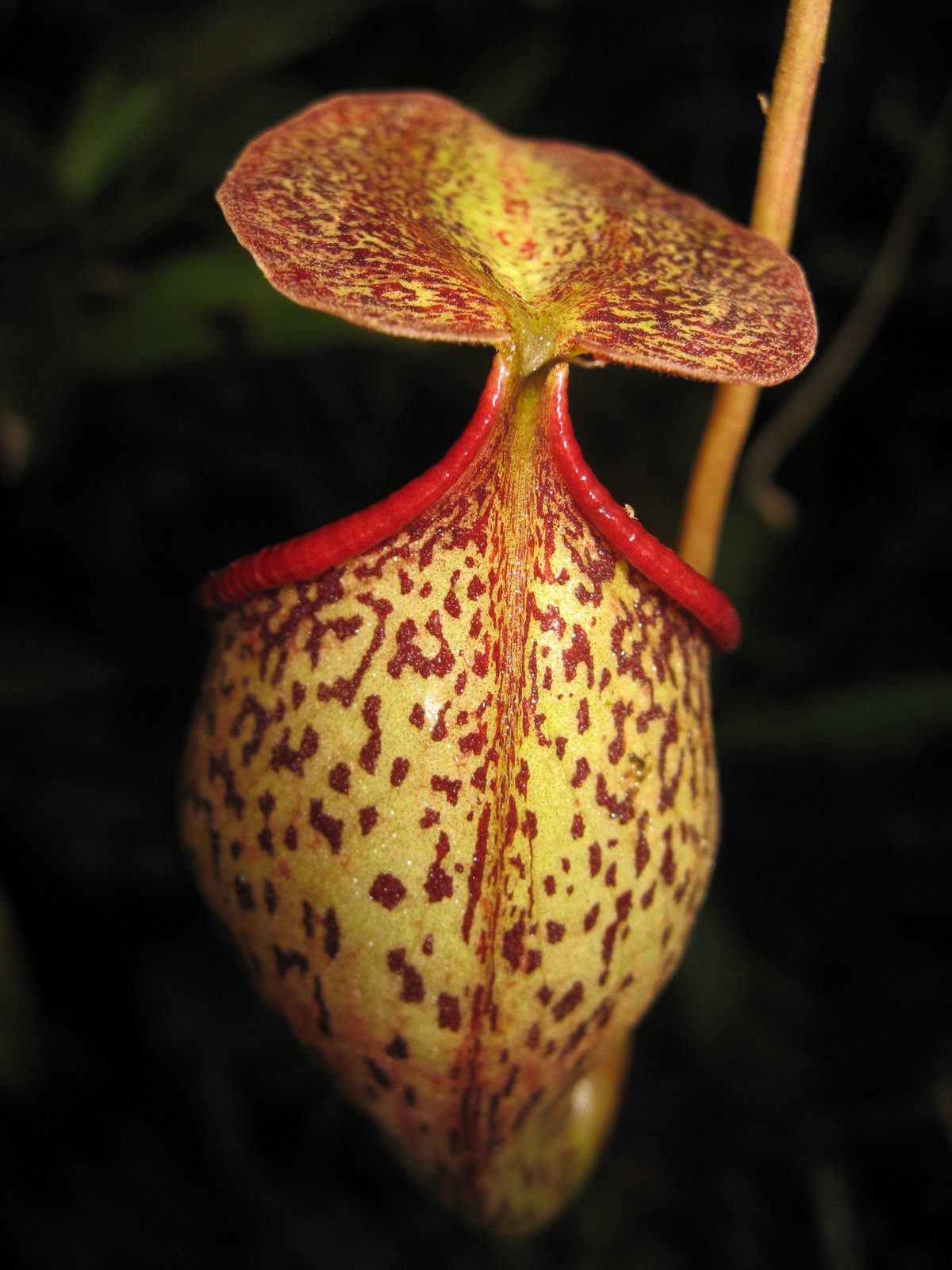
A small pitcher plant of the highest parts of an active volcano in West Sumatra, after which it is named. Nepenthes talangensis was collected as early as 1918 but described only in 1994 by Nerz and Wistuba, then placed in N. bongso by Jebb and Cheek, and restored as a species by Clarke in 2001. Characteristic are the squat, yellow-green to olive pitchers with red speckles and a broad, strongly incurved peristome with distinct teeth. The species is a favourite subject in research on carnivorous-plant physiology.


Identification
A climber to about 3 m, with a stem to 5 mm thick and internodes to 10 cm, sometimes branched. The leaves are stalkless and leathery, linear to lanceolate or slightly spathulate, to 16 cm long and 3 cm wide, with an acute to obtuse tip; the margin bears red, brown or white hairs to 3 mm. The tendril reaches 30 cm. Lower pitchers are ovate or ovate-infundibular, narrowed below the peristome, to 10 cm tall and 6 cm wide, usually with fringed wings. The peristome is flattened, strongly incurved and up to 15 mm wide, with ribs ending in teeth to 3 mm; the mouth rises at the back into a short neck. The lid is ovate to elliptic, to 6 by 5 cm. Upper pitchers are narrowly funnel-shaped and swollen in the lower half, or funnel-shaped throughout, to 12 cm tall, with a peristome to 24 mm.
Similar species
Nepenthes bongso, with which the species was long merged, has a far less incurved peristome, larger leaves without a hair fringe, a rounded leaf tip with the tendril inserted just below it, and upper pitchers with a gland-free cylindrical upper zone; in N. talangensis the inner wall is wholly glandular. Its closest relative is N. aristolochioides, with dome-shaped pitchers and an almost vertical mouth. From N. eymae, N. flava, N. inermis, N. pitopangii and N. tenuis it is told by the combination of a broad lid without appendages and a strongly incurved peristome with distinct ribs and teeth.
The trap and how it works
A pitfall without a waxy zone: the entire inner wall is lined with digestive glands. The peristome is remarkable: it is so strongly incurved that about three-quarters of its surface lies on the inside of the mouth, and its ribs, up to 0.8 mm high and 1 mm apart, end in teeth to 3 mm that overhang the opening. An insect slipping on the wet, smooth peristome thus lands directly above the fluid. The species has been used in physiological research: experiments showed that prey capture raises photosynthetic efficiency, and that leaf fertilisation can partly replace prey.
Habitat and ecology
Mossy upper montane cloud forest (B1), between 1800 and 2500 m. The plant almost always grows on the ground, rarely as an epiphyte, both under a dense, shaded canopy and among open, stunted shrubs. At lower elevations it shares the mossy forest with N. gymnamphora and N. inermis. The volcanic soil is acid and poor, and the forest stands in cloud most of the time.
Distribution and elevation
Endemic to Sumatra, Indonesia, in the province of West Sumatra, and confined to the volcanic massif after which it is named and an adjoining hill. Altitude: 1800 to 2500 m. Because the species is listed as endangered, this guide gives no precise localities. The area in our species list agrees with the literature and the world checklist.
- Recorded (one-degree cells)
Forms and variation
The species varies little across its small range, and no varieties are recognised. Colour is pale yellow to olive green with red or purple speckles; the peristome is yellow or orange at first and darkens to deep red or purple, and the underside of the lid is often wholly red. Upper pitchers are usually lighter. Three natural hybrids are known: with N. bongso, N. gymnamphora and N. inermis. The last resembles N. dubia but has a broader lid never reflexed beyond a right angle and a mouth rising at the back.
Where and when to see it
The volcano is active, and for that reason and to protect the species the area is not freely accessible; always follow official guidance on volcanic activity. This guide gives no routes or sites. Anyone reaching the montane forest above 1800 m on an organised visit with a recognised guide will know the species by its small, squat pitchers with the strongly incurved, toothed peristome and by the hairy leaf margins. Stay on the path and collect nothing: every plant on a single mountain counts.
Conservation status
The Red List assesses the species as Endangered (2000 assessment). Being confined to one mountain, it could by current criteria even qualify as Critically Endangered. McPherson (2009), however, judged the wild populations extensive and not seriously threatened. Remarkably, volcanic activity protects the species more than it threatens it: it keeps visitors and clearing at bay. The species is listed in CITES Appendix II.
Scientific name
Nepenthes talangensis | Nerz & Wistuba, 1994
Described by Nerz & Wistuba in December 1994, in Carnivorous Plant Newsletter, in the article "Five new taxa of Nepenthes (Nepenthaceae) from North and West Sumatra". Holotype Nerz 2501, Mount Talang, West Sumatra, Indonesia, at 2200 m elevation, collected on 6 September 1986. The species occurs at 1800-2500 m, in upper montane forest on Mount Talang and the nearby Bukit Gombak. Named after Mount Talang, its type locality, plus the Latin suffix -ensis ("from").
World Checklist of Vascular Plants (WCVP), via Plants of the World Online (POWO), Royal Botanic Gardens, Kew.