All species › Caryophyllales › Tropical pitcher plant family › Nepenthes thai
Nepenthes thai
A species with a simple name and a complicated back-story. In the 2001 Flora Malesiana treatment, plants from the limestone hills in the far south of Thailand were still included in Nepenthes benstonei, a species of the Malay Peninsula. On closer study they proved to differ on a few consistent points, and in 2009 Martin Cheek described them as a species of their own: Nepenthes thai. It is a member of group Montanae, pitcher plants of hills and mountains on the peninsula and in Indochina, and one of the few species that grows on limestone.
Identification
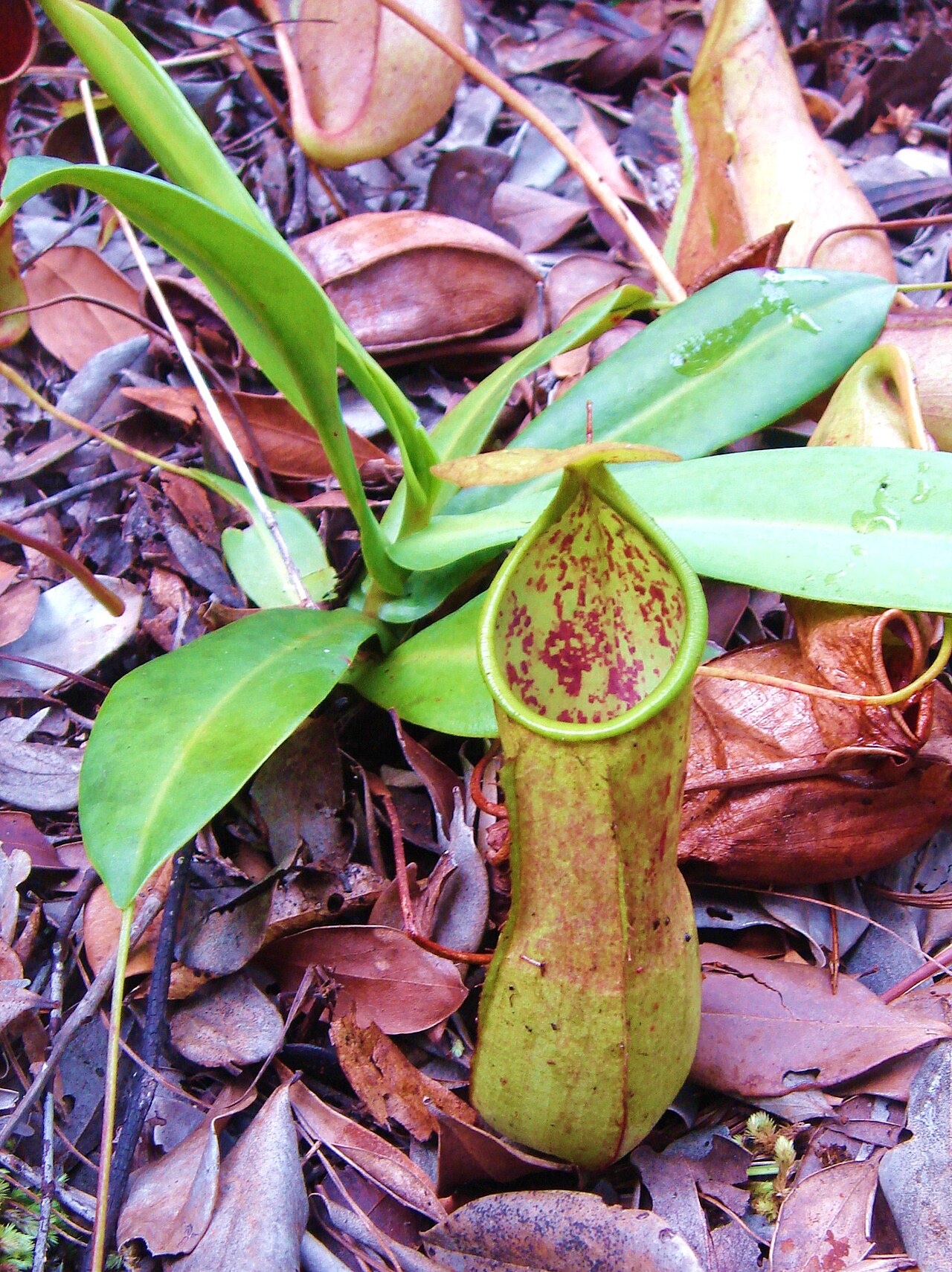
A climbing plant with glabrous stems. The leaf blades on the short stems are 11.5 to 29 cm long and 2.7 to 6 cm wide. Lower pitchers are 8 to 11 cm tall and 3 to 4.4 cm wide, upper pitchers 7.5 to 14 cm tall and 1.5 to 4.2 cm wide — slimmer and often more funnel-shaped than the lower ones, which are broader below and carry wings on the front. The inflorescence has short partial peduncles of 2 to 4 mm. In male flowers the staminal column (androphore) is about 2 mm long.
Similar species
The closest relative is Nepenthes benstonei of the Malay Peninsula, with which the species was formerly confused. The difference lies in details: N. thai has glabrous stems where N. benstonei is sparsely hairy; the partial peduncles are 2 to 4 mm long against about 9 to 10 mm in N. benstonei; and the androphore is 2 mm against 4 mm. In the field habitat helps most: N. thai grows on limestone in southern Thailand. Other species of the Montanae group, such as N. sanguinea and N. macfarlanei, grow higher in the mountains of the peninsula and have different pitchers.
The trap and how it works
A pitcher trap of the usual kind, with a slippery peristome, nectar on the rim and under the lid, and digestive fluid at the bottom. The lower pitchers stand on the ground or on limestone ledges and mainly catch walking prey; their wings serve as a walkway for ants. The upper pitchers hang in the air from the climbing stems and also catch flying insects. On limestone the soil is not acid but alkaline, and nutrients are scarce because there is hardly any soil; the extra nitrogen and phosphorus from prey are just as worthwhile to the plant there.
Habitat and ecology
Limestone hills in the lowland and low hill zone, between about 500 and 665 m (R2). The plants grow on the slopes and ridges of these hills, where the soil is thin and lies between the rocks. Limestone is an unusual substrate for pitcher plants; most species of the genus grow on acid, nutrient-poor ground. The limestone hills of southern Thailand are isolated ‘islands’ in the landscape, with a flora of their own, often endemic.
Distribution and elevation
Endemic to Thailand, in the southern peninsula, in Narathiwat province. According to the description the species is known from only four limestone sites in a small area, between 500 and 665 m. It is the southernmost member of the Montanae group in Thailand and lies close to the border with Malaysia, where N. benstonei occurs.
- Native
Forms and variation
No varieties or forms are distinguished, and no natural hybrids of N. thai are known. Taxonomically the species results from splitting N. benstonei in the broad sense: the Thai material treated under that name in 2001 has been N. thai since 2009. Because the species has been recognised only recently and is known from few sites, little has yet been published on its natural variation.
Where and when to see it
The limestone hills of Narathiwat province in the far south of Thailand are the only area. The region is remote, and the security situation in the southern border provinces has been tense for years; check current travel advice and go only with local guidance. On the hills themselves, look on the ledges and in the shrubs on the slopes for slender upper pitchers, and for lower pitchers among the rocks. Do not enter quarries.
Conservation status
The species is not evaluated for the Red List (Not Evaluated) in the source this guide uses. The describers themselves proposed Endangered in 2009, because the species is known from only four limestone sites in a small area and those hills are threatened by quarrying for the cement industry. Limestone hills in Southeast Asia are literally disappearing into the crusher in many places, and their endemic species with them. As a member of the genus it is listed in CITES Appendix II.
Scientific name
Nepenthes thai | Cheek, 2009
Described by Cheek & Jebb in 2009, in "Nepenthes group Montanae (Nepenthaceae) in Indo-China, with N. thai and N. bokor described as new", Kew Bulletin, volume 64, no. 2, p. 319-325. Endemic to peninsular Thailand, on limestone hills, at 500-600 m elevation; a more specific mountain or place name is not given in the available sources. Simply named after Thailand, the country to which the species is endemic — no deeper etymological meaning is known.
World Checklist of Vascular Plants (WCVP), via Plants of the World Online (POWO), Royal Botanic Gardens, Kew.