All species › Caryophyllales › Tropical pitcher plant family › Nepenthes tboli
Nepenthes tboli
Few pitcher plants rest on so little material. Nepenthes tboli was described in 2014 from a single herbarium collection made in 1993 in the uplands of southern Mindanao, and the description states plainly that only one or two mature plants are known for certain in the wild. It belongs to the so-called Nepenthes alata group, a set of Philippine species with winged petioles, pitchers broadest at the base and a ridge or appendage on the underside of the lid. The name honours the T'boli people, in whose land the plant was found.
Identification
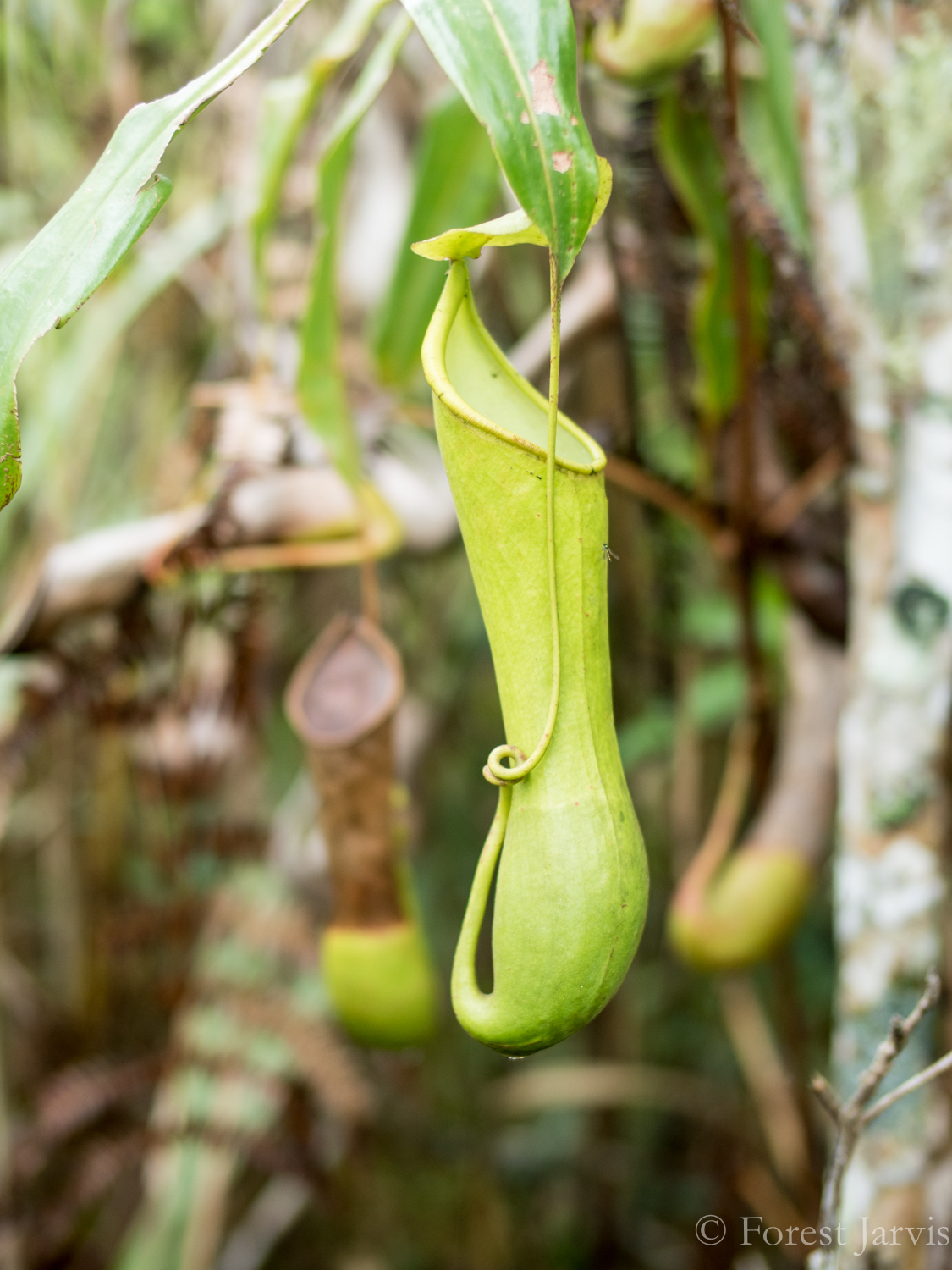
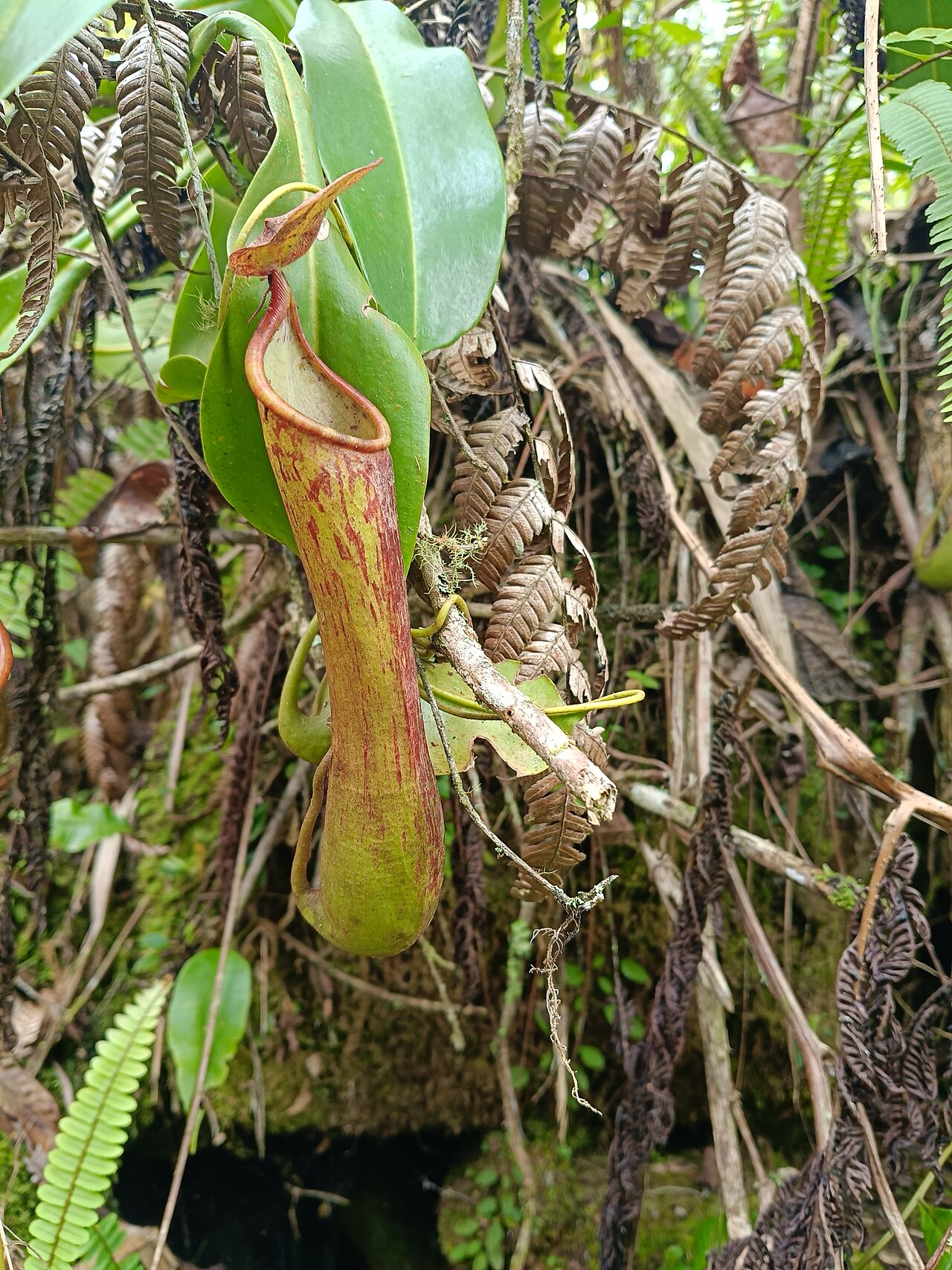
A small shrubby or weakly climbing plant at least half a metre tall, with terete stems four to six millimetres thick. The leaves are oblong-elliptic, 11 to 16 cm long and 2.8 to 3.5 cm wide, narrowing into a winged petiole 4.5 to 6 cm long. The hairs stand out: the leaf margin and the midrib beneath carry spreading hairs, and small red glands dot the lower surface. The only known pitchers are upper pitchers: narrow, almost cylindrical, 11.5 to 17.5 cm tall and 3.5 to 4 cm wide, broadest at the base. The wings are reduced to ridges. The peristome is narrow, just 2 to 2.5 mm, with its outer edge tightly rolled in. The lid is ovate, 3 to 3.8 cm long, with a notched tip. Lower pitchers have not been described, and the description says almost nothing about colours in the field.
Similar species
The describers name Nepenthes saranganiensis, from the same southern corner of Mindanao, as the most similar species. That plant, however, has stems with four conspicuous wings formed by long-decurrent leaf bases, hairless leaves and a rounded lid tip. Nepenthes tboli has terete stems, hairy leaf margins and midribs, and a notched lid tip. A peculiar feature is a small forward-pointing pocket on the underside of the lid, a few millimetres behind the tip; within the alata group such a pocket is otherwise known only from Nepenthes graciliflora, and outside it from Nepenthes albomarginata and Nepenthes robcantleyi. In doubt in the field, the combination of round stem and narrow peristome is the most useful.
The trap and how it works
A pitfall trap like that of every pitcher plant: a pitcher at the end of a leaf tendril, with a slippery peristome as its rim and digestive fluid at the bottom. Here the peristome is narrow and finely ribbed, the ribs less than two tenths of a millimetre high; the inner edge lacks teeth but has small holes where nectar glands open. The lid carries three kinds of nectar gland: a band of large oblong glands along the midline, small rimmed glands on the basal appendage, and still smaller ones where the lid meets the peristome. The pocket under the lid is a puzzle; the describers suspect it plays a role in luring prey, but this has not been studied. Nothing is known of the prey itself. Since only upper pitchers have been collected, it is plausible but not shown that the plant mainly catches flying insects.
Habitat and ecology
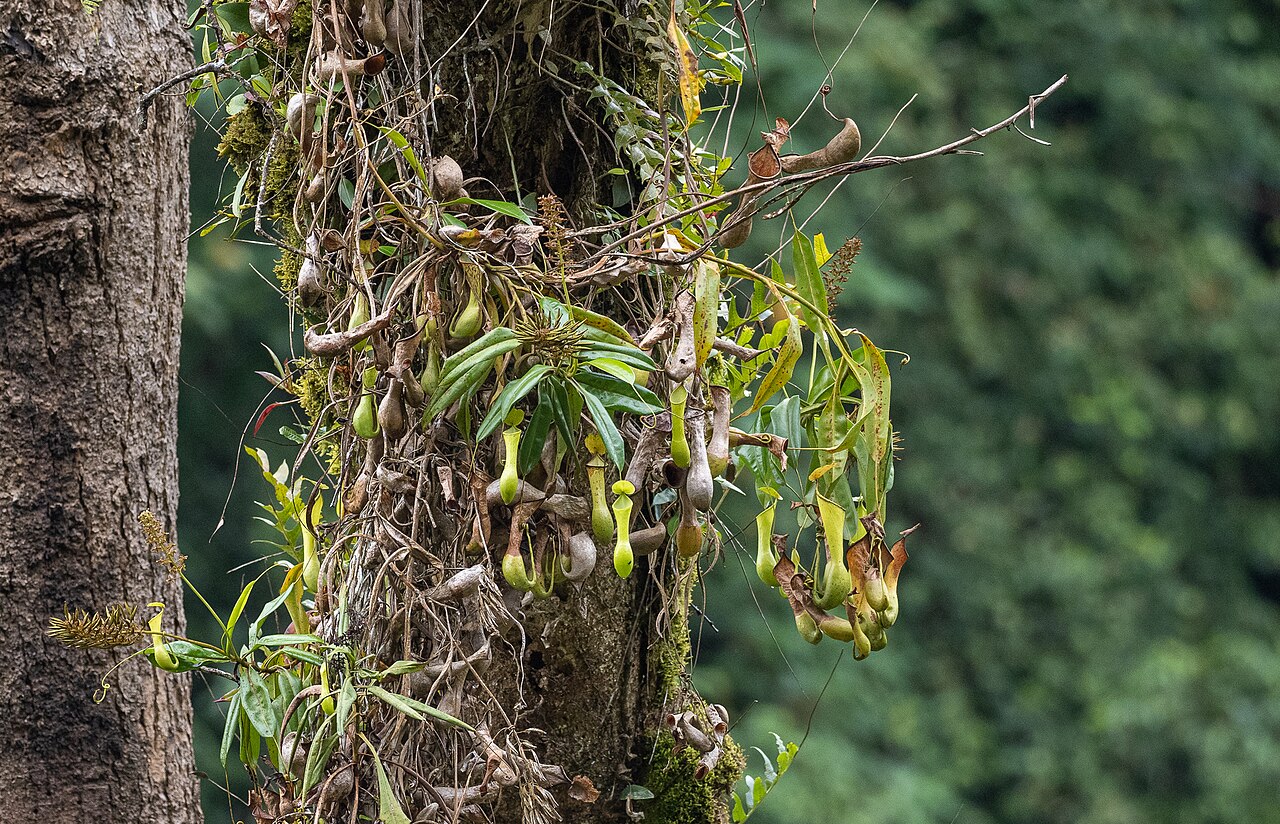
The label of the type collection records open grassland at 1463 m, in the uplands of southern Mindanao. That fits the way many species of the alata group live: in open, sunny vegetation or along forest edges, leaning up through grass and shrubs (B5). The description says nothing about the soil, and it is not known whether the ground is naturally open or was opened up by people. The elevation field gives the only known collecting altitude; with one site, a true altitudinal range cannot be given.
Distribution and elevation
Endemic to the Philippines and known only from the south of Mindanao, in South Cotabato Province, in T'boli country. The type collection was made in August 1993 and included male flowers and fruit. Because the species is considered critically endangered, this guide gives the site no more precisely. It is quite possible that the species grows at more places in the surrounding uplands: southern Mindanao is poorly explored botanically, and small pitcher plants in tall grass are easily overlooked. Until that is shown, the range remains a single site.
- Recorded (one-degree cells)
Forms and variation
No varieties or colour forms have been described, and with so little material nothing can be said about variation within the species. It is not even known what the lower pitchers look like; in related species they are usually squatter, ovoid and carry two fringed wings, but that has not been observed here and should not simply be assumed. No natural hybrids have been reported. Plants appearing in the trade under this name have no known wild origin and say nothing about the species.
Where and when to see it
For the ordinary naturalist this is not a species to seek out. The only known site lies in an area where tourism and agriculture are precisely the main threat, and every extra visitor counts. Anyone travelling through the uplands of South Cotabato can still walk open, grassy ground with open eyes and photograph small pitcher plants with narrow cylindrical pitchers without touching them. A good photograph with date and rough altitude, shared with botanists at a Philippine university or herbarium, is worth more than a precise location on a public website.
Conservation status
The Red List assesses the species as Critically Endangered. The describers reached that assessment because only one or two mature plants are known for certain, at a site threatened by plantation agriculture and tourism development. As a member of Nepenthes it is listed in CITES Appendix II, so international trade in wild plants requires a permit. For a species with so small a known population, every plant lost from the wild is a measurable loss; protection of the remaining open ground and targeted fieldwork for further populations are the obvious first steps.
Scientific name
Nepenthes tboli | Jebb & Cheek, 2014
Described by Jebb & Cheek in 2014, in "Expansion of the Nepenthes alata group (Nepenthaceae), Philippines, and descriptions of three new species", Blumea – Biodiversity, Evolution and Biogeography of Plants, volume 59, no. 2, p. 144-154 (31 December 2014). Collected in 1993, around Lake Parker, T'Boli, South Cotabato province, Mindanao, Philippines, at 1463 m elevation. Named after the T'boli people and the eponymous town of T'Boli in South Cotabato — the same place as the type locality.
World Checklist of Vascular Plants (WCVP), via Plants of the World Online (POWO), Royal Botanic Gardens, Kew.