All species › Caryophyllales › Tropical pitcher plant family › Nepenthes talaandig
Nepenthes talaandig
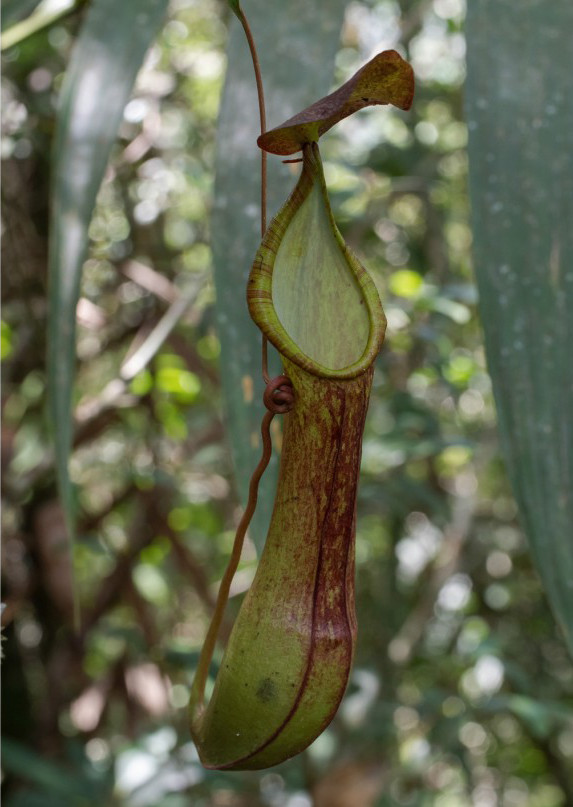
A pitcher plant named after a people. Nepenthes talaandig was described in 2014 from the Pantaron Range in central Mindanao, in the same paper as Nepenthes pantaronensis, and the describers chose the name to acknowledge the Talaandig, the indigenous people in whose ancestral domain the plant grows. It is a robust climber with small, bulbous lower pitchers in rust red and violet, and slender yellow-green upper pitchers: two guises so different that they hardly seem to belong on one plant. The species is one of four new pitcher plants described in a single 2014 paper from the mountains of central Mindanao, a number that shows how little known the mountains of central Mindanao were until recently.
Identification
The stems climb to eight metres and are seven or eight millimetres thick. The leaves are elliptic, to 35 cm long but only 4.5 cm wide, with four longitudinal veins on each side of the midrib, and a narrowly winged petiole six centimetres long that clasps a third of the stem. Lower pitchers are small and squat, bulbous or ovate, about 10 cm tall and 5 cm wide, with fringed wings up to seven millimetres wide. The peristome is flattened, up to one and a half centimetres wide and crenellated, dark red; the outside of the pitcher is rust red to violet with red-purple blotches, the inside white with purple blotches. Upper pitchers are slender, about 20 cm long, slightly swollen below, yellow-green with red speckles and cream inside; their wings are reduced to ribs and the peristome is up to 1.2 cm wide.
Similar species
The describers compare the species with Nepenthes cornuta, described in the same paper. That species has slender, cylindrical lower pitchers and a channelled, unwinged petiole; Nepenthes talaandig has bulbous lower pitchers with a flattened, crenellated peristome and a winged petiole. Of the other pitcher plants of the Pantaron Range, Nepenthes pantaronensis grows epiphytically and has much larger pitchers with a broader peristome. The contrast between the small dark lower pitchers and the long pale upper pitchers is the best field character for Nepenthes talaandig.
The trap and how it works
A pitfall trap in which the two pitcher forms share the work clearly. The bulbous lower pitchers sit on or just above the ground, with fringed wings that act as walkways, and catch mainly crawling animals; the crenellated peristome extends the slippery zone inward. The slender upper pitchers hang higher in the vegetation and, with their pale colour and red speckles, are presumably tuned mainly to flying insects. On the inner side of the peristome lie the nectar glands that lure animals to the rim. No specific prey study has been published for this species.
Habitat and ecology
Terrestrial on ultramafic soil, in clearings and on bright ridges in lower montane forest, at around 1000 m (R3, B5, B1). The preference for light is clear: the plant climbs where the forest is broken and sun reaches the ground. Since the description gives only 'around 1000 m' and no range, the elevation field is left empty. Ultramafic soils form from rock of the Earth's mantle brought to the surface by mountain building. They are rich in magnesium, iron, nickel and chromium and poor in nitrogen, phosphorus and potassium, and the vegetation on them often stays lower and more open than on other soils. For pitcher plants these are favourable conditions: there is light, and competition from fast-growing plants is slight.
Distribution and elevation
Endemic to Mindanao, in the Pantaron Range of Bukidnon Province, the ancestral domain of the Talaandig in the east of that province. According to the describers little has yet been recorded about its distribution, but they expect the species to be widespread in the range. This guide gives no further sites.
- Native
Forms and variation
No varieties have been described. The colour of the lower pitchers runs from rust red to violet, with red-purple blotches to varying degrees; the upper pitchers are yellow-green with red speckles. No natural hybrids are mentioned. The strong difference between lower and upper pitchers is normal for the genus and no indication of two species. Since the species has had a name only since 2014 and most records come from one range, future fieldwork may reveal more variation than is now known.
Where and when to see it
Search sunny ridges and clearings in the montane forest of the Pantaron Range at around 1000 m, and look at the ground first: the small, bulbous, dark lower pitchers often lie half in the litter. Then follow the stem up to the long yellow-green upper pitchers. Access to the area runs through local government and indigenous communities, and engaging a local guide is customary and appropriate.
Conservation status
The species has not (yet) been assessed for the Red List. The describers proposed Vulnerable, because little was yet known of its distribution, though they expected it to prove widespread. Ultramafic ground in central Mindanao is sought after by mining companies, and logging and agricultural expansion also threaten the montane forest. As a member of Nepenthes it is listed in CITES Appendix II, so international trade in wild plants requires a permit.
Scientific name
Nepenthes talaandig | Gronemeyer, Coritico, Wistuba, Micheler, Marwinski, Gieray & Amoroso, 2014
Described by Gronemeyer, Coritico, Wistuba, Micheler, Marwinski, Gieray & V.B. Amoroso in 2014, in the open-access journal Plants (volume 3, no. 2, p. 284-303). Earlier, in 2012, announced online under the placeholder name "Nepenthes species 3". Pantaron mountain range, central Mindanao, Philippines; terrestrial on ultramafic soils, around 1000 m elevation, in the ancestral territory of the Talaandig people, eastern Bukidnon province. Named after the Talaandig indigenous people, on whose ancestral land (eastern Bukidnon) this species grows.
World Checklist of Vascular Plants (WCVP), via Plants of the World Online (POWO), Royal Botanic Gardens, Kew.