All species › Caryophyllales › Tropical pitcher plant family › Nepenthes spathulata
Nepenthes spathulata
The pitcher plant of the high mountains of southern Sumatra, from the volcano Tanggamus in the south to Lake Kerinci in the north. Nepenthes spathulata was described by Danser in 1935 from a plant that the dragonfly specialist Lieftinck had collected that year at 2000 m, and owes its name to its spathulate leaves. Most striking are the large lower pitchers with a peristome narrow at the front and hugely widened towards the lid; the upper pitchers, by contrast, are small and slender.
Identification
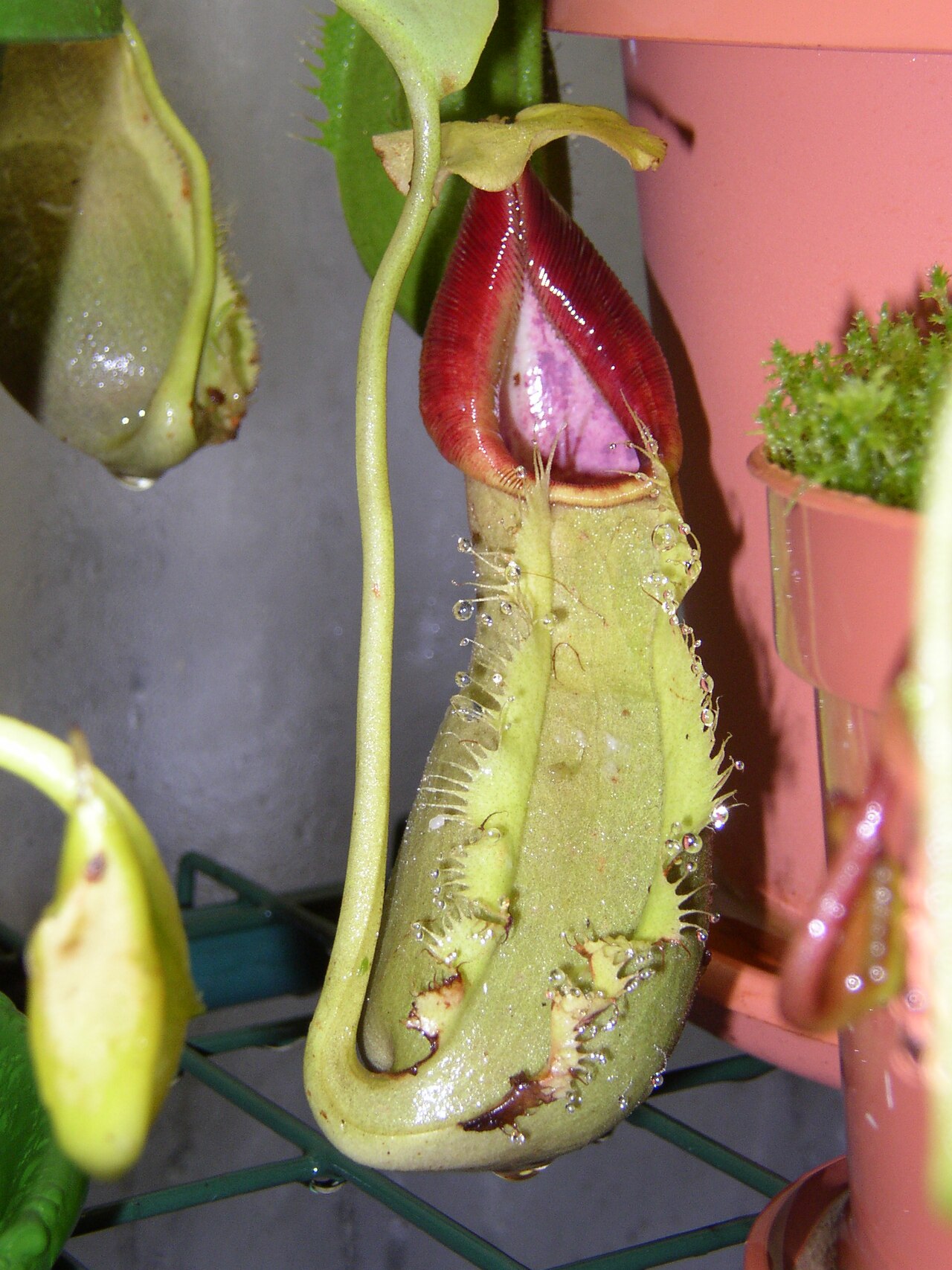
A climber to about 5 m, with a stem only 8 mm thick and internodes to 15 cm, round to angular in cross-section. The leaves are stalkless to nearly so, leathery and spathulate, to 30 cm long and 10 cm wide, gradually narrowed to the base and with a rounded tip; the tendril reaches 20 cm. Lower pitchers are ovoid in the lower third to two-thirds and cylindrical above, to 30 cm tall and 10 cm wide, with fringed wings to 25 mm. The mouth is round and strongly oblique; the peristome is at most 5 mm wide at the front but up to 25 mm near the lid, flared at the sides, sometimes wavy, with short teeth on the inner edge. Upper pitchers are much smaller, narrowly ovoid below and cylindrical above, to 15 cm tall and 3 cm wide, with a peristome to 7 mm and two ribs instead of wings.
Similar species
Its closest relative is Nepenthes singalana, with which it was even merged in 1986. N. singalana has a peristome contracted at the front and very wide at the sides, with less prominent ribs and shorter teeth, an ovate rather than round lid, and fewer glands on the lid underside. On Mount Masurai in Jambi, plants intermediate between the two occur. N. densiflora usually has funnel-shaped upper pitchers, and N. bongso and N. ovata can be told by the shape of their upper pitchers. The combination of large, broad-rimmed lower pitchers and small, slender cylindrical upper pitchers is characteristic.
The trap and how it works
Two very different pitchers on one plant. Lower pitchers are large pitfalls with broad fringed wings and a peristome that widens so much near the lid that it forms a large slippery platform: an insect landing on this nectar-rich rim slides inwards once a water film is present. About a third of the peristome surface lies on the inside of the mouth. Upper pitchers are slender, almost cylindrical tubes with a narrower peristome and two ribs, aimed at flying insects. The lid is ovate and cordate at the base, without appendages. No prey data have been published.
Habitat and ecology
A species with a wide range of mountain habitats, between 1100 and 2900 m. As an epiphyte it grows in mossy cloud forest and lower montane forest (B1); on the ground it stands in stunted upper montane forest on ridges and summits, and in high-altitude peat swamp forest, as around Lake Kerinci (B4). Plant form varies with habitat: epiphytes are slenderer, plants on open summits stockier and more strongly coloured. Around Kerinci it grows with lowland species such as N. mirabilis and N. ampullaria, which explains the many hybrids there.
Distribution and elevation
Endemic to Sumatra, Indonesia, in the provinces of Jambi, South Sumatra, Bengkulu and Lampung, from Mount Tanggamus in the south to Lake Kerinci in the north. Altitude: 1100 to 2900 m. A plant from Java, described in 2006 as N. adrianii, is included in this species by some authors; the world checklist gives only Sumatra for N. spathulata, and this guide follows it. The area in our species list (Jambi, South Sumatra, Bengkulu) is correct but omits Lampung.
- Recorded (one-degree cells)
Forms and variation
No varieties are recognised. Colour varies strongly: from pale green pitchers with a dark purple peristome to yellowish-bronze pitchers with a bright red peristome. The species forms many natural hybrids, especially in the peat swamp forest near Lake Kerinci: with N. mirabilis, N. reinwardtiana, N. tobaica and N. ampullaria; further with N. inermis in Jambi and with N. gymnamphora, and there is a seventh, unclear cross from Mount Belirang. The sites around Kerinci are thus among the richest hybrid zones in Sumatra.
Where and when to see it
Easiest to see around Lake Kerinci and on the mountains of the Kerinci Seblat region, where trails run through montane forest and peat swamp forest. Above 1100 m, look for spathulate leaves and the large lower pitchers with their strikingly widened peristome near the ground; the small, slender upper pitchers hang in the shrubs and are often taken for another species. In the hybrid zones around the lake many plants are not pure: check the shape of the peristome and the leaf texture before giving a name.
Conservation status
The Red List assesses the species as Least Concern (2018 assessment). The range covers four provinces and a large altitudinal span, and much of the montane forest lies in protected areas such as Kerinci Seblat National Park. Local risks are the clearing of peat swamps and montane forest for agriculture, especially at the edges of the protected area. As a member of the genus it is listed in CITES Appendix II.
Scientific name
Nepenthes spathulata | Danser, 1935
Nepenthes spathulata was described in 1935 by Benedictus Hubertus Danser, in "A new Nepenthes from Sumatra" (Bulletin du Jardin Botanique de Buitenzorg, series III, 13: 465-469). The type material (Lieftinck 11) was collected in January 1935 by Maurits Lieftinck, on Mount Tanggamus near Lampung, Sumatra, at 2,000 m elevation; it was formally designated the lectotype in 1997 by Jebb and Cheek. Mount Tanggamus, near Lampung, Sumatra, Indonesia, at 2,000 m elevation. The specific epithet derives from the Latin "spathulatus" ("spatula-shaped"), referring to the shape of the leaf blade (lamina).
World Checklist of Vascular Plants (WCVP), via Plants of the World Online (POWO), Royal Botanic Gardens, Kew.