All species › Caryophyllales › Tropical pitcher plant family › Nepenthes treubiana
Nepenthes treubiana
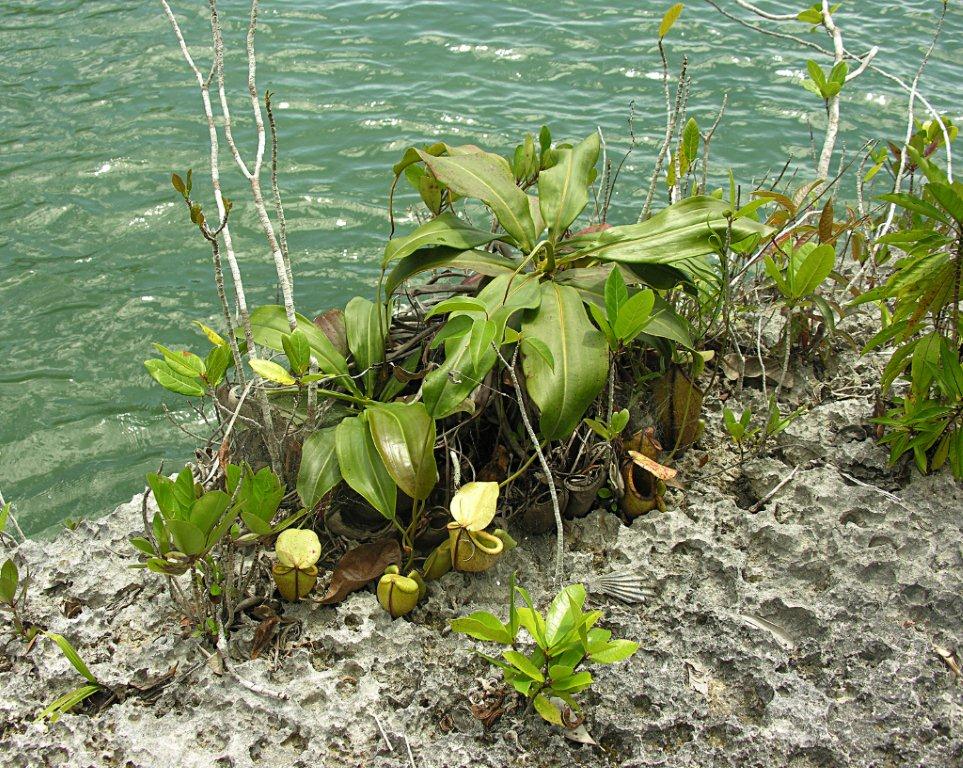
A robust lowland climber from the western tip of New Guinea and the island of Misool, with large, rounded lower pitchers and broad funnels high in the scrub. Nepenthes treubiana was described in 1891 by the German botanist Otto Warburg and named after Melchior Treub, the influential director of the botanic garden at Buitenzorg (Bogor). The name has a tangled history: Macfarlane and later Danser applied it to plants from Sumatra now called Nepenthes sumatrana. Anyone reading about this species in older literature must therefore check carefully which plant is meant.
Identification
A large climber reaching six to nine metres into the vegetation, with terete stems 0.8 to 1.3 cm thick, sometimes ridged or narrowly winged. The leaves are large and distinctly stalked: a blade 30 to 39 cm long and 7 to 12 cm wide, lanceolate to oblong, on a petiole of 7 to 15 cm with narrow wings running down the stem. The leaf margins are densely hairy. Lower pitchers are urn-shaped to almost globose, up to 20 cm tall and 10 cm wide, with two fringed wings nearly two centimetres broad and a rounded peristome of about one and a half centimetres with small teeth on the inner edge. Upper pitchers are funnel-shaped to broadly so, slightly constricted at the mouth, mostly 14 to 24 cm tall and 6 to 7.5 cm wide, with a shallowly elliptic, often concave mouth and a peristome of 4 to 12 mm with conspicuous ribs.
Similar species
Flora Malesiana separates the species from Nepenthes sumatrana and Nepenthes rafflesiana, which it resembles in pitcher shape, by three features: the teeth on the peristome, the densely hairy leaf margins, and the evenly distributed glands under the lid. Neither relative occurs in New Guinea, so confusion arises mainly in the literature. Within its own range the common lowland species are Nepenthes mirabilis and Nepenthes ampullaria. The former has slimmer, usually wingless upper pitchers and a narrower peristome; the latter has small, round pitchers with a reflexed lid that sit in dense clusters on the ground.
The trap and how it works
Two clearly different pitchers on one plant. Lower pitchers are bulbous and roomy, with broad fringed wings that serve as a ramp for crawling animals such as ants and beetles; the broad peristome with small teeth on the inner edge makes the rim hard to climb back over. Upper pitchers hang from long tendrils high in the scrub and are funnel-shaped, with a narrower, strongly ribbed rim; they mainly catch flying insects. In both, nectar on the peristome and under the lid draws prey to the slippery rim, and digestive fluid waits at the bottom. No prey study specific to this species was found in the literature consulted.
Habitat and ecology
The margins of Agathis forest and coastal forest in the lowlands, from sea level to about 500 m (B5, B2). The species is also recorded from the cliffs along McCluer Gulf and from the coastal region of the Fakfak peninsula. These are light, open places at forest edges, where the plant can climb up through the surrounding vegetation towards the light on its long stems. Soils in these regions are often calcareous or sandy and nutrient-poor, and prey makes up the shortfall in nitrogen and phosphorus.
Distribution and elevation
Endemic to western New Guinea: the Bird's Head peninsula around Sorong, the coast of McCluer Gulf and the Fakfak peninsula, plus the island of Misool with several smaller islands nearby. Large populations have been confirmed on Misool. Our own species list gives New Guinea and the Moluccas; Misool belongs to the Raja Ampat group and is historically sometimes counted among the Moluccas, but administratively and biogeographically it belongs to New Guinea. The species is not known from the Moluccan islands proper, such as Halmahera or Seram, in the sources consulted.
- Recorded (one-degree cells)
Forms and variation
No varieties or forms have been described, and no natural hybrids are known. Variation in the field mainly concerns the difference between the bulbous, winged lower pitchers and the slimmer funnel-shaped upper pitchers, and the size of the upper pitchers, which can range from about 11 to 24 cm tall. Anyone consulting older literature should watch for the confusion with Nepenthes sumatrana: descriptions of 'N. treubiana' by Macfarlane (1908) and Danser (1928) largely concern that Sumatran species and so say little about variation in the true Nepenthes treubiana.
Where and when to see it
Sorong is the gateway to the Bird's Head and the Raja Ampat islands, and Misool can be reached by boat from there. Search along forest edges and coastal cliffs, not in closed forest: the plant grows where light breaks into the vegetation. Upper pitchers often hang high, but the large, bulbous lower pitchers on young plants sometimes lie close to the ground at the foot of the vegetation. On Misool the species is reported to be locally abundant. The region is sparsely populated and infrastructure is limited; travel with local guidance and ask permission before entering land.
Conservation status
Assessed on the Red List as Least Concern. Its range is limited to western New Guinea and nearby islands, but the species occurs at several places there, with large populations on Misool, and much of the area is thinly populated. As a member of Nepenthes it is listed in CITES Appendix II, so international trade in wild plants requires a permit. Logging, plantations and infrastructure along the coast of the Bird's Head are general threats to lowland forest in the region; no threats specific to this species are named in the literature consulted.
Scientific name
Nepenthes treubiana | Warburg, 1891
Described by Otto Warburg in 1891; the exact publication (journal/work) could not be established with certainty. The precise type locality could not be established with certainty. The species occurs on the cliffs of McCluer Gulf and the coastal Fakfak Peninsula, western New Guinea, and on the island of Misool. Named after Melchior Treub, botanist and director of 's Lands Plantentuin in Buitenzorg (present-day Bogor).
World Checklist of Vascular Plants (WCVP), via Plants of the World Online (POWO), Royal Botanic Gardens, Kew.