All species › Caryophyllales › Tropical pitcher plant family › Nepenthes vogelii
Nepenthes vogelii
A small, often epiphytic pitcher plant from the montane forest of Borneo, with cream-coloured, darkly speckled pitchers. Nepenthes vogelii was collected as early as 1961 on Mount Api in Gunung Mulu, but was then taken for Nepenthes fusca. Only in 2002 did the Leiden botanists André Schuiteman and Eduard de Vogel describe it as a new species in the journal Blumea, based on a plant collected as a seedling on the Kelabit Highlands and raised at the Hortus botanicus Leiden by Art Vogel. The species is named after him. It is easily overlooked, as it often grows high in the trees.
Identification
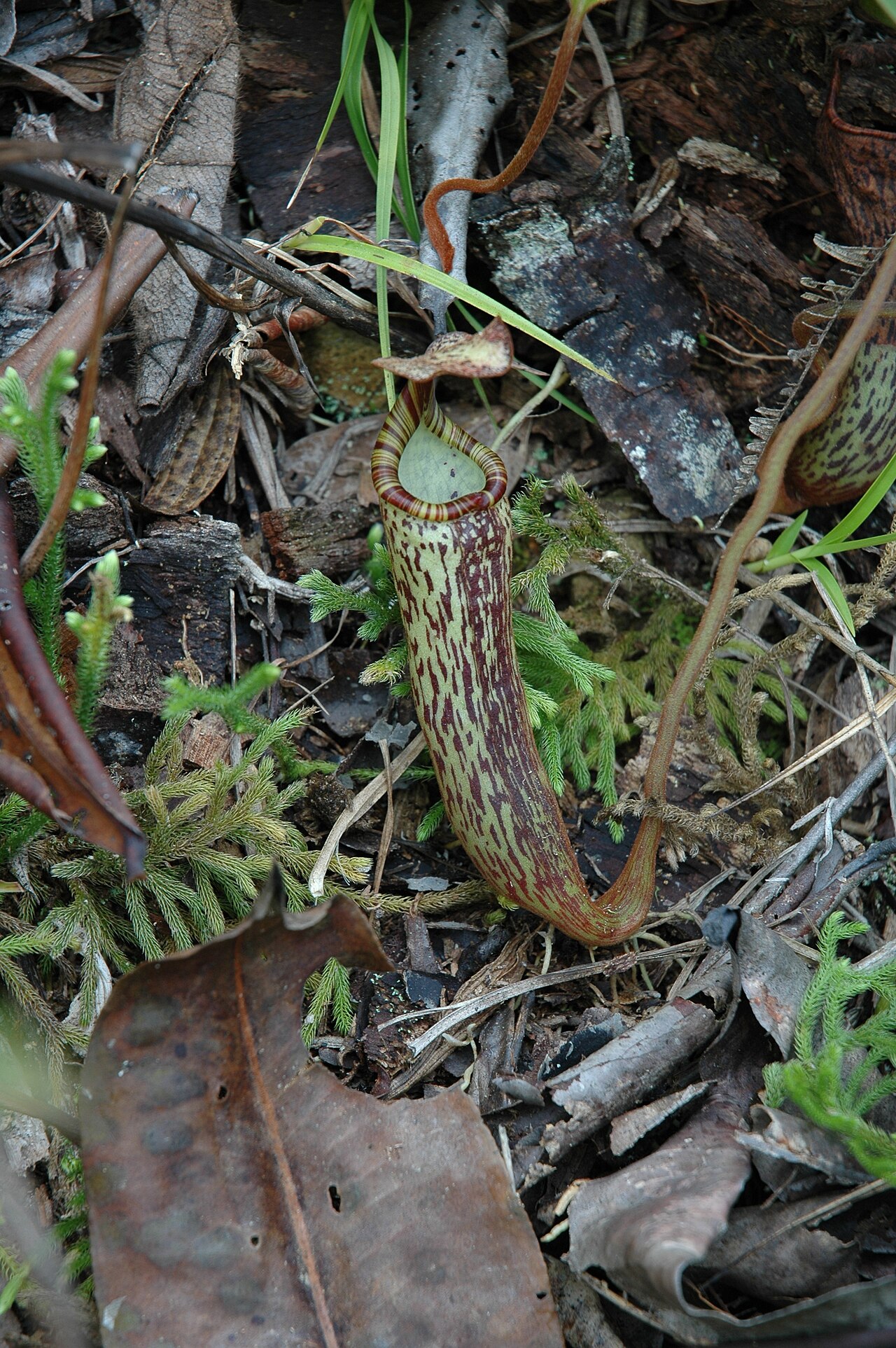
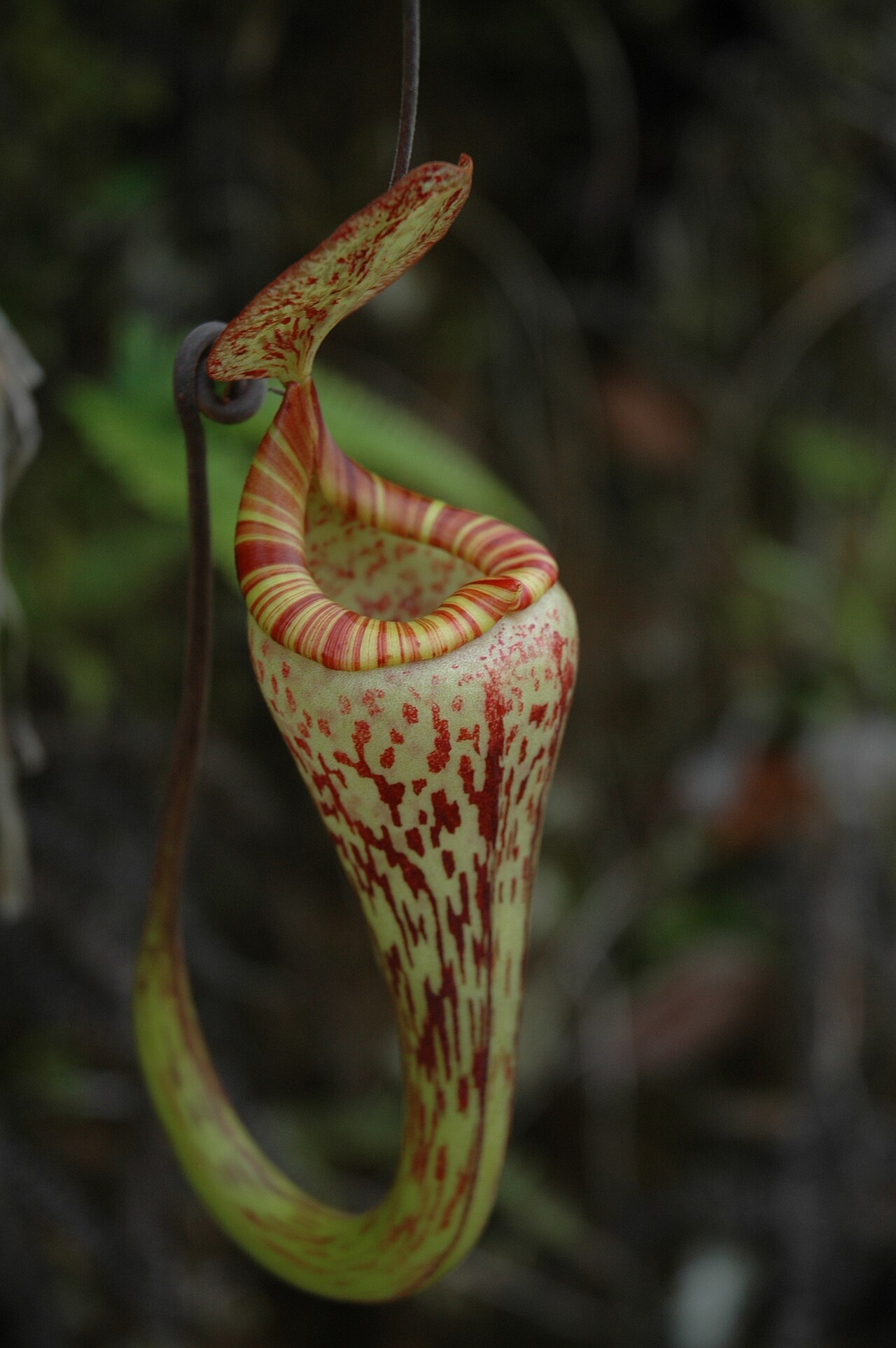
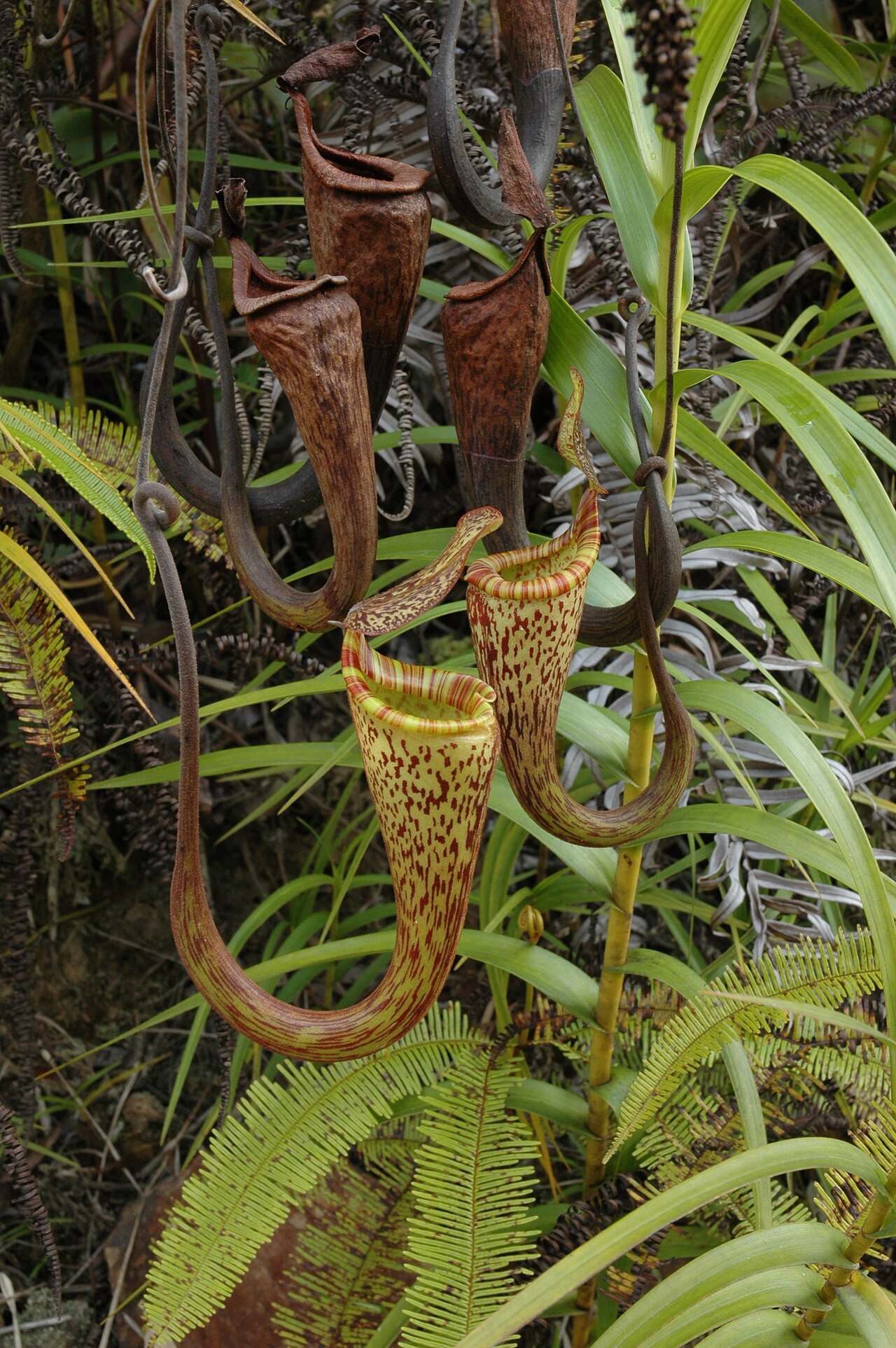
A slender climber with terete stems about 4 mm thick and internodes of 3 to 7.5 cm. Young parts are covered in a reddish-brown felt of short branched hairs mixed with longer ones. The leaves are leathery and distinctly stalked: a channelled petiole of 2.5 to 3.5 cm and an oblong blade 8 to 12.5 cm long and 2.4 to 4.3 cm wide, with a wedge-shaped base and an acute tip. Lower pitchers are cylindrical, tapering gradually to the base, about 9 cm tall and one and a half centimetres wide, without wings, greenish cream with deep dull red to purple blotches. The peristome is flattened and finely ribbed, about 2 mm wide at the front and 3 mm at the back. Upper pitchers are funnel-shaped with a long narrow base, 7.5 to 9 cm tall, and likewise pale cream with dark speckles.
Similar species
The closest relative is Nepenthes fusca, for which the species was mistaken when first found. Nepenthes vogelii, however, has much smaller pitchers, lacks appendages on the underside of the lid, and has a broadly rather than narrowly triangular lid. From Nepenthes burbidgeae and Nepenthes stenophylla it differs in its pale cream colour with dark speckles. There is also an affinity with Nepenthes platychila, but that species has winged lower pitchers and a much broader peristome. On Mount Mulu it grows in a narrow altitudinal band between Nepenthes fusca below and Nepenthes hurrelliana above, which helps identification in the field.
The trap and how it works
A small pitfall trap, wingless in both forms: even the lower pitchers lack the fringed ridges that serve as a ramp in many species. That fits a plant that grows mainly as an epiphyte and whose pitchers rarely stand on the ground. Lower pitchers have a small, horizontal mouth; upper pitchers are funnel-shaped, sometimes narrow, sometimes distinctly bulbous at the top. As throughout the genus, insects slip off the wet peristome into the fluid at the bottom, which contains digestive enzymes. No study of the prey of this species was found in the literature; with small pitchers in mossy montane forest, prey is usually ants and other small arthropods.
Habitat and ecology
Submontane and tall lower montane rainforest, usually as an epiphyte among moss on trunks and branches, at 1000 to 1500 m (B1, B3). The type material, however, was found growing terrestrially among moss in wet kerangas forest on white sand, together with Nepenthes stenophylla and Nepenthes veitchii. Kerangas is Borneo's poor heath forest on leached sandy soil; epiphytic sites are equally nutrient-poor. In both cases that poverty explains the importance of prey to the plant. The montane forest where it grows is damp for most of the year and often wrapped in cloud.
Distribution and elevation
Endemic to Borneo. Our own species list places the species in Papua New Guinea, but that rests on an error: all the literature consulted, from the original description to later overviews, gives Borneo. The species was first known only from northern Sarawak, with the type locality on the Kelabit Highlands at about 1000 m and records from Mount Mulu; it has since been reported from southern Sabah and from West Kalimantan. It thus appears more widespread on Borneo than first thought, and its epiphytic habit makes it likely that it has been overlooked in more places.
- Recorded (one-degree cells)
Forms and variation
No varieties or forms have been described. Despite growing alongside related species, no natural hybrids involving Nepenthes vogelii have been recorded either. Variation lies mainly in the shape of the upper pitchers, which can range from narrowly funnel-shaped to distinctly bulbous above, and in the amount of dark speckling on the cream ground. Lower pitchers are yellowish with dark speckles and a striped peristome. Before its description the plant circulated among growers under a provisional name, but that has no bearing on the wild species.
Where and when to see it
Gunung Mulu National Park in Sarawak is the most accessible place, although the climb to the species' altitudinal band requires an organised multi-day trek with a guide. Do not look only at the ground: this plant usually grows in the trees, and the small speckled pitchers often hang out of reach among moss. Binoculars are genuinely useful here, and it is no coincidence that few herbarium specimens exist. Mind the altitude: below about 1200 m on Mulu a similar plant is more likely to be Nepenthes fusca, and higher up Nepenthes hurrelliana takes over.
Conservation status
Assessed on the Red List as Least Concern. The species occurs at several places in the uplands of Borneo, partly within protected areas such as Gunung Mulu, and its epiphytic life in hard-to-reach montane forest makes it less vulnerable to collectors. The small number of herbarium records mainly reflects how hard it is to find, not necessarily rarity. As a member of Nepenthes it is listed in CITES Appendix II, so international trade in wild plants requires a permit. Clearing of hill and montane forest outside the parks remains a general threat.
Scientific name
Nepenthes vogelii | Schuiteman & de Vogel, 2002
Described by André Schuiteman & Eduard Ferdinand de Vogel in 2002, in "Nepenthes vogelii (Nepenthaceae): a new species from Sarawak", Blumea, volume 47, no. 3, p. 537-540. Kelabit Highlands, Sarawak, Malaysian Borneo; collected as a seedling in 1997 by A. Vogel, A. Schuiteman & T. Roelfsema (specimen 981037, deposited at the SAR herbarium). Precise coordinates and elevation are not known. Named in honour of Art Vogel, botanist and former conservatory manager at the Hortus Botanicus Leiden, who grew the type specimen to maturity himself.
World Checklist of Vascular Plants (WCVP), via Plants of the World Online (POWO), Royal Botanic Gardens, Kew.