All species › Caryophyllales › Tropical pitcher plant family › Nepenthes vieillardii
Nepenthes vieillardii
Of all pitcher plants this one grows furthest to the east. Nepenthes vieillardii is the only Nepenthes of New Caledonia, a Pacific island isolated for tens of millions of years and home to one of the strangest floras in the world. Much of that flora grows on ultramafic soil — red, iron-rich weathering material from rocks of the Earth's mantle, poor in nutrients and rich in nickel and chromium — and that is exactly where this species grows. It is named after Eugène Vieillard, who collected plants in New Caledonia and Tahiti between 1861 and 1867.
Identification
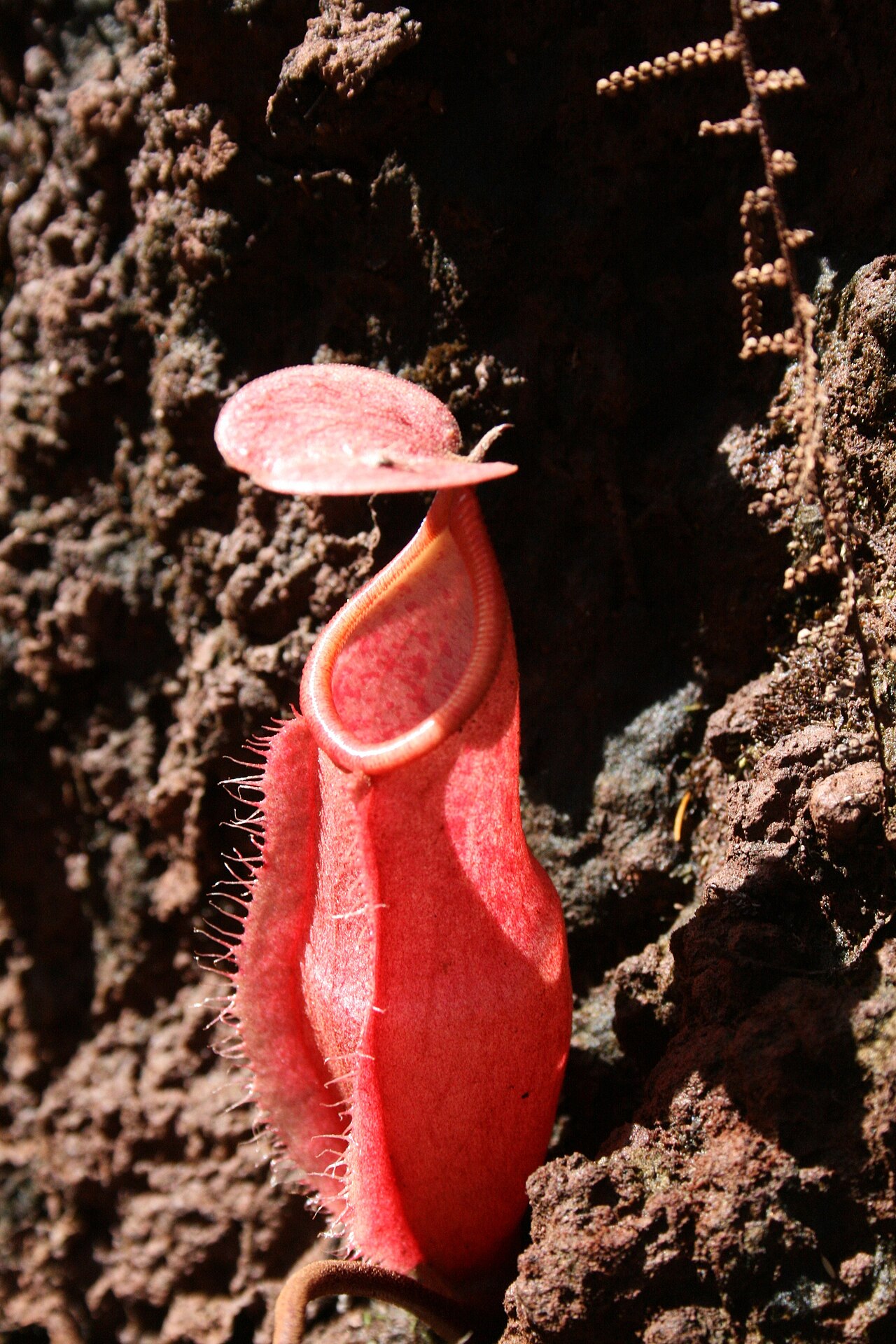
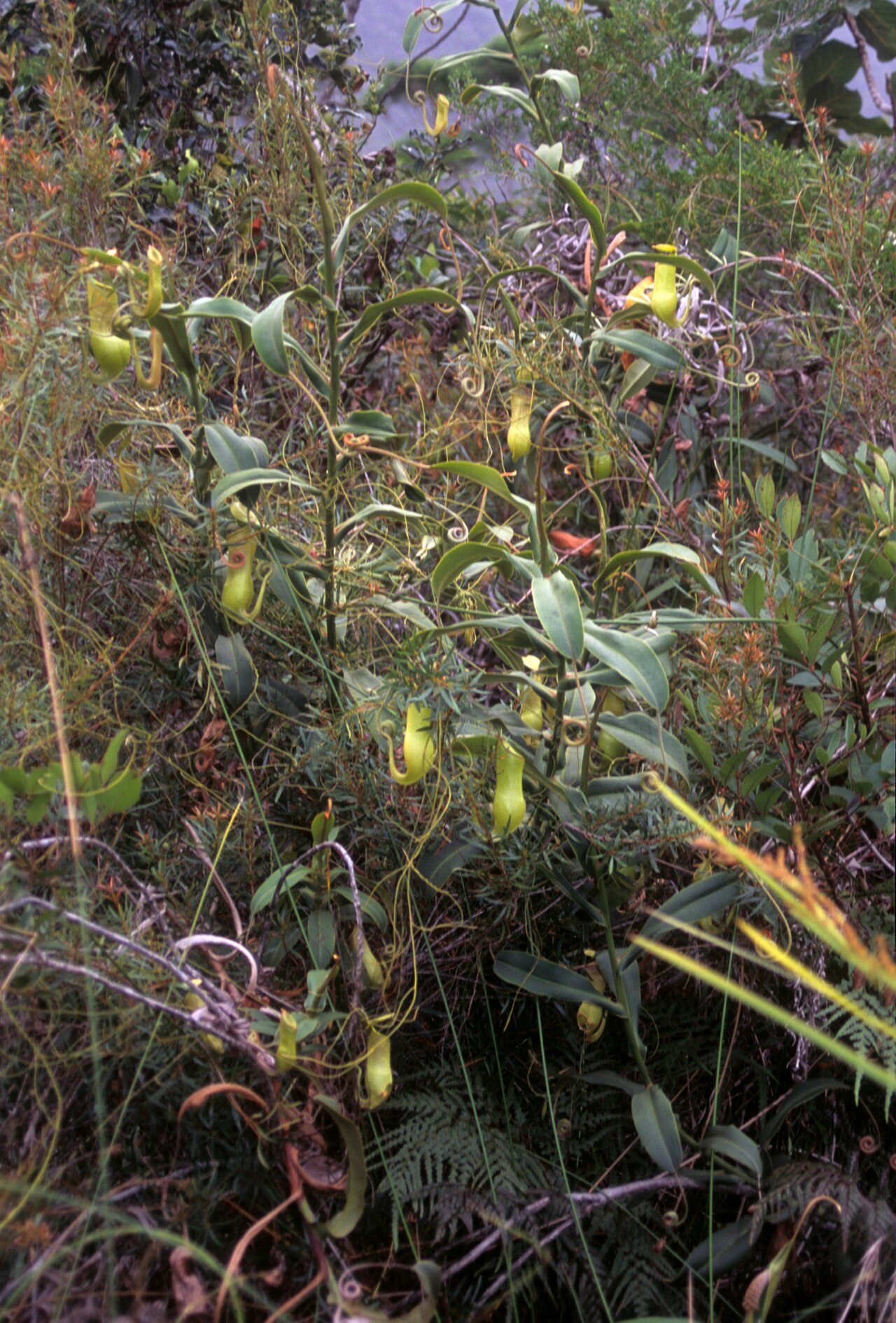
A climbing or scrambling plant with branched stems up to eight metres long. The lamina is linear to oblong, to 35 cm long and 8 cm wide. Lower pitchers are up to 17 cm long and 6 cm wide, ovate and swollen below and cylindrical or slightly funnel-shaped above, with two wings up to 18 mm wide down the front, lined with narrow filaments up to 7 mm. Upper pitchers are up to 21 cm tall and 5 cm wide and variable in shape: from wholly funnel-shaped to ovate and swollen below. The peristome is cylindrical and glossy, up to 5 mm wide, with ribs up to 0.3 mm high. The lid is usually almost round, sometimes ovate or elliptic, up to 5 × 5 cm. The inflorescence is a raceme up to 35 cm long.
Similar species
In New Caledonia confusion is impossible: it is the only pitcher plant on the island and in the surrounding archipelagos. The nearest other species grow in New Guinea and northern Australia, such as Nepenthes mirabilis, with which it shares the broad wings of the lower pitchers. The big differences are habitat and shape: N. vieillardii grows on ultramafic rock and within the island itself is strikingly variable in pitcher shape, so that plants from different sites sometimes look very different.
The trap and how it works
An ordinary pitfall trap of the genus, with a glossy peristome, nectar glands on the lid and fluid with digestive enzymes at the bottom. The lower pitchers, with their broad fringed wings, are set up for walking prey such as ants; the upper pitchers also catch flying insects. As in many species the pitcher fluid is a community of its own: the mosquito Tripteroides caledonicus lays its eggs there, and its larvae live in the pitcher water, feeding on prey remains without being digested themselves.
Habitat and ecology
Red lateritic soil on ultramafic rock (R3): the margins of conifer forest, grassy upland meadows and logged lowland forest, and the open, shrubby maquis typical of these soils (B5). The species grows from sea level to about 850 m, and in some sources to 900 m. These soils are toxic to many plants because of their high levels of nickel, chromium and magnesium, and the vegetation is therefore open and low; a pitcher plant that takes nitrogen and phosphorus from prey has an advantage here.
Distribution and elevation
Endemic to New Caledonia: on the main island, Grande Terre, mainly in the south where the ultramafic massifs are largest, and on the Île des Pins. It grows from sea level to about 850 m. This makes it the easternmost species in the whole genus, far outside the Malesian heartland. How its ancestor arrived here is unknown; long-distance dispersal of the light seed is given as the likeliest explanation.
- Recorded (quarter-degree cells)
Forms and variation
No wild varieties are now recognised; a series of earlier described names are treated as synonyms. Kurata and colleagues studied variation in shape and genetic diversity within the species in the 2000s and found that populations from different parts of the island differ clearly from one another, especially in pitcher shape and indumentum. That variation is geographical and cannot be divided into clear-cut forms. Natural hybrids do not exist, as no other species occurs on the island.
Where and when to see it
The south of Grande Terre, with its wide red ultramafic plains and hills, is the place to search. The nature parks and reserves in the south, such as around the Rivière Bleue and the Plaine des Lacs, have maquis in which the species grows. Look among the low shrubs and along the edges of conifer forest; the lower pitchers often lie on the ground in the litter. On the Île des Pins it grows in the vegetation on ultramafic ground. The cooler, drier months from about June to September are the most pleasant for walking.
Conservation status
The Red List assesses the species as Least Concern. It is locally common in the southern part of Grande Terre and grows in several protected areas. The main threat to its habitat, and to the whole New Caledonian flora on ultramafic soil, is open-cast nickel mining: the mines remove exactly the soils on which this vegetation stands. Fire also plays a part. As a member of the genus it is listed in CITES Appendix II; international trade in wild plants requires a permit.
Scientific name
Nepenthes vieillardii | J.D. Hooker, 1873
Described by Joseph Dalton Hooker in 1873, in Prodromus Systematis Naturalis Regni Vegetabilis, volume 17, p. 90-105 (monograph "Nepenthaceae") — the same monograph as N. tentaculata (golf 32), fourteen years after Hooker's description of N. veitchii. The precise type locality could not be established with certainty. The species is endemic to New Caledonia, with a habitat of shrubland and forest up to about 900 m elevation. Named after Eugène Vieillard, a plant collector active in New Caledonia and Tahiti between 1861 and 1867.
World Checklist of Vascular Plants (WCVP), via Plants of the World Online (POWO), Royal Botanic Gardens, Kew.