All species › Lamiales › Bladderwort family › Pinguicula acuminata
Pinguicula acuminata
A butterwort of cold, misty pine and fir forest high in Hidalgo, with a modest pale flower and a summer rosette that can grow to a palm's width. Pinguicula acuminata was described by Bentham as early as 1839 — exceptionally early for a Mexican species — and grows in and around the El Chico national park, among other places.
Identification
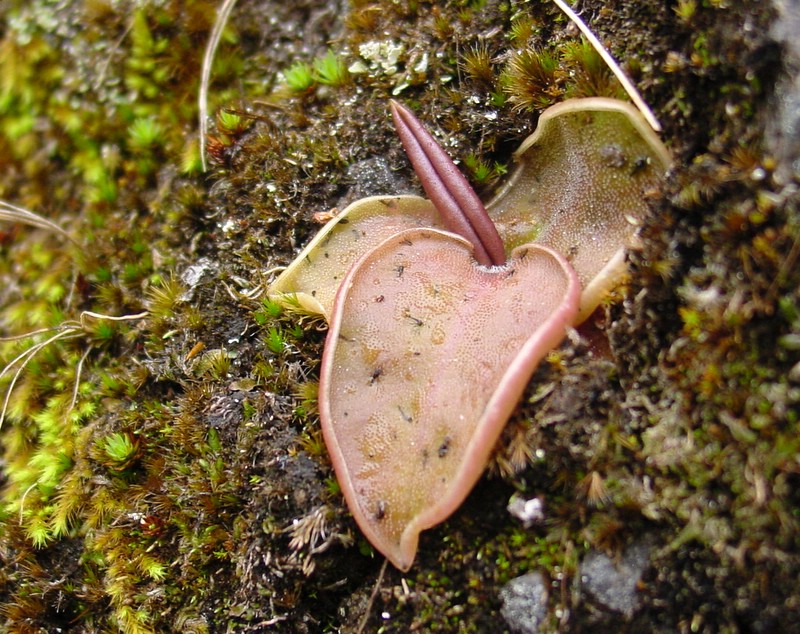
In the dry season a small winter rosette remains, of leaflets 6 to 19 mm long and 3 to 9 mm wide, fleshy and with few glands. The flowers come from that winter rosette, on scapes 7.4 to 15 cm tall, sometimes 17.5 cm. The flower measures 17 to 22 mm including the spur and is about as wide; the colour is whitish, pale bluish-pink or lilac, and the spur is short, 4 to 5 mm. Only afterwards, with the rains, does the summer rosette unfold with far larger flat sticky leaves 34 to 120 mm long and 16 to 83 mm wide. That order — flowering first, large leaves later — is usual in a number of Mexican species and can confuse field identification.
Similar species
Pinguicula moranensis grows in the same park and is recognised by its much larger, deeper-coloured flower with a spur over a centimetre long; the two regularly stand side by side. P. heterophylla has strap-shaped summer leaves and filiform leaflets in the centre of the winter rosette. P. macrophylla also has large leaves but a violet-purple flower with a spur over two centimetres. The short spur and the pale, broad flower remain the best characters for P. acuminata.
The trap and how it works
A flypaper trap on a broad flat leaf, active in the rainy season once the summer rosette has emerged. The stalked glands carry a clear droplet and hold the prey; the sessile glands between them release digestive enzymes on contact, after which the leaf margin rolls slowly over the prey. In a cool misty mountain forest the supply of small flies is large, and over the season a distinct layer of dark insect remains builds up on the broad leaves. During flowering, from the glandless winter rosette, the plant catches almost nothing.
Habitat and ecology
Shady banks and slopes in misty mountain forest of pine, oak and Abies, on loamy ground between boulders, among moss, ferns and succulents (B1, B5). Elevation is high, roughly twenty-four hundred to twenty-eight hundred metres, which means night frost is possible. The plant grows not on rock but in a thin layer of loam and humus that bakes dry in the dry season; the winter rosette and underground reserves bridge that period. Shade is not a drawback here but a requirement: in open spots the soil dries out too fast.
Distribution and elevation
Endemic to Mexico and known from Hidalgo, centred in and around the Parque Nacional El Chico near Real del Monte. Our species list says only 'Mexico'; the literature is more precise and keeps to Hidalgo, where the species grows in a limited number of mountain forests. Older records from other states probably rest on confusion with P. macrophylla. The range is small and lies high, in a zone found in only a few places in Mexico.
- Recorded (quarter-degree cells)
Forms and variation
No wild varieties are distinguished. Flower colour shifts within and between populations from nearly white through pale bluish-pink to distinct lilac; that is individual variation. The size of the summer leaves differs greatly with the wetness of the year and the shade of the site — the published figures run from three and a half to twelve centimetres in length, one of the widest spreads in this group. Natural hybrids with P. moranensis have been reported from the area; they have a larger flower with a medium-length spur.
Where and when to see it
Go from March to May, because the species flowers then while the summer rosette has yet to emerge: the pale flower on its slender scape is then the only thing standing above the litter. Search shaded banks along the paths in the mountain forest, among boulders and in the moss at the foot of trees. Later in the year the large glistening leaves are the more conspicuous feature, but the flowers are over. Keep to the paths: the site consists of loose loam and moss that washes away quickly.
Conservation status
Not assessed for the global IUCN Red List and not listed in CITES. In its favour, part of the known range lies inside a national park, which limits logging and forest conversion. Less favourably, this is a small range in one state, in a high-elevation forest type sensitive to fire and to recreational pressure — El Chico is a busy park close to the capital. Trampling of banks and collecting of plants are both named. Population figures are unpublished, so no trend can be supported.
Scientific name
Pinguicula acuminata | Bentham, 1839
Described by George Bentham in 1839. The type area lies in the municipality of El Chico, in the Mexican state of Hidalgo, where the plant grows on shaded, mossy rock banks between 2400 and 2800 metres elevation. The species name acuminata is Latin for "tapering to a point" and refers to the heart-shaped, pointed leaves of this species.
World Checklist of Vascular Plants (WCVP), via Plants of the World Online (POWO), Royal Botanic Gardens, Kew.