All species › Lamiales › Bladderwort family › Pinguicula algida
Pinguicula algida
A butterwort of the Siberian tundra and high mountains, described in 1966 by the Russian botanist Leonid Malyshev. The epithet means 'icy cold', and that is no literary flourish: Pinguicula algida grows in a belt where the ground is largely permanently frozen and the growing season lasts barely two months.
Identification
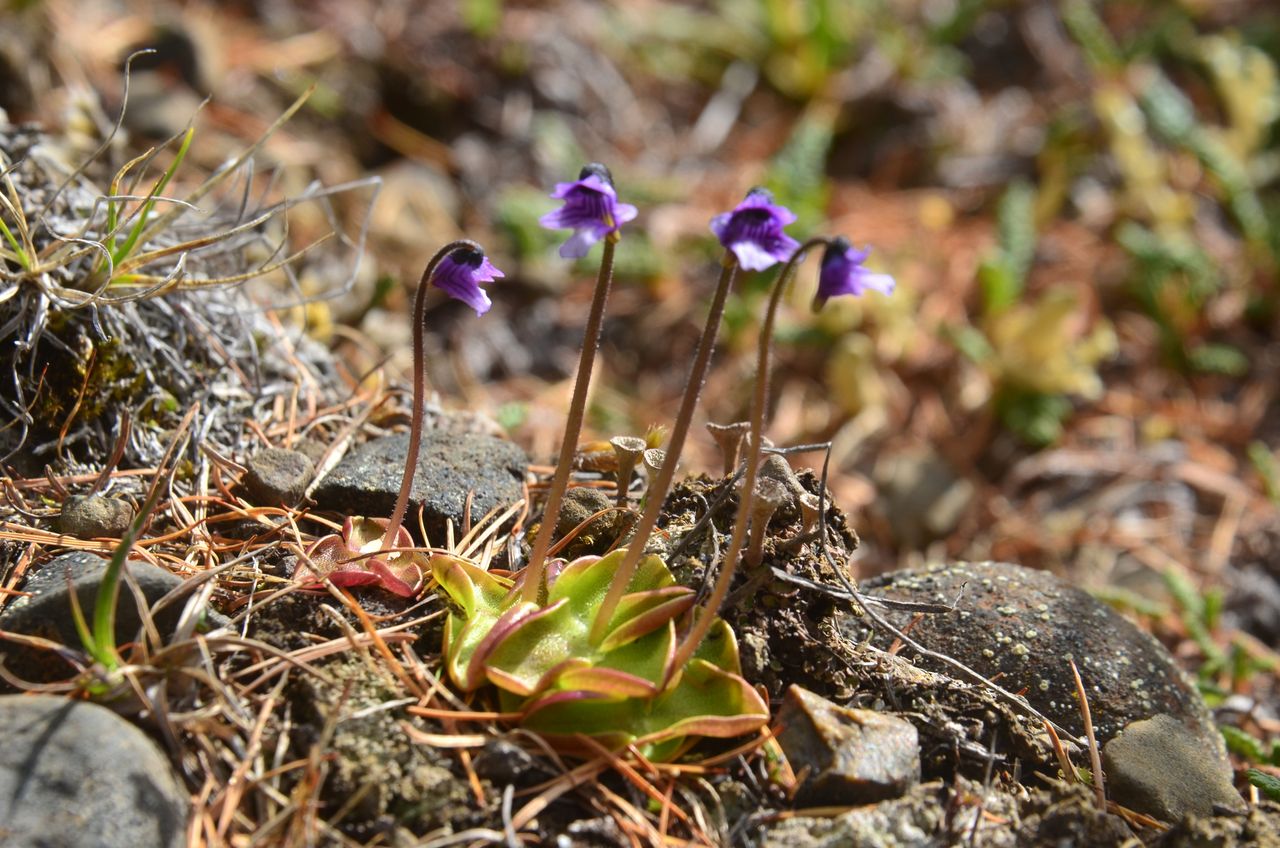
A small flat rosette of entire, sticky leaves lying on moss or bare wet ground, the upper surface covered in stalked and sessile glands. A short scape rises from the centre with one two-lipped, spurred flower. The species stands close to Pinguicula alpina and P. spathulata and shares with both the pale, unshowy flower type of the northern group. This guide enters no measurements for it: the original description appeared in a Russian systematic journal inaccessible to most readers, and dependable figures from other checkable work are lacking. The plant overwinters as a winter bud under snow.
Similar species
Three other small northern butterworts occur in the same country, and those are the real risk. Pinguicula villosa is recognised by its distinctly hairy scape — the one character usable without flowers and without literature. P. spathulata has a strikingly three-coloured flower, white with yellow and blue, and spathulate leaves with a fringed margin. P. alpina is larger, yellow-green in leaf, with a white flower bearing yellow blotches. Anyone finding a butterwort in Siberia does well to photograph flower, leaf and habitat and settle the name afterwards.
The trap and how it works
A flypaper trap with an extremely short working season. In the Siberian tundra and subalpine mountains snow lies eight to ten months of the year; what the plant catches in the remaining weeks must pay for the whole cycle of flowering, seed set and the building of a new winter bud. The mechanism is that of the genus: stalked glands with a sticky droplet, sessile glands releasing digestive enzymes as soon as prey is lying there, and a margin that rolls slowly over the catch. The supply in July is overwhelming — the northern tundra produces clouds of mosquitoes and midges — but the season is short and digestion is slow at low temperatures.
Habitat and ecology
Open wet ground in the subalpine and subarctic belt: slopes above the treeline with a thin layer of moss and sedge (R5), Sphagnum peat and wet tundra (W1), and more base-rich sedge mires and flushes along mountain streams (W2). The substrate is permanently wet through the growing season, cold and poor; under many of these sites lies permafrost, which keeps meltwater at the surface. There is no tall vegetation, because the climate does not allow it — the plant need not avoid competition, it simply lives where almost nothing else grows.
Distribution and elevation
Central and eastern Siberia into the Russian Far East, with records from Krasnoyarsk, Chita and Amur, from Magadan and from Yakutia. The species therefore occurs almost entirely within Russia, but over an area larger than Europe. A range confined to one country here does not mean a small range. Within that belt the plant follows the wet places in the mountains and the tundra; the intervening taiga and dry plateaux are unsuitable for it.
- Recorded (quarter-degree cells)
Forms and variation
No wild varieties are recognised. As with most northern butterworts the species is strikingly uniform across a vast area; what varies is mainly rosette size and scape length, which stays shorter on exposed sites. The species concept in this group is meanwhile not everywhere firm: P. algida, P. spathulata and P. alpina are closely related and Russian and western floras have not always drawn the limits the same way. No natural hybrids have been described for this species.
Where and when to see it
This is a species for those already in northeastern Siberia. Search in July, soon after snowmelt, on the wet slopes above the treeline and along the edges of tundra mires and mountain streams. The rosettes are small and green on green; the little flower on its stalk gives them away. Get low and look in raking light, which lights up the glandular droplets. The ground here is often boggy and fragile; walk on stones or on the dry hummocks rather than straight through the wet zones.
Conservation status
The species is assessed as Least Concern on the global IUCN Red List and is not in CITES. Given its range that is understandable: a belt thousands of kilometres long through Siberia and the Russian Far East, mostly in thinly settled country where farming and building hardly figure. The risks that exist therefore lie not in direct destruction but in the ground itself. Thawing permafrost alters the water regime of exactly the wet tundra and mountain slopes the plant occupies: where meltwater sinks away instead of standing at the surface, the habitat disappears. That effect is hard to measure across so large an area and does not yet feature in the current assessment.
Scientific name
Pinguicula algida | Malyschev, 1966
Described by Leonid Malyschev in 1966. The type area lies in Siberia, where the species occurs in cold, wet montane environments. The species name algida is Latin for "cold, icy" and refers to this species' cold, northerly habitat.
World Checklist of Vascular Plants (WCVP), via Plants of the World Online (POWO), Royal Botanic Gardens, Kew.