All species › Lamiales › Bladderwort family › Pinguicula mesophytica
Pinguicula mesophytica
A butterwort to look for above your head rather than at your feet: Pinguicula mesophytica grows as an epiphyte on mossy trunks in the cloud forest of Central America, and only secondarily on wet rock. The deeply two-lipped, reddish purple flower with its almost two-centimetre spur then hangs at eye level or higher among the mosses and ferns, and is often visible from a distance before the plant itself is.
Identification
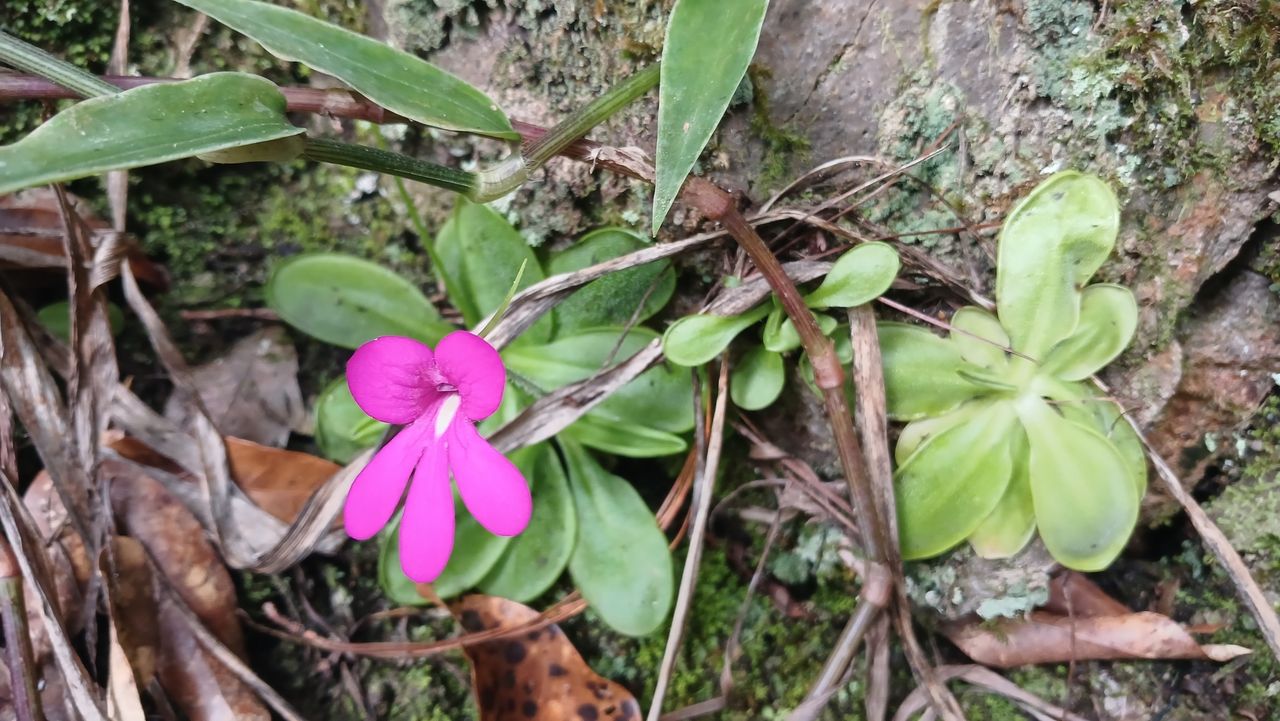
The rosette carries two series of leaves. The summer leaves are petiolate and obovate to almost circular, 12 to 27 mm long and 10 to 25 mm wide, thin and bearing the usual glistening glandular droplets. The winter leaves are far smaller, spathulate, 5 to 9.5 mm long and 2 to 3.5 mm wide, forming a tight bud. The flower is the most striking feature: 25 to 40 mm long including the spur, reddish purple, deeply two-lipped, with suborbicular lobes on the upper lip. The corolla tube itself is very short and funnel-shaped, 3 to 4 mm, followed by a subulate, recurved spur 14 to 20 mm long — far longer than the tube, which makes the flower recognisable at a distance as a coloured butterfly with a long tail.
Similar species
In the Central American highlands Pinguicula moranensis is the species to compare: also large-flowered and purple, but with a longer, clearly funnel-shaped tube and a more substantial rosette, and almost always on the ground or on rock rather than on trees. Pinguicula hemiepiphytica of Oaxaca resembles our species in habit but grows further north and has a different flower shape. In practice the combination of epiphytic habit, very short corolla tube and very long recurved spur is enough. The minute P. crenatiloba, which may grow on the ground in the same forest, is impossible to confuse.
The trap and how it works
The summer leaves are the trap. Stalked glands carry a sticky droplet that in cloud forest almost never dries out, and sessile glands release digestive fluid as soon as prey lies on them; the leaf margin then rolls slowly over the catch to hold the fluid in. For an epiphyte this is no luxury. A plant on a trunk has no access whatever to soil nutrients and must live on what arrives through the air: the minerals in rain and mist water and the nitrogen in captured insects. Here the catch is mostly small two-winged flies, psyllids and flying ants that gather in the sheltered zone against the trunk.
Habitat and ecology
Cloud forest between roughly 1300 and 2400 m, in multi-layered woodland rich in climbers and epiphytes, with Hedyosmum, Liquidambar, Persea and pines. The plants sit on moss on wind-swept trunks, or as rock dwellers near wet places and waterfalls (R1). Constant mist is the governing factor: it keeps the glandular coating working and the moss mat the plant sits on wet. Where the forest is thinned and the mist breaks through, the species disappears quickly, because an epiphyte has no soil moisture as a buffer.
Distribution and elevation
Central America: El Salvador, Guatemala and Honduras, in the highlands along the borders of these three countries and in the adjoining volcanic massifs; the type material comes from Montecristo in El Salvador. A clear correction to our species list is needed here: it names Mexico, but the species is not known from Mexico, and both the protologue and Kew confine the range to the three countries above. So it is not endemic to a single country, yet it is restricted to a fairly small mountainous area in which the populations are spread over a handful of summits — which amounts in practice to an island distribution.
- Recorded (one-degree cells)
Forms and variation
No wild varieties have been described. The species is known from a limited number of mountain tops, and material is too scarce to distinguish forms reliably; what varies is chiefly rosette size, larger on a sheltered trunk than on an exposed one, and the shade of reddish purple. That different populations sit on separate summits makes genetic differences between mountains plausible, but no published study addresses this. No natural hybrids are reported.
Where and when to see it
Go to cloud forest on one of the high summits of the Guatemala-Honduras-El Salvador border country and look up rather than down: the first six metres of thick mossy trunks yield most, especially on the side that catches the wind and the mist. The reddish purple flower gives the plant away, because the rosette itself merges completely into the moss mat. Go on a misty morning rather than a clear afternoon; the moss is then saturated, the glands glisten and the flowers are open. Binoculars are more use here than a hand lens.
Conservation status
The species has not been assessed for the global IUCN Red List and is not listed in CITES. What is known sketches a vulnerable picture: a restricted range spread across a small number of isolated summits in three countries, and a way of life wholly dependent on permanently misty forest. Cloud forest in this part of Central America is under pressure from logging, coffee growing and fire, and in a warming climate the mist belt shifts upward — for species already on the summits there is then nowhere left to go. Collecting for the plant trade plays a part as well. The lack of an international category is because the species has never been examined; it says nothing about the state of the populations.
Scientific name
Pinguicula mesophytica | Zamudio, 1997
Described by Sergio Zamudio in 1997, in the article "Una especie nueva de Pinguicula (Lentibulariaceae) de Centroamérica", Acta Botánica Mexicana 40: 65–69. The type locality lies in El Salvador, Santa Ana Department, Montecristo, in a wet part of the cloud forest. The name "mesophytica" refers to the habitat: the wet, multi-layered cloud forest ("mesophyllous mountain forest") with abundant climbers and epiphytes in which this species occurs.
World Checklist of Vascular Plants (WCVP), via Plants of the World Online (POWO), Royal Botanic Gardens, Kew.