All species › Lamiales › Bladderwort family › Pinguicula calyptrata
Pinguicula calyptrata
The butterwort of the northern Andes, and the only member of the genus Humboldt and Bonpland brought back from their American journey. Pinguicula calyptrata grows in the páramo of Ecuador and Colombia, among tussock grasses and cushion plants, at elevations where it nearly freezes every night and fogs in every afternoon. For a long time it served as the catch-all for almost any Andean butterwort; only recently has that picture begun to be cleaned up.
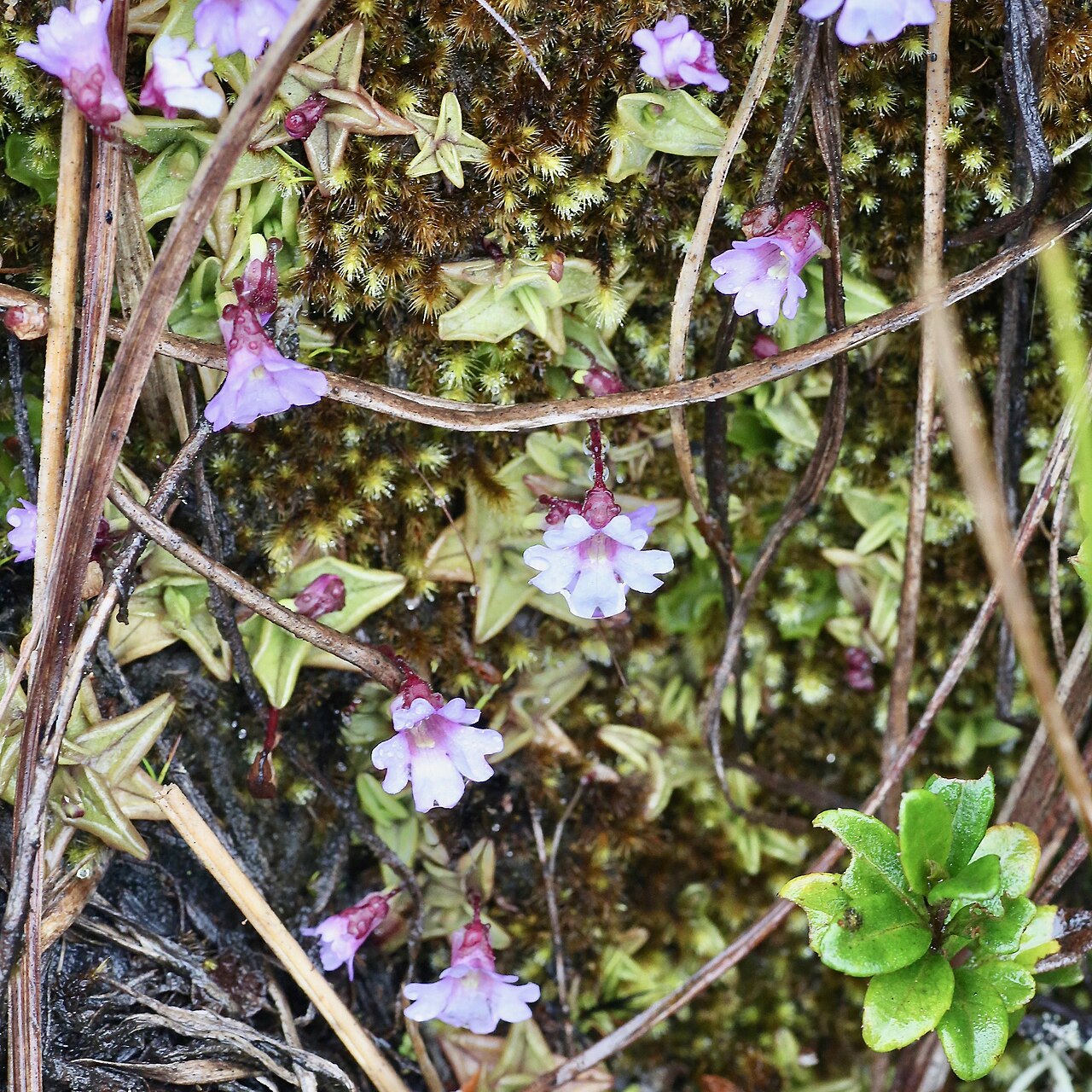


Identification
A flat rosette of olive-green leaves which, at ten to thirty-five millimetres long and seven to twenty wide, is among the larger South American butterworts. The leaf carries both stalked and sessile glands and feels distinctly greasy; the margin is slightly inrolled, but nothing like as strongly as in P. involuta. Slender erect scapes rise from the centre, each with one flower. Including the spur the flower is ten to fifteen millimetres long, two-lipped, violet to pale violet with a blue cast in the throat and darker veins. The spur is strikingly short for such a flower: conical, blunt, one to three and a half millimetres — a character that identifies the species in the páramo without a ruler.
Similar species
The two species split off in 2023 from the old, broad calyptrata concept — P. jimburensis and P. ombrophila, both from southern Ecuador — are the most confusing neighbours; they differ in floral structure and each grows at a single known site, so locality usually settles it. P. involuta, further south in Peru and Bolivia, is smaller, has a strongly inrolled leaf margin and a longer, curved spur. P. elongata, in the Colombian páramo, is unmistakable through its long, strap-shaped summer leaves of more than ten centimetres. When in doubt, measure the spur: shorter than four millimetres and conical points here to P. calyptrata.
The trap and how it works
A flypaper trap that in the páramo has to cope with two things: fierce ultraviolet radiation by day and near-frost at night. The stalked glands hold a sticky droplet that seldom dries in the near-permanent fog; the sessile glands beneath act only once prey is lying there, releasing enzymes that dissolve the insect on the spot. The leaf margin rolls slowly over the catch so that the fluid pools in a shallow dish. The supply consists of small flies, midges and springtails sheltering in the lee of the tussocks. In the páramo nitrogen is scarce and cold — organic matter breaks down slowly — and that is exactly why a captured insect yields more than the roots can extract from the ground.
Habitat and ecology
Wet places in the páramo between roughly two and a half and four thousand metres: seeping rock faces and small scarps (R1), open, short-turfed ground above the treeline between the tussocks (R5), and the boggy margins of springs, mires and wet pasture (W6). The plant wants bare, permanently moist substrate with nothing tall above it; it disappears as soon as the tussocks close. Where páramo is grazed it often benefits from the short sward, as long as stock does not trample the site.
Distribution and elevation
The species occurs in Ecuador and Colombia along both Andean cordilleras, and is therefore not endemic to one country. Older literature also cites Peru, but those records cannot be confirmed from herbarium material and are no longer followed. The distribution tracks the páramo belt: a long, narrow, high-lying band broken by the valleys into dozens of islands. That explains why the old species concept contained so many deviating populations — every páramo is an island, and isolation does the rest.
- Recorded (quarter-degree cells)
Forms and variation
No wild varieties are recognised, but the species is markedly variable in leaf size and flower colour, from deep violet to almost pale lilac. Part of that variation turned out on closer study not to be variation within one species at all: two Ecuadorian populations were described as separate species in 2023, and the authors note that the remaining material still holds more difference than one species can carry. What now goes by the name P. calyptrata is therefore probably a group of closely related plants whose limits are not yet settled. No natural hybrids have been described.
Where and when to see it
The páramo is large and the plant is small; let the landscape do the work. Follow the wet lines — a spring-fed rill, a seepage under a small scarp, the edge of a high mire — and search the bare patches between the tussocks there. The rosettes lie flat and are olive on brown; the flower gives them away fastest. Go early in the morning, before the fog lifts: the light is soft then and the glandular droplets are full. Take your time at altitude, and remember that the sites themselves are easily trampled.
Conservation status
The species has not been assessed for the global IUCN Red List and is not listed in CITES, so it carries no international category. What is known is mixed: two countries and hundreds of kilometres of páramo look generous, but the recent splitting off of two species shows that the real number of populations of the species in the strict sense is smaller than was thought. The páramo itself is under pressure from stock and cultivation pushing higher, from burning, and from a drying fog belt. A targeted assessment would have to say something about both the species and the habitat; it does not yet exist.
Scientific name
Pinguicula calyptrata | Kunth, 1817
Described by Alexander von Humboldt, Aimé Bonpland and Carl Sigismund Kunth in 1817, in Nova Genera et Species Plantarum 2: 183. The type area lies in Colombia and Ecuador. The species name calyptrata is Latin for "covered with a cap/hood" and refers to a hood-shaped structure in the flower's build.
World Checklist of Vascular Plants (WCVP), via Plants of the World Online (POWO), Royal Botanic Gardens, Kew.