All species › Lamiales › Bladderwort family › Pinguicula christinae
Pinguicula christinae
On the crest of the northern Apennines, on the wet slopes where Tuscany becomes Emilia, grows a butterwort that was only named in 2013. Pinguicula christinae is a blue-flowered species with a range of a handful of mountain faces, and a good example of how much remained to be found in Italy once modern methods were brought to bear.
Identification
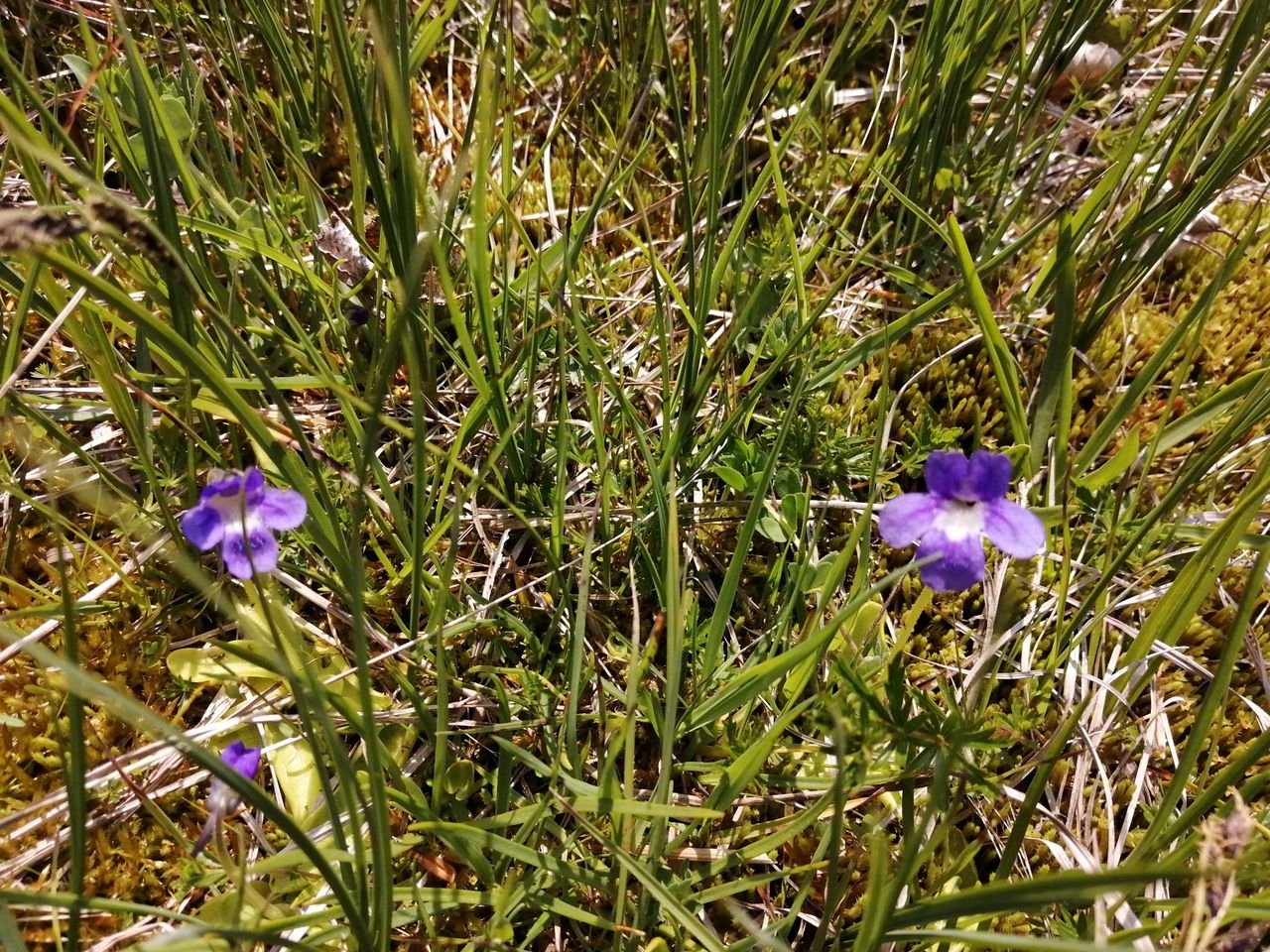
A flat rosette of five to nine leaves, oblong to triangular in outline and roughly fifteen to seventy-five millimetres long — a wide span, because the spring leaves are distinctly smaller than the summer ones. The upper surface feels greasy and glistens with glandular droplets; the margin is slightly inrolled. The flower is blue to violet, sometimes pale blue, two-lipped, with a paler throat. Fruiting follows in erect, ovoid-conical capsules three to seven millimetres long, holding reticulate seeds of about seven tenths of a millimetre. The plant overwinters as a winter bud.
Similar species
In the northern Apennines the first candidate is Pinguicula vulgaris, which grows in comparable wet places and is likewise violet-flowered; a certain identification requires comparing flower and seed characters, which is work for the literature rather than the trail. A little further south-west, in the Apuan Alps, stand P. apuana and P. mariae, separated geographically by their own mountains. For the field-guide reader the practical message is this: a violet butterwort on this crest is this species, but anyone wanting certainty should record the site and not take the plant.
The trap and how it works
A flypaper trap that works slowly but effectively. The leaf bears stalked glands with a sticky droplet and, between them, sessile glands releasing digestive enzymes once prey is lying on them. What sticks is small: midges, gnats and springtails from the humid air along a seeping slope. In the hours after a catch the leaf margin rolls further inward, so the digestive fluid stands in a shallow dish instead of running off the sloping face. Because the site is constantly flushed by running water, there is next to no nitrogen to be had from the soil, and the catch is no sideline.
Habitat and ecology
Wet, generally calcareous mountain faces and slopes with spring water running through them, plus soaked, short-cropped patches in the uppermost forest belt and above it. The species wants permanent moisture and an open, uncompetitive sward, so it grows where water keeps the substrate bare or the turf stays thin. Rank growth, shading and drought are all fatal. Its elevation is that of the higher Apennine crest; exact altitude limits are not consistently given in the available sources.
Distribution and elevation
The northern Apennines, on the border of Tuscany and Emilia-Romagna: the species is reported from the province of Pistoia and from the adjoining uplands of Modena and Reggio Emilia. It is an Italian endemic with a small, elongated range along the main crest. Important for this guide: our own species list records Bulgaria for this taxon, and that is wrong — the species was described from and is known from Italy, and there are no Balkan populations. Anyone searching the literature should look for the author names Peruzzi and Gestri.
- Recorded (one-degree cells)
Forms and variation
No wild varieties are recognised. What varies most is leaf size through the season: the spring rosette is small and compact, the summer rosette considerably larger, and seeing both at once in different populations can easily suggest two different plants. Flower colour runs from pale blue to fairly saturated violet. Because the species was segregated only recently, older records from this area still stand under P. vulgaris in the literature; anyone using historical data should allow for that.
Where and when to see it
Search in June and July along the wet edges of the main crest: seeping faces, flushes below rock bands, the headwaters of small streams. The plant is small and the flower sits low; sit down and look into the slope, and the violet stands out against dark wet rock. Do not walk across the soaked turf itself — the sites are small and the rosettes sit precisely on the wettest centimetres. Record the locality and photograph flower, leaf and fruit; for these recently described species that is worth more than any collected plant.
Conservation status
The species has not been assessed for the global Red List and therefore carries no international category; CITES does not apply. At national level in Italy it has been weighed and placed in the near-threatened band, just below the threshold, and it enjoys no legal protection there. What is known: an Italian endemic with a small range along one mountain crest, in habitats wholly dependent on a steady flush of groundwater. The risks are the capping of springs, the rank growth of short-cropped sites and trampling; on top of that, a newly described and easily recognised species draws particular attention from collectors.
Scientific name
Pinguicula christinae | Peruzzi & Gestri, 2013
Described by Lorenzo Peruzzi and Gabriele Gestri in 2013, in Plant Biosystems 147(3): 692–703. The type area lies near Foce di Campolino, in Pistoia province in the Northern Apennines (Italy), in a bog on siliceous substrate at 1600 metres elevation. The species name christinae is dedicated to Cristina Gavazzi, the wife of co-author Gabriele Gestri and herself a native of the Northern Apennines.
World Checklist of Vascular Plants (WCVP), via Plants of the World Online (POWO), Royal Botanic Gardens, Kew.