All species › Lamiales › Bladderwort family › Pinguicula poldinii
Pinguicula poldinii
Of all European butterworts this may be the least likely: a species described only in 2001, known from a single valley in north-eastern Italy, and growing largely on rock faces created by construction work. Pinguicula poldinii is a white-flowered butterwort with a world range the size of a village.
Identification
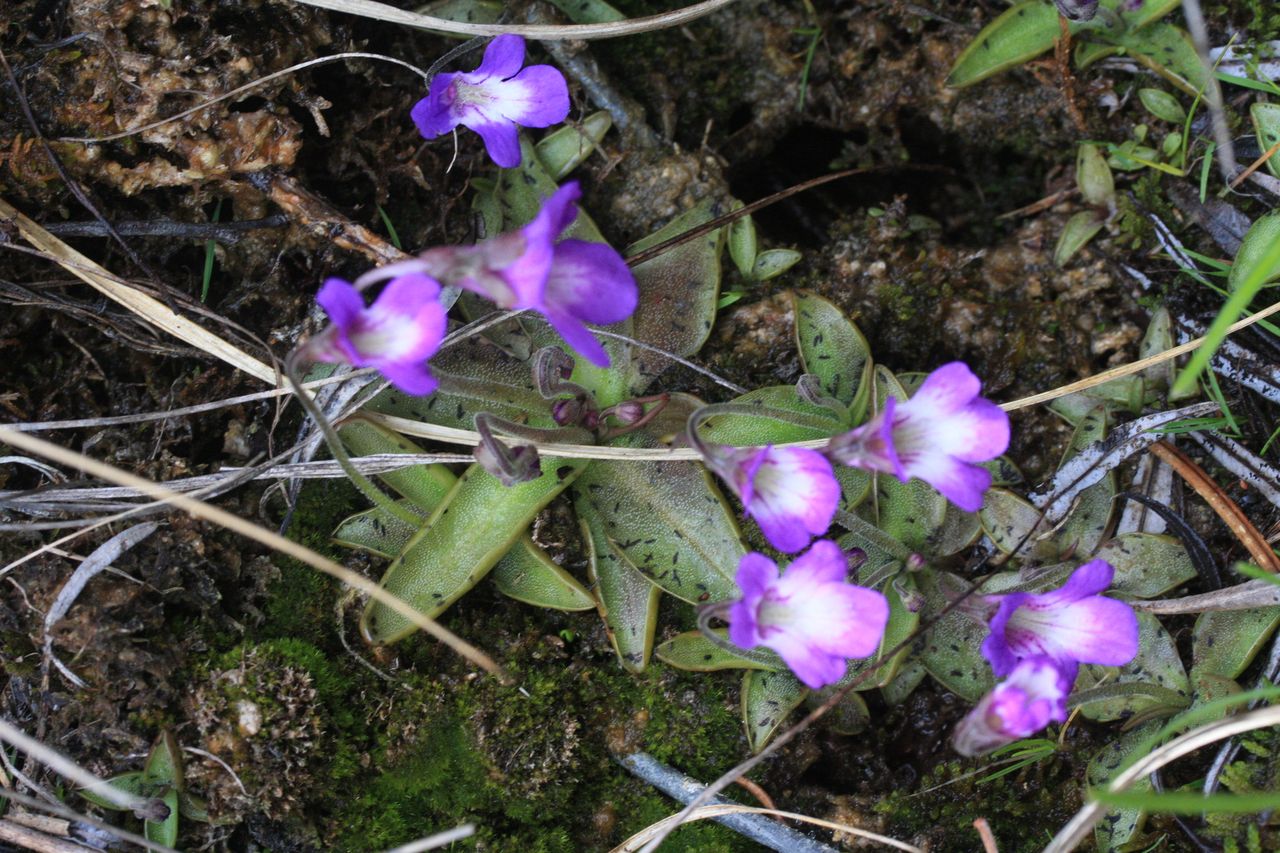
A flat rosette of entire, ovate to oblong leaves, yellow-green, greasy to the touch and with margins curled upward. Slender scapes rise from the centre, each with one flower. The corolla is two-lipped and white to pale cream, with yellow markings in the throat guiding the visiting insect inward; the spur is short and straight. The plant is small and stays low: on the steep wet walls where it grows the rosette often hangs at an angle or nearly vertically, wedged into a crack or on a thin moss cushion. Outside the growing season it withdraws into a compact winter bud.
Similar species
The species belongs to the group of white-flowered butterworts around Pinguicula alpina and is barely separable from it in the field without taking measurements; the differences lie in flower and spur proportions and in chromosome number. Geography helps: in the same region P. alpina grows higher in the mountains, while P. poldinii sits at barely five hundred metres in a valley wall. Pinguicula vulgaris, also present in Friuli, has a violet flower with a long pointed spur and is ruled out at once as soon as anything is in bloom.
The trap and how it works
Glue, and then patience. The upper leaf surface carries stalked glands producing an adhesive droplet and sessile glands that release digestive enzymes once prey is lying on them. On a wet rock face the supply consists of midges, gnats and springtails that hang in the permanently humid air along the stone. After a catch the leaf margin rolls slowly over the prey, which matters even more on a near-vertical site: without that dish the digestive fluid runs straight off. Everything the plant needs in nitrogen and phosphorus has to come from those insects, because the bare limestone supplies nothing.
Habitat and ecology
Steep, permanently wet rock faces in a narrow mountain valley, on limestone, with water seeping over them year-round. Strikingly, part of the habitat is not natural: the ground on which the species was discovered had largely been created by excavation at a construction site, which exposed fresh wet rock. That says something about the plant's ecology: it is a pioneer of bare, soaked stone and disappears as soon as moss, grass and scrub grow over it. The elevation is low for a butterwort, around five hundred metres.
Distribution and elevation
One valley in Friuli Venezia Giulia in north-eastern Italy, in the foothills north-west of Udine, at roughly 450 to 550 metres. The entire world range covers a few hectares. That makes the species one of the most sharply bounded endemics in Europe: there is no second site in a neighbouring valley, no outlier in Slovenia or Austria, nothing. How such a range arises is not entirely clear, but the pattern is common in the southern Alps and the Apennines: isolated wet limestone walls act as islands.
- Recorded (one-degree cells)
Forms and variation
No wild varieties are recognised — with a population this size that would mean little anyway. Such variation as exists concerns plant size and the number of flowers per rosette, and tracks how wet and how sheltered a patch of wall is. Because the species was described only in 2001 and hid under P. alpina in older Italian floras, scattered literature records may well still stand under that old name. No crosses with other species are reported; there is no second butterwort in the immediate surroundings to cross with.
Where and when to see it
This is not a species to go looking for on your own. The range is so small and the population so concentrated that walking on the wall itself does damage, and over-collection is explicitly named as a risk for this species. Anyone visiting the area should look at the wet walls from the path or road with binoculars, in spring, when the pale flowers show best against dark wet rock. Touch nothing, dig nothing up, and leave no traces in the moss cushions at the foot of the wall.
Conservation status
The species has not been assessed for the global Red List, so there is no international category, and CITES does not apply. What is known speaks for itself: the world range is one valley, the population is small and concentrated, and part of the habitat was created by human intervention and could as easily be removed by the next one. On top of that, removal of plants by collectors is explicitly named as a threat. A species with this distribution would almost certainly fall into a high threat category if assessed; the absence of that assessment is a gap in the file, not reassurance.
Scientific name
Pinguicula poldinii | Steiger & Casper, 2001
Described by Jürg Steiger and Siegfried Jost Casper in 2001. The species is endemic to the Val d'Arzino, in Italy, where it grows at 450–550 metres altitude. Who exactly is honoured by the species name could not be established with certainty.
World Checklist of Vascular Plants (WCVP), via Plants of the World Online (POWO), Royal Botanic Gardens, Kew.