All species › Lamiales › Bladderwort family › Pinguicula leptoceras
Pinguicula leptoceras
Anyone searching the Alps for a butterwort with a big, dark blue flower usually finds this one. Pinguicula leptoceras is the alpine counterpart of the common butterwort: a plant of wet slopes, tufa walls and small mountain mires in the subalpine and alpine belts, with a flower disproportionately large for the plant that carries it.


Identification
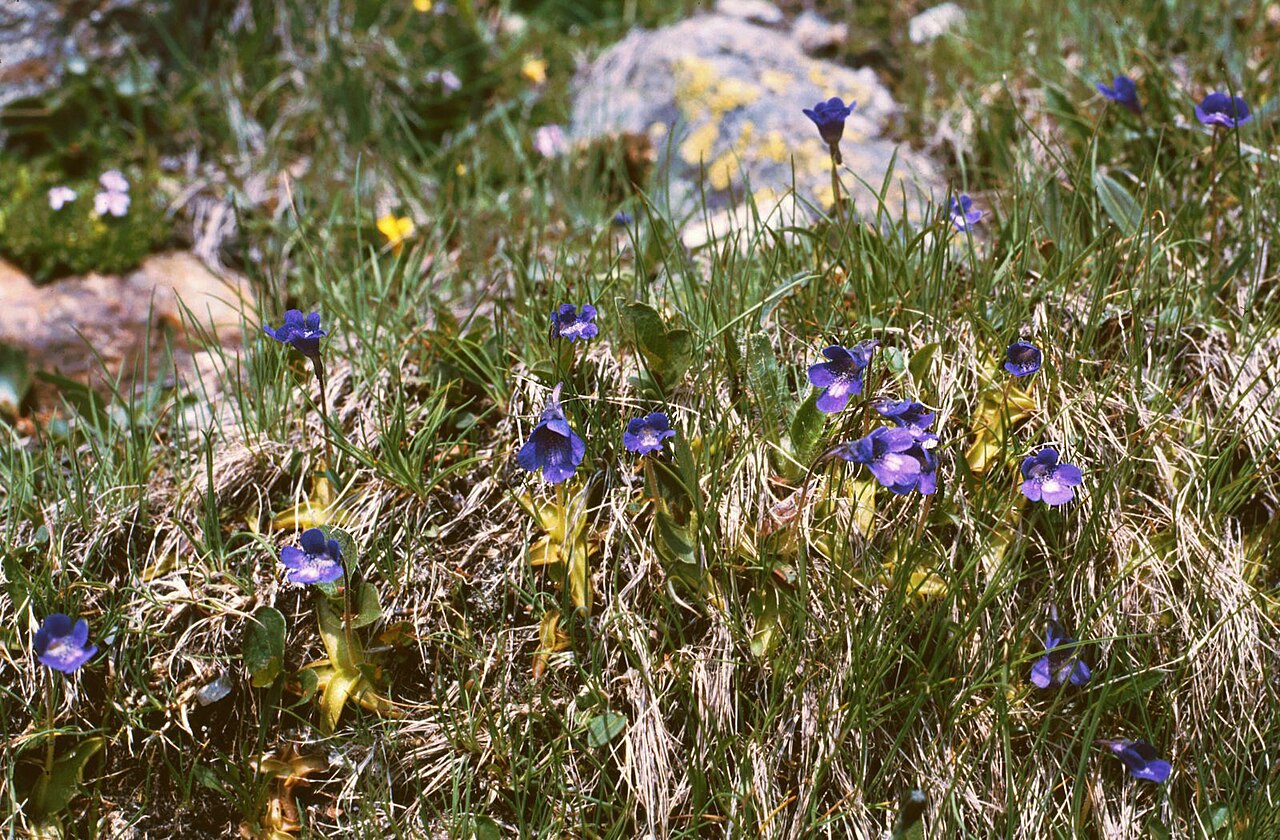
A flat rosette of entire, oblong-ovate leaves, light green and greasy to the touch; the inrolled leaf margin is often interrupted rather than even, which is a useful character. One to several glabrous scapes rise from the centre, each with a single flower. The corolla is dark blue-violet and, spur included, one and a half to three centimetres long — generous for a butterwort. The lower lip usually bears one to three white blotches pointing into the throat, and its lobes are rounded and partly overlapping, so the flower reads as full and closed. Flowering is June to August, depending on when the snow leaves.
Similar species
The species that causes trouble is Pinguicula vulgaris, which occupies comparable ground in the Alps. In P. vulgaris the lower-lip lobes are narrower and stand apart, leaving open gaps between them, and the flower averages smaller. The interrupted inrolling of the leaf margin in P. leptoceras also helps. Pinguicula alpina, often in the same mire, separates at once on flower colour: white with yellow blotches and a short, yellow-green spur. Where the three grow together, intermediates can occur.
The trap and how it works
An active flypaper trap with a slow movement. The upper leaf surface is covered in stalked glands producing a clear adhesive droplet, and in sessile glands that deliver digestive enzymes once prey is lying on them. A midge sticks fast, struggling brings more glands into contact, and over the following hours the leaf margin rolls towards the prey so the digestive fluid stands in a shallow gutter instead of running down the slope. The catch consists mostly of midges and other small flies that swarm densely in spring habitats. On an old leaf the black remains can be counted with the naked eye.
Habitat and ecology
Wet, generally base-rich ground in the subalpine and alpine belts: small fens and sloping mires, tufa slopes with spring water seeping over them, and soaked mountain pasture. The species wants throughflow — standing, nutrient-rich water is no use to it — and an open sward. It is less strictly tied to lime than P. alpina and occurs on more neutral substrates too, but drought and shading are out of the question. In summer the site stays cool thanks to the melt and spring water passing through, and that is probably the real constraint.
Distribution and elevation
The Alps, along the full length of the chain, with its centre of gravity in the central and western Alps; in Switzerland the species is known from the alpine biogeographic regions. Beyond that there are occurrences in adjoining uplands as far as the northern Apennines. It is therefore not an endemic of a single massif, but it is tied to high mountains: below the montane belt it is absent. It does not occur in the Low Countries; the nearest populations are in the Swiss and French Alps.
- Recorded (quarter-degree cells)
Forms and variation
No wild varieties are recognised. Flower colour ranges from deep blue-violet to a lighter purple, and the number of white blotches on the lower lip varies between none and three; both are individual variation and no taxonomic foothold. More important are the natural hybrids: where the species grows with P. vulgaris or P. alpina, crosses have been described with flowers of intermediate colour and spur length. Such plants are generally sterile and belong with the parents in this guide.
Where and when to see it
June and July in the subalpine belt, higher up in August. The best places to search are not the open meadow but the wet edges: flushed slopes, tufa patches shining with water, and the fringes of small mires where low sedges grow. A solid dark blue flower on a slender stalk is visible from five metres, so walk slowly and scan the wet ground before stepping onto it. Then sit down to look at the leaf margin: that interrupted inrolling is what clinches an identification.
Conservation status
The species counts as of least concern, and on the Swiss national red list it sits in the lowest category of concern. Its range covers the whole Alpine chain and most sites lie in high country that cannot be brought into cultivation. That does not mean nothing is happening: low-lying sites disappear through the capping of springs and the drainage and fertilising of mountain pasture, and mires inside ski areas suffer from piste construction and water abstraction for snowmaking. In the longer term the rising snowline is the main uncertainty, since the species depends on cool, flowing water. CITES does not apply.
Scientific name
Pinguicula leptoceras | Reichenbach, 1823
Described by Heinrich Gottlieb Ludwig Reichenbach in 1823, in Iconographia Botanica seu Plantae Criticae 1: 69. The holotype originates from Monte Grimsel in Switzerland (Bernese Alps). The name derives from the Greek leptos (thin, slender) and keras (horn), referring to the flower's spur. Later observers noted that it is not entirely clear why Reichenbach named this species "slender-spurred", since the spur is often rather thick even at the type locality.
World Checklist of Vascular Plants (WCVP), via Plants of the World Online (POWO), Royal Botanic Gardens, Kew.